(Unsplash/Jeswin Thomas)

by Russell Fiorella
Imagine you are a member of an emergency response team for the United Nations High Commissioner for Refugees (UNHCR). Water levels are rising as the planet heats up. Action is needed to protect the people of the small Pacific island nation of Tuvalu, which is home to approximately 10,000 people. The prime minister of Tuvalu, Feleti Teo, and the commissioner of the UNHCR (the U.N. refugee agency), Barham Salih, are willing to contribute an unprecedented $300 million toward a managed retreat for Tuvaluans. To secure funding for the operation, your team must present a convincing plan to the UNHCR board of directors, complete with a step-by-step strategy and budget.
This is the scenario I presented to the young men and women in my sophomore-level biblical studies class at Jesuit High School in Portland, Oregon. I designed it with an essential question in mind, one that lies at the heart of eco-citizenship education: How do we help students recognize that global ecological crises are problems they should care about?
After I outlined the assignment, the students initially froze. Some started rereading the prompt nervously, others with determination behind their eyes, and others sat unaffected.
To break the silence, I proposed a five-minute brainstorm for each team to draft preliminary questions. I stepped back, and the room started humming.
"Who's low-key good at math? They should handle the budget."
"How much fuel does a cargo ship use per day?"
"Which is less risky: elevation or flotation? Or should we go to Australia?"
"How much time before the island sinks?"
As each group shared their "best" questions, I pointed out that they were mostly about what to do, rather than who we were helping or why the problem existed.
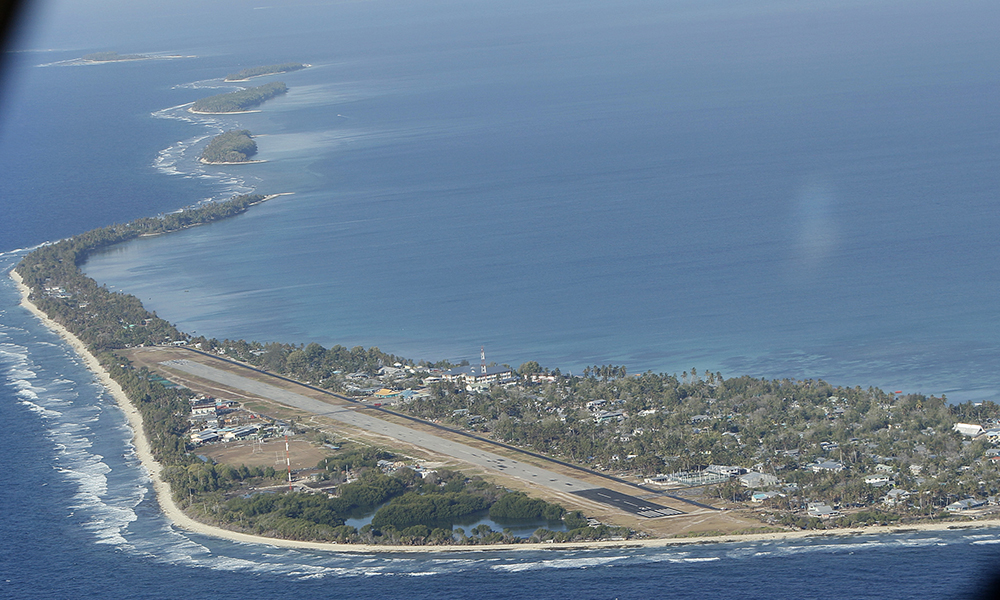
In this Oct. 13, 2011 photo, Funafuti, the main island of the nation state of Tuvalu, is seen from a Royal New Zealand airforce C130 aircraft as it approaches at Funafuti, Tuvalu, South Pacific. (AP/Alastair Grant, file)
This was the moment the project needed — their initial focus on logistics cracked open enough space for deeper questions about our brothers and sisters' dire situation across the world.
After more brainstorming, one student asked with a trace of irritation, and so that everyone could hear, "Why is this my problem? It's theirs, not mine!"
A hush fell over the class. They were suddenly skeptical.
I asked in reply, "How did you get to school today?" The kids stared back. They knew the answer but were proceeding with caution. I asked the question again and waited.
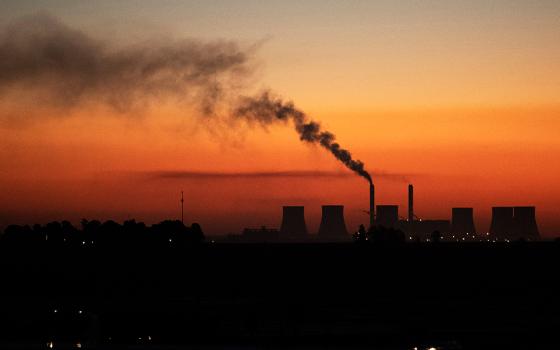
After much silence, a few students shared about their commutes by bus, train and car, which incited a serious conversation about the long-term consequences of greenhouse gas emissions, primarily released from burning fossil fuels, that are warming the planet.
"Maybe we should have begun by asking ourselves, 'Who is causing the problem?' huh?" I said.
Advertisement
From there, the teams of students approached the project with more sincerity as they conducted research and collaboratively developed five-minute videos that outlined their proposals. Afterward, they reflected on how their projects animated the tenets of Catholic social teaching and what relationships they see between the Israelites' exodus and today's climate refugee crisis.
A decade of teaching theology courses in Jesuit Catholic high schools has taught me that awkward, frustrated or aggressive questions from students are not to be feared, avoided or dismissed. "Why is this my problem?" is a profound question because it revealed how the student, like their classmates, felt: Perturbed by the complexity and gravity of this problem, they were resigned to question its merit or to look for a way out. In other words, they were precisely where they needed to be.
A decade of teaching theology courses in Jesuit Catholic high schools has taught me that awkward, frustrated or aggressive questions from students are not to be feared, avoided or dismissed.
Ignatian pedagogy, the guide for the style and process of Jesuit teaching developed in 1993 by the Society of Jesus, names this dynamic — how disorientation and the proper level of challenge actually drive learning. It is healthy and good to push students into unfamiliar spaces where the whole person is challenged to understand the world in a new way:
At the beginning of new lessons, teachers often perceive how students' feelings can move them to grow. … Confrontation of new knowledge with what one has already learned cannot be limited simply to memorization or passive absorption of additional data, especially if it does not exactly fit what one knows. It disturbs a learner to know that he does not fully comprehend. It impels a student to further probing for understanding — analysis, comparison, contrast, synthesis, evaluation — all sorts of mental and/or psychomotor activities wherein students are alert to grasp reality more fully.
Pope Francis echoes this pedagogical insight in his 2015 encyclical, "Laudato Si', on Care for Our Common Home." Education in environmental responsibility cannot be "limited to providing information" that "fails to instill good habits."
If information alone cannot cultivate eco-citizenship, then teachers must rethink their approach. How can we help students see beyond themselves and connect with humanitarian and ecological problems near and far? How can teachers meet students where they are instead of talking over or around them?
A carefully designed project-based experience can be a powerful way to cultivate what Laudato Si' calls "sound virtues" that form a "selfless ecological commitment." Rather than talk about the Israelites in Egypt and relate their story to the climate refugee crisis in Tuvalu to a passive sea of spectators, my project scenario invited my students into a climate refugee crisis, which elicited a student to ask one of the great questions — "Why is this my problem?" — that will, in part, determine whether creation is cherished and renewed in the critical years ahead.
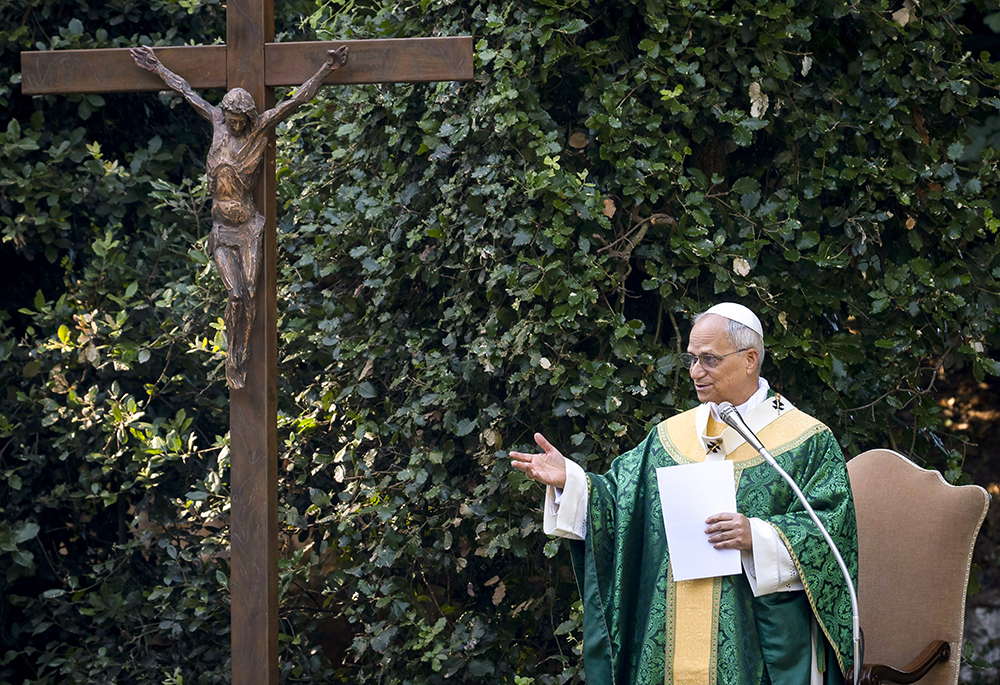
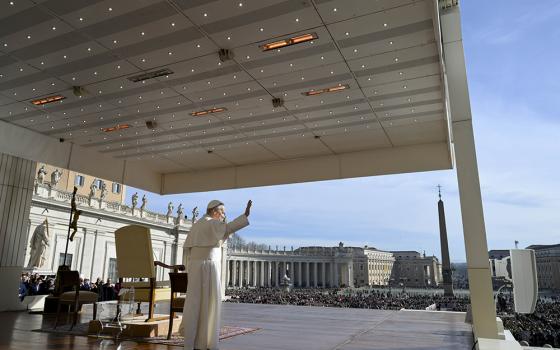
Pope Leo XIV celebrates Mass for the Care of Creation on the grounds of the Borgo Laudato Si’ ecology center in Castel Gandolfo, Italy, July 9, 2025. In his homily, the pope called for ecological conversion while drawing from the legacy of Pope Francis and his encyclical "Laudato Si', on Care for Our Common Home." (CNS/Cristian Gennari, pool)
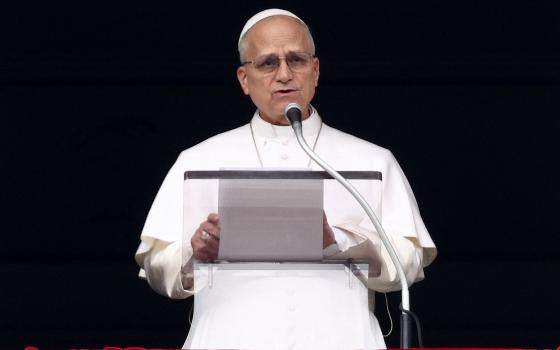
This orientation toward recognizing students' context and designing learning experiences that promote action seems to be endorsed by Pope Leo XIV in his recent apostolic letter "Drawing New Maps of Hope":
Ecological responsibility is not limited to [presenting] technical data. These are necessary, but they are not enough. There is a need for education that involves the mind, the heart, and the hands: new habits, community styles, virtuous practices. … I ask educational communities: disarm words, raise your eyes, and safeguard the heart.
Taken together, these insights point to a guiding principle for promoting eco-citizenship. If students are to see beyond themselves, meaning their learning translates to "new habits, community styles, and virtuous practices," the teacher's involvement in learning must decrease while the student's involvement increases.
Teachers must set aside their words, look up at the young people they serve, and "safeguard the heart" by designing experiences that help students know not only that they are part of the problem, but also that they can play a part in its solution.