
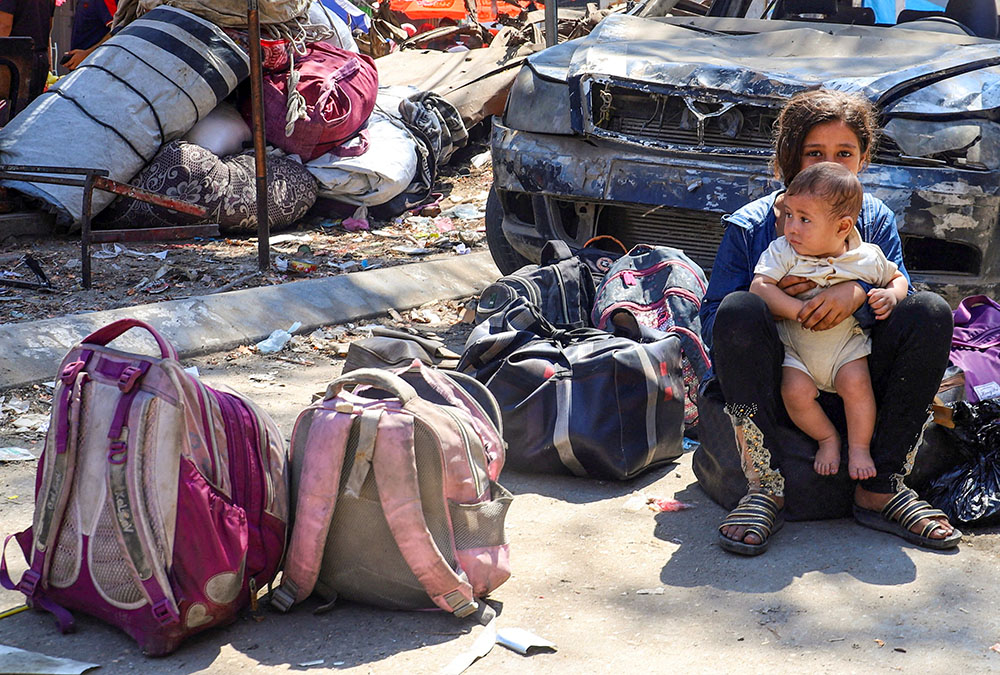
Displaced Palestinian children sit near their belongings during an Israeli military operation in Gaza City, Aug. 26, 2025. (OSV News/Reuters/Ebrahim Hajjaj)

The Israeli government needs to find a way to pour humanitarian aid into Gaza even while it continues its efforts to root out Hamas. These two realities are often confused and seen as intertwined, but they can and should be kept distinct.
It is shocking that so many people express deep concern about the plight of the people in Gaza but do not apportion any responsibility for that suffering to Hamas. Hamas bears a moral responsibility for restarting the war, for putting civilians in harm's way, for refusing to negotiate a peace with its neighbor. Hamas could end the suffering tomorrow by surrendering, which is how wars usually end, or even just by releasing the hostages, which would eliminate what support for continuing the war exists in Israel.
This fact that Hamas bears great responsibility does not let Israel off the hook. Surely the nation that could figure out how to decapitate Iran's nuclear program in one or two nights of targeted attacks can figure out how to get more humanitarian aid into Gaza. Reports that Hamas was stealing some of the aid entering the country is no surprise. How do you think Hamas paid for its system of tunnels for war-making? A suit in New York alleges up to $1 billion in U.N. aid was siphoned by Hamas.
Still, if Hamas steals some food aid, so what? That fact alone cannot allow Israel to stand aside while people go hungry. The Jewish Federations of North America sponsored a webinar on July 25 to explain some of the challenges in distributing aid, and many of the speakers reiterated their belief that the humanitarian crisis must be addressed, no matter how we got here, no matter what one thinks of Hamas.
There is an important political and moral precedent. The Kahan Commission report of 1983 examined the massacre of Palestinian civilians, many of them refugees, in Sabra and Shatila in southern Lebanon the previous year. The commission concluded that the massacre was committed by Phalangists, a radical Christian militia, but it also examined Israel's indirect responsibility for the massacre.
Advertisement
"If it indeed becomes clear that those who decided on the entry of the Phalangists into the camps should have foreseen — from the information at their disposal and from things which were common knowledge — that there was danger of a massacre, and no steps were taken which might have prevented this danger or at least greatly reduced the possibility that deeds of this type might be done, then those who made the decisions and those who implemented them are indirectly responsible for what ultimately occurred, even if they did not intend this to happen and merely disregarded the anticipated danger," the report stated.
The commissioners went on to cite an ancient precedent. "A basis for such responsibility may be found in the outlook of our ancestors, which was expressed in things that were said about the moral significance of the biblical portion concerning the 'beheaded heifer' (in the Book of Deuteronomy, chapter 21)." There, too, the issue was not direct responsibility for the crime, but the moral obligation not to be a bystander.
The report concluded, "Even if these legal norms are invalid regarding the situation in which the Israeli government and the forces operating at its instructions found themselves at the time of the events, still, as far as the obligations applying to every civilized nation and the ethical rules accepted by civilized peoples go, the problem of indirect responsibility cannot be disregarded."
Flooding Gaza with humanitarian aid is, similarly, an obligation for Israel today. Such aid also should become an essential component of Israel's ongoing war aims. I do not know if Israel's continued pursuit of Hamas is justified or not. Making that determination requires an assessment of intelligence to which we are not privy. Hamas is severely degraded, but it still has sufficient control to hold hostages and evade efforts to free them.
Sometimes, as during World War II, unconditional surrender is a legitimate war aim. More recently, in the fight against ISIS, there was no question of allowing the Caliphate to control part of Iraq or Syria. ISIS forces were defeated, dispersed, and the fight against the few remaining insurgents continues, but ISIS lacks the power to inflict damage that Hamas clearly still exercises in parts of Gaza.
The failure to recognize the fact that the people of Gaza are oppressed by Hamas, which even the Arab League recognizes must disarm, distorts the vision of many in the West.
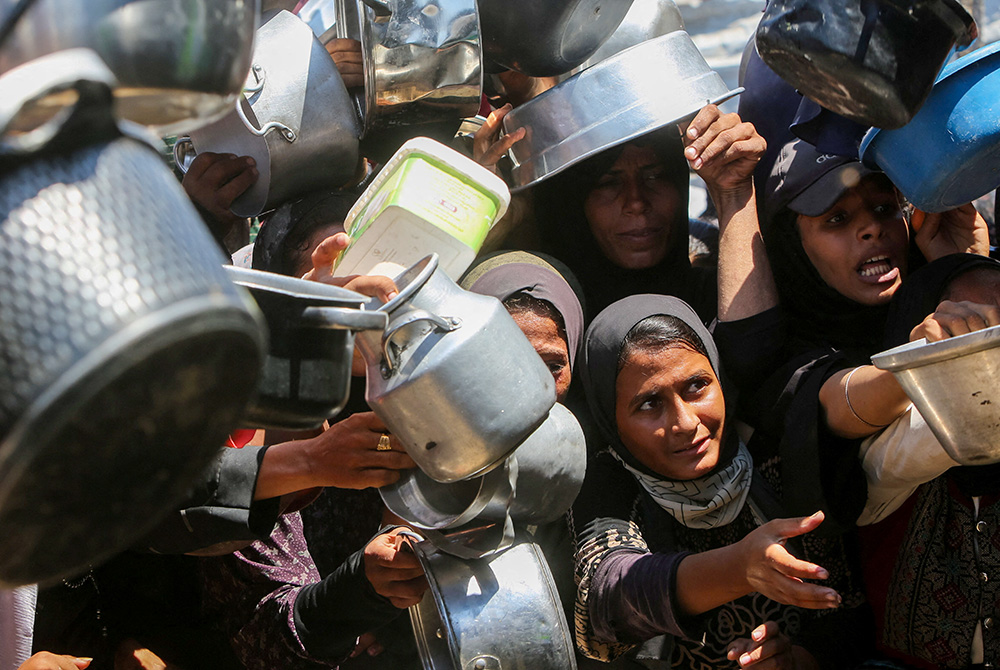
Displaced people wait to receive food Aug. 2, 2025, from a charity kitchen in Gaza City, Gaza Strip, amid a hunger crisis. (OSV News/Reuters/Hatem Khaled)
In considering the war in Gaza, the left in the U.S., including the religious left, too often merely repeats cant drawn from Algerian propagandist Frantz Fanon and his theories about colonialism. His theories, such as they are, certainly do not apply here. For starters, in the long, complicated history of the region, one thing is obvious: The Jews are the indigenous people of Israel.
Second, the language of oppressor and oppressed mischaracterizes the core problem in this section of the Mideast. The problem is that two people desire control over the same land and so both are oppressed by the burdens of history.
Finally, no one can ignore the more recent, equally tragic, history of Palestinian political leaders rejecting the kinds of compromises that might have made peace possible. Egypt and Jordan both signed peace treaties with Israel, and they have stuck.
Employing ideas drawn from Fanon to interpret the reality on the ground in the Mideast is a kind of intellectual and moral sloth. Learning about the complex history of the region takes time. Why bother when employing the buzzwords and the hoary categories of settler colonialism get you published?
Lastly, we must ask if these criticisms of Israel amount to antisemitism. It is hard to tell. Certainly, there are plenty of Jews in Israel who protest against the continuation of the war. Objecting to actions of the state of Israel is not, per se, an exercise in antisemitism. Still, we must remember that antisemitism doesn't start with hatred of Jews, it ends there. It starts when Jews get blamed for complex problems. The embrace of intellectual arguments echoing an Algerian propagandist is a prime example of the phenomenon. It may not be antisemitism, but it is rich soil for the growth of antisemitism.
Catholics should support efforts to get humanitarian aid into Gaza. We should also resist simplistic narratives about the sources of the conflict. We should pray for peace, mindful that there can be no peace if Hamas remains in power. And we should be concerned about the rise in antisemitism. We can do all four.