
A woman walks past a homeless man sleeping on a sidewalk in Baltimore June 6, 2023. (OSV News/Bob Roller)

Last week, in conjunction with the retirement party for its founder, John Carr, Georgetown University's Initiative on Catholic Social Thought And Public Life held an all-day convening on the theme "Promoting Pope Leo XIV's Leadership: Placing the Poor at the Center of U.S. Catholic and Public Life."
The discussions were conducted under "Chatham House Rules," so I am not permitted to quote directly from any of the many fine interventions that were presented, but a few themes emerged that both surprised me and pointed to the deeper challenges in following the pope's lead on highlighting Catholic concern for the poor.
The first was straightforward: Concern for the poor must become "an essential identifying mark of Christian life," something that confirms our mission and our witness. It cannot be something on the side, an add-on to Christian life, a cherry on the top of the sundae. It is of the essence of Christian life because Christ himself demonstrated this concern for the poor, from the beginning of his public ministry until his passion.
"Who is my neighbor?" Jesus is asked by a lawyer in the Gospel of Luke, prompting the Lord to answer with the parable of the good Samaritan. This is a question that the church must constantly pose to itself and to the wider culture.
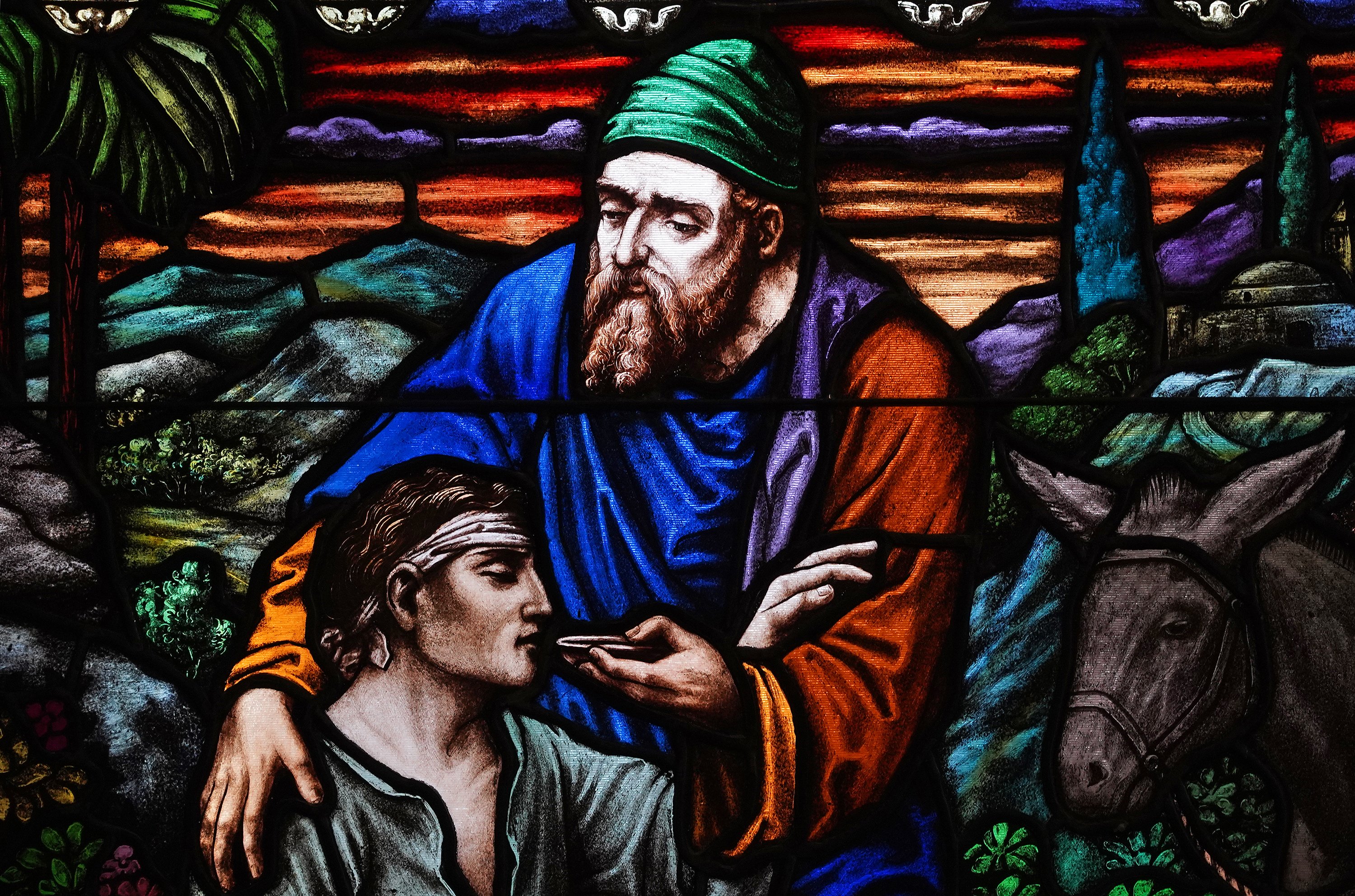
The parable of the good Samaritan is depicted in a stained-glass window at Good Samaritan Hospital Medical Center in West Islip, New York, on World Day of the Sick, Feb. 11, 2021. (CNS/Gregory A. Shemitz)
It is a question that strikes deeper than ethics. Concern for the poor is a sacramental sign of the closeness of the body of Christ, the church, to its head, Jesus Christ. The wounds of the poor are the wounds of Christ. This cannot be a metaphor. Ours is an incarnational faith and the sacraments are the principal means by which God's grace is made present in the world. For us Catholics, we must see Christ in the poor or we will not really see him in the Eucharist, and if we do not see him in the Eucharist, we cannot really see him in the poor.
What keeps this attitude from becoming paternalistic, an exercise in noblesse oblige, is that Christ not only came to feed the hungry, he came to free all of us from whatever enslaves us and few things are as enslaving to upper middle class, highly educated folk as is their belief in meritocracy. Protecting and furthering the agency of the poor is an essential element of our concern for them. This requires a relational, not a transactional, approach to Christian witness. It is good to give to the poor, but we must also look them in the eye, treat them with the dignity that is theirs, acknowledge our shared humanity.
Advertisement
Another theme that emerged in the discussion was the need to cultivate docility towards the teachings of the successor of Peter. Some Catholics consider themselves "John Paul II Catholics" and others self-identify as "Francis Catholics," but we should be teachable by all popes.
I have written about this recently, asking "When we encounter a difficulty in the teaching of the church, do we try and convert ourselves or do we demand that the church convert to us?" Blind obedience is not what is demanded. We moderns must pray with our eyes open. But we are called to obedience. The knee-jerk embrace of dissent as a viable option for the Catholic, whether on the left or the right, is unserious. It also has proven sterile.
This stance of docility is not a psychological imperative, but a theological and ecclesiological one. We do not generate grace. We do not manufacture it. We receive it. No good deed counts as a Christian deed if it does not spring from an awareness that all is grace. Docility is essential to the unity of the church. In his First Letter to the Corinthians, 1:12-13, St. Paul addresses this issue, noting that some disciples say, "I belong to Paul," while others insist "I belong to Apollos," or "I belong to Cephas," or "I belong to Christ." But, he asks, "Is Christ divided? Was Paul crucified for you? Or were you baptized in the name of Paul?"
The third insight was that the ambient culture not only tolerates indifference to the poor, it celebrates wealth in ways that are frankly idolatrous. In the 1980s, Reaganomics enshrined income inequality in our economic policies and shows like "Lifestyles of the Rich and Famous" glorified the rich and their extravagance. Robin Leach, the show's host, gushed about the vulgar displays of wealth. It is no surprise that Donald Trump appeared on the show and delivered a cringeworthy performance.
The question that emerged was whether or not, and how, we are called to stigmatize the idolatry of wealth, the modern equivalents of the golden calf (the platinum calf?), and the economic and cultural structures that support it? It is worth thinking about. Should we label them heretical?
This convening brought national Catholic leaders together, but it would be wonderful to see bishops convening local Catholic leaders for similar discussions. There is so much we can learn from each other. Maybe we could come up with a name for getting Catholic leaders together to talk with each other. Maybe we could call it synodality.