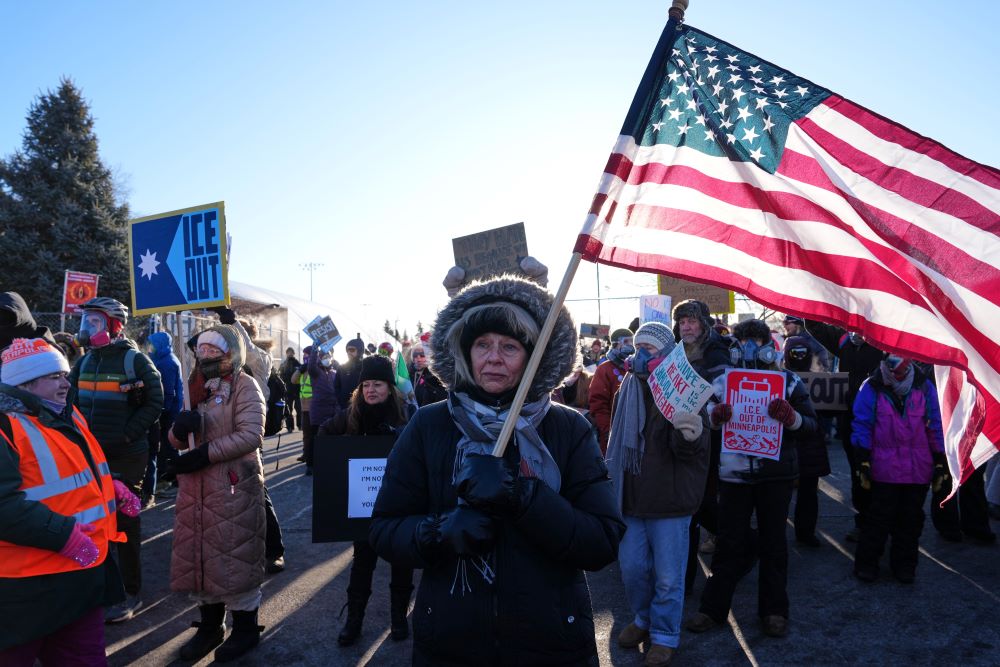
People gather for a protest against ICE outside the Bishop Henry Whipple Federal Building Jan. 30 in Minneapolis. (AP/Adam Gray)
In the face of all the disastrous things that President Trump has perpetrated upon the nation, from the killing of protesters in Minneapolis to the delegitimizing of vaccines to the abrogation of almost all foreign aid to impoverished countries to undermining the independence of the Federal Reserve to eliminating investments in clean energy, it is easy to feel overwhelmed and enraged.
Our emotional state notwithstanding, we are left with the questions: What to do? What to say? How to say it?
We need to keep in mind that the day will come when Donald Trump will not be president and the country must bind its wounds. It is easy to let anger obscure the need to act and speak in ways that contribute to the binding of those wounds. So many have been hurt by our government. So many are distrustful of our government. So many are ashamed of our government. It is vital to act and speak in ways that heal, that invite trust and that both demand an accounting and paint a picture of a government of which we can be proud again.
Protests must be peaceful. Otherwise, you take the bait and accelerate the chaos that Trump has unleashed and from which he thinks he can further justify his own political power. The most consequential political movement of the past 100 years was the Civil Rights Movement, and its insistence on nonviolence was a key to its success. Further, insofar as the lawlessness of ICE is one of the most potent charges against the administration, protests should not themselves exhibit even a whiff of lawlessness.
We must learn to love those who continue to support Trump … They view our shared country through very different lenses than progressive Catholics do, but we are called to love them.
Protests should be respectful of others who do not share one's own views. Protesters who disrupted a church service in St. Paul, Minnesota, not only failed this standard but they violated an essential societal norm. As Catholics and as Americans, we believe in religious freedom as a foundational good of civil society. In a pluralistic society, tolerance for people of different religious beliefs may be the most essential public virtue given the power of religion to stir people to the depths of their souls. No extremist is more dangerous than a religious extremist and our national tradition of religious toleration remains the best antidote to such extremism. If someone can disrupt a church service, others can disrupt a synagogue or a mosque as well.
Our Catholic bishops' recent statements have been clear and, frankly, have gotten more attention than I had expected. People are hungry for moral clarity and for the voice of the church in solidarity with our migrant brothers and sisters in Christ. The bishops' statements did not mention President Trump by name. They did not make it personal. They did not throw aspersions against those who voted for Trump nor question anyone's motives. They said simply and powerfully: This is wrong.
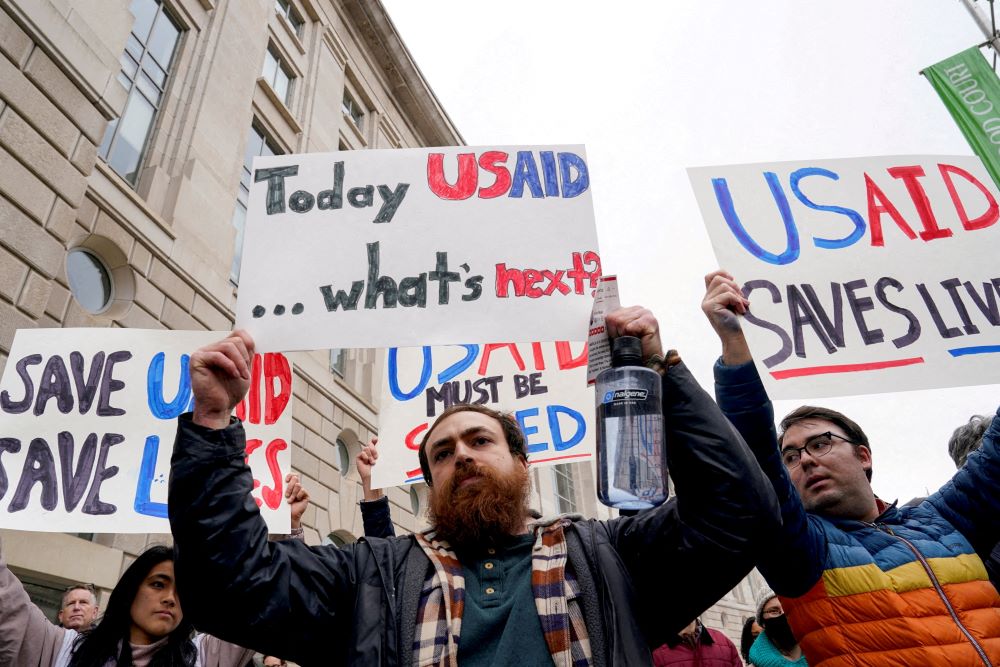
People hold placards outside the U.S. Agency for International Development building in Washington Feb. 3, 2025, protesting the Trump administration's moves to shut down the U.S. foreign aid agency. (OSV News/Reuters/Kent Nishimura)
Archbishop Bernard Hebda of St. Paul-Minneapolis wrote an op-ed in The Wall Street Journal reminding us that if our political leaders had passed comprehensive immigration reform, his hometown would not be in this mess in the first place. In 2024, in 2014 and in 2007 it was congressional Republicans who failed to support reform bills that had cleared the U.S. Senate. The remote political cause was computerized gerrymandering which does nothing to encourage compromise. In a "safe" district, an incumbent member of Congress only has to fear a primary challenge from the extremes. Our politics will be handicapped until we break this pattern of politically driven gerrymandering.
In the aftermath of the shootings of Renee Good and Alex Pretti, the most politically powerful criticisms have come from others in the law enforcement community. Minneapolis police chief Brian O'Hara's raising issues of competence and constitutionality are especially damning to ICE precisely because he has been in similar situations and achieved happier outcomes.
In terms of defeating Trumpism politically, the only people who matter are those who voted for Trump in 2024 but look at what is happening to the country and think to themselves, "I didn't vote for this." That is why Democrats need to be measured in their arguments and remember the sage political axiom that to get someone from "no" to "yes" you first have to get them to "maybe." In short, the opposition to Trumpism must learn how to persuade, not to demonize, to identify shared values and concerns with those who previously supported the president.
As Americans, we need to go beyond defeating Trumpism. We need to rekindle the better angels of our nature. Reread Lincoln's second inaugural address, with its magnificent call to national comity at a time even more polarized than our own. Rewatch, as I did last week, the History Channel's documentary about Franklin Delano Roosevelt. Revisiting the threats to democracy and capitalism that FDR faced and overcame helped lift my spirits.
As Christians, we have an even more challenging task. We must learn to love those who continue to support Trump, those who look at the events in Minneapolis and question why anyone would protest ICE. They view our shared country through very different lenses than progressive Catholics do, but we are called to love them. Those of us who object to Trump and Trumpism must do better than help the Democrats win in November and in 2028. We need to win in a way that invites a rehumanization of our political discourse.
In his farewell essay at The New York Times, David Brooks enlisted one of his and my favorite quotes from Reinhold Niebuhr and I'll give him the last word too:
Nothing that is worth doing can be achieved in our lifetime; therefore we must be saved by hope. Nothing which is true or beautiful or good makes complete sense in any immediate context of history; therefore we must be saved by faith. Nothing we do, however virtuous, can be accomplished alone; therefore we are saved by love. No virtuous act is quite as virtuous from the standpoint of our friend or foe as it is from our standpoint. Therefore we must be saved by the final form of love which is forgiveness.
Advertisement