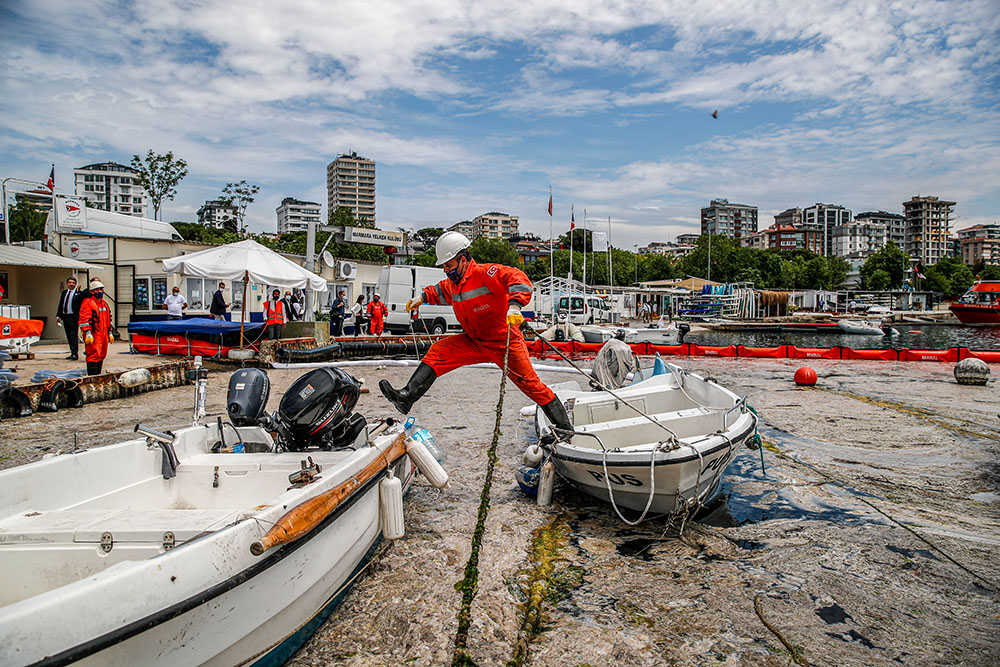
An expert works to clear a mass of marine mucilage, a thick, slimy substance made up of compounds released by marine organisms, from Turkey's Sea of Marmara at the Caddebostan shore, on the Asian side of Istanbul, June 8, 2021. (AP/Kemal Aslan)

by Ersun Augustinus Kayra
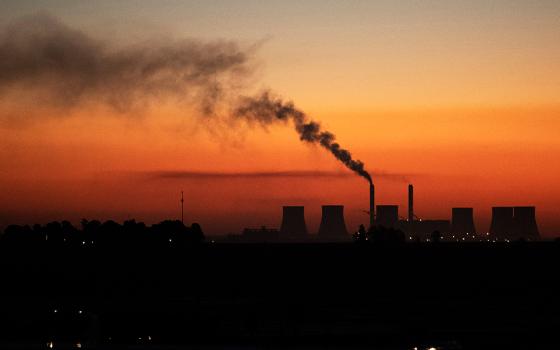
On the morning ferry from Kadıköy, commuters do what they always do: tea in tulip glasses, phones in one hand, the city sliding past in gray-blue layers. The boat engine murmurs that steady growl Istanbulites barely hear anymore. Diesel exhaust hangs in the air — thin and familiar, a faint burn in the throat — until something else rises underneath it, damp and faintly sour, like seaweed left too long in a plastic bag.
The return of mucilage ("sea snot") in the Sea of Marmara has become a test case for Ecumenical Patriarch Bartholomew's language of "ecological sin" — language Pope Francis echoes in "Laudato Si', on Care for Our Common Home": Crimes against the natural world are sins against ourselves, and against God.
From a distance, the Sea of Marmara — the biodiverse link between the Aegean and the Black Sea — looks calm, almost decorative, until the boat slows near shore and you look down.
A few passengers glance, frown, then glance away. Istanbul is good at looking away; earthquakes, economic crises, and now this.
Turks call it müsilaj. In English it becomes "mucilage," and the nickname is cruder: "sea snot." Tabloid words until you meet the thing itself.
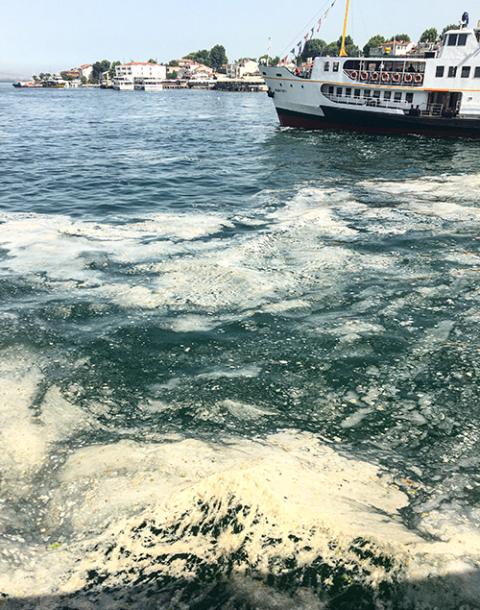
A boat passes as marine mucilage is seen in the waters off Istanbul in July 2021. (Wikimedia Commons/Furkan)
A pale film, a gelatinous smear. It doesn't float like ordinary foam; it clings. It drifts in streaks that look intentional, like the sea has started keeping receipts. It happened before. That's the point — and the problem.
In 2021, mucilage turned the Marmara into a global image. And then the images faded, the way images do. But the sea didn't reset. In late 2024, researchers reported thick layers again, up to 10 meters in some places, detected around 22 meters down near the district of Marmara Ereğlisi — an unnerving depth because it suggests something more chronic than a surface nuisance.
Mucilage is not merely an eyesore. In the water column, it can form sticky aggregates that clog nets and coat gills; on the seabed it can settle as a heavy blanket, smothering corals, shellfish, and other benthic life. By stressing already oxygen-poor waters, it turns a visible scum into an invisible suffocation — an ecological harm that ripples into fisheries and livelihoods.
This is not "just a local environmental issue." That phrase has the comfort of a fence around it. The Marmara is a semi-enclosed sea — and the world's smallest — serving a megacity and an industrial basin, and the pressures that feed mucilage are structural: pollution loads, weak or uneven wastewater treatment, and warming waters in a changing climate.
Symptoms aren't polite. They show up when the body can't compensate anymore.
The city speaks, if you listen for fatigue
If you want Istanbul's theology, don't start with slogans. Start with how people talk when they're tired.
Near a fish stall, you hear it as bitterness: "The sea used to tell us where the fish were. Now it tells us where the waste is."
On the ferry, it's closer to shame: "I used to look at the water to breathe. Now I look away."
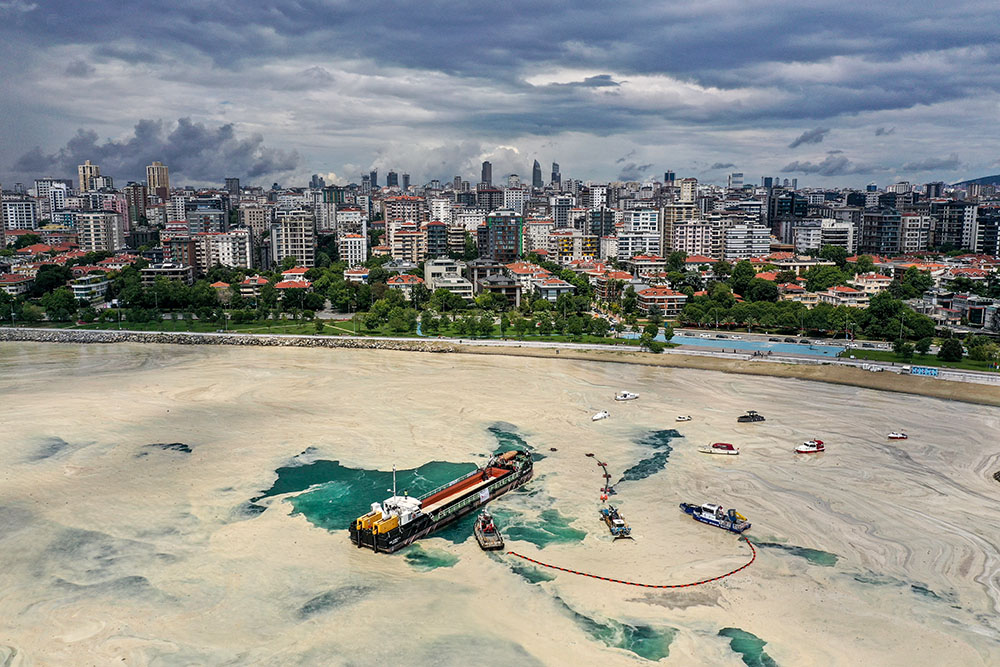
Sea-surface-cleaning vessels and barrier-laying boats of Istanbul clean up a thick, slimy layer of the organic matter known as marine mucilage June 15, 2021. (CNS/Reuters/Umit Bektas)
Along the shore, municipal crews do the work that never stays in anyone's feed for long — scraping the surface while the deeper water continues to fester, unseen and unaddressed, and everyone knows it'll come back on a different tide.
One worker put it in a sentence that sounded like a verdict: "We clean the surface. What feeds it is upstream."
Mucilage humiliates the fantasy that ecology is someone else's department. It makes infrastructure visible. It turns pipes into moral instruments.
And it is not only "the state" in the abstract. In January 2025, Türkiye Today (citing figures compiled from public materials of Istanbul's water and sewage administration) reported that only 34.43% of Istanbul's wastewater was treated in advanced biological facilities — an awkward statistic for a city that depends on the Marmara as if it were infinite.
'Ecological sin' was never a branding exercise
This is where Ecumenical Patriarch Bartholomew of Constantinople stops sounding like an environmental champion and starts sounding like a priest naming sin. For decades, he has insisted that environmental harm is not merely unfortunate; it is morally charged — an offense against God, neighbor and the created order. In a 1997 address, he put it plainly: "To commit a crime against the natural world is a sin."
In Christian moral language, "sin" is not a substitute for science or policy. It is a way of naming agency: a rupture in relationship — between creature and Creator, neighbor and neighbor, present and future. It also keeps responsibility from dissolving into vagueness. The question becomes not only what is happening in the sea, but what we have permitted to become normal.
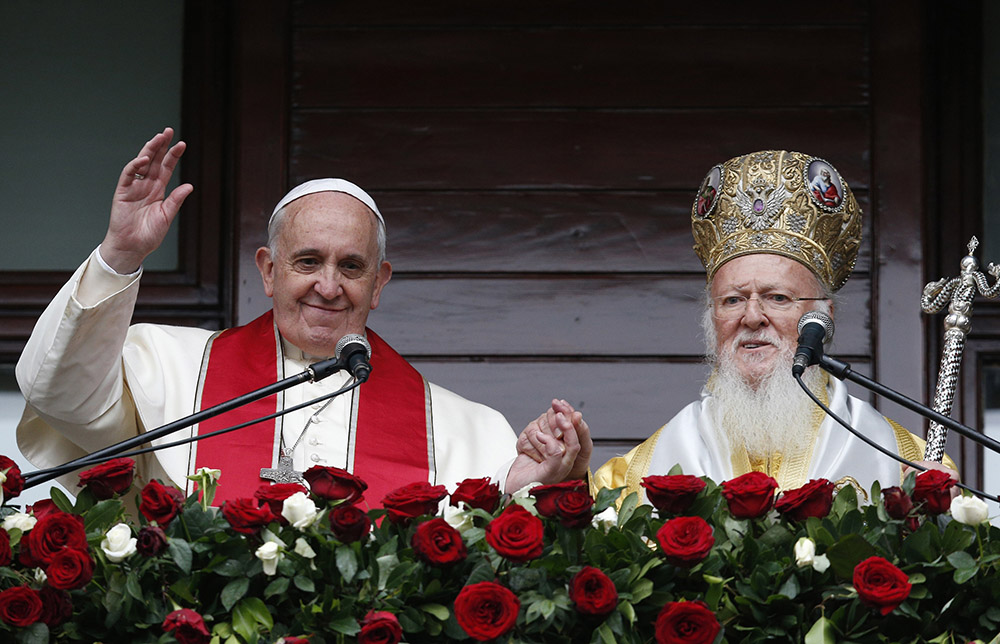
Pope Francis and Ecumenical Patriarch Bartholomew of Constantinople greet a small crowd after delivering a blessing in 2014 in Istanbul. (CNS/Paul Haring)
Francis took that diagnosis seriously enough to quote Bartholomew in his 2015 encyclical Laudato Si', including the blunt line: "To commit a crime against the natural world is a sin against ourselves and a sin against God."
In 2019, the synod for the Amazon proposed a definition of "ecological sin" as an action or omission against God, against one's neighbor, the community, and the environment — a sin against future generations. Weeks later, Francis said the church was considering introducing "the ecological sin against the common home" into the catechism, echoing that synodal language.
The water does not care which calendar you keep.
The plan, the deadlines, the stamina problem
After 2021, Türkiye announced a 22-point Marmara Sea Action Plan whose spine is simple: Stop feeding the sea nitrogen and phosphorus loads it can't digest; upgrade wastewater treatment; tighten discharge standards; monitor continuously.
In 2022, a legal deadline was set: Municipalities in the Marmara basin were given time to build or convert facilities toward advanced treatment. By mid-2025, that window had essentially run out, and the progress, by official reporting, looked grim.
In June 2025, Anadolu Agency reported that the region's advanced biological wastewater treatment rate moved from 51% (2021) to 51.7% — an increase of 0.7% in roughly three years, alongside the detail that only 42 of 169 submitted work plans had been completed.
Advertisement
Enforcement exists, too, and it's part of the picture: In August 2025, reporting described intensified inspections in the Marmara basin, with 55 facilities closed and substantial fines issued.
But the sea keeps returning the evidence. The question is not whether Türkiye has plans. It does. The question is whether political will can outlast the news cycle.
A liturgy you can't fake
You don't need a seminar on "cosmic liturgy" to understand the spiritual bite of this. You only need to notice what Christians do with water.
In Orthodox practice, Theophany (Epiphany) includes the Blessing of the Waters, a public way of saying water is not raw material for our convenience; it is gift, sign, something holy. Catholics carry the same grammar in our bodies: baptismal water, holy water at the door, the language of cleansing, rebirth, life.
So what do we mean when the waters we foul are the waters we bless?
Marmara's mucilage presses that question until it stops being "spiritual" in the safe sense. It becomes physical. On some days the smell near the shore is not dramatic — just wrong. A wet, sour mix that clings to your mask or scarf, the kind of odor you carry onto the bus without realizing it until you sit down.
Repentance that looks like repair
There is no salvation-by-metaphor here. If ecological sin is real, ecological repentance has to be real too: not seasonal cleanups, not a performance of grief, but the hard, public work of repair.
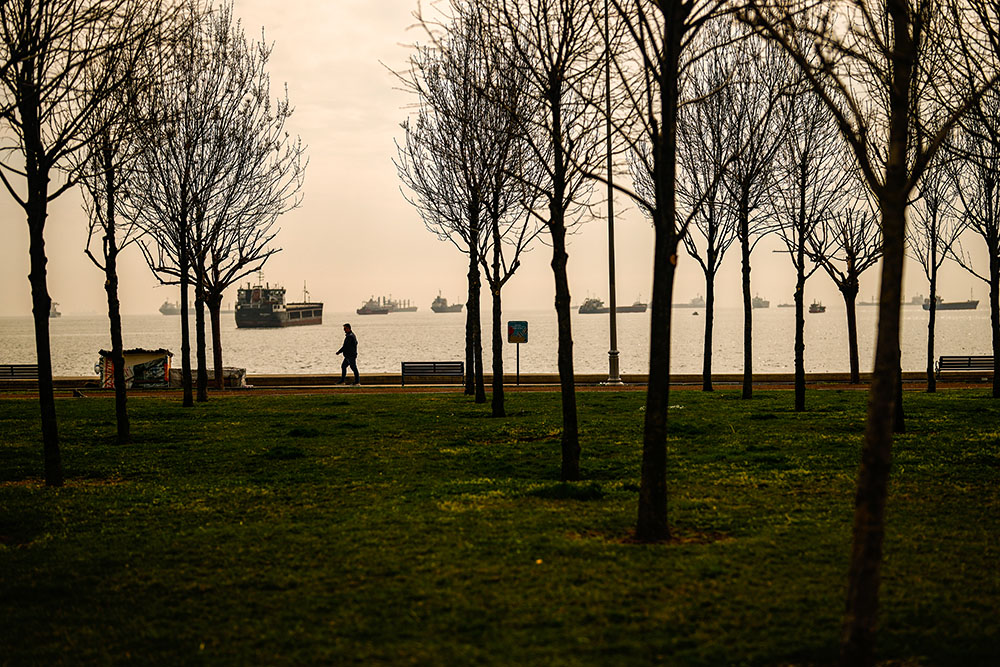
A man walks along a public park near cargo ships anchored in the Sea of Marmara, in Istanbul on March 16, 2024. (AP/Emrah Gurel)
That means treatment plants upgraded and actually operated at full capacity; discharge standards that bite; monitoring that doesn't flatter anyone. It also means household-scale honesty. What we pour down the drain does not vanish into "away." It becomes somebody else's shoreline.
And it means not treating this as a one-season story.
In October 2025, international coverage described how mucilage and jellyfish invasions together threatened Türkiye's Marmara fishing industry. Still, Professor Mustafa Sarı of Bandırma Onyedi Eylül University's Faculty of Maritime Studies repeated the same refrain: Reduce the pollution load; make wastewater treatment real; strengthen monitoring; build public awareness.
Francis' Laudate Deum sharpened the same insistence: Denial and delay are no longer harmless differences of opinion; they are a refusal to live in reality.
Back on the ferry, the tea still steams. Phones still glow. The metal railing is cold through your sleeve.
And below, well, the sea keeps telling the truth.
Mucilage is what happens when we outsource consequence. If ecological sin is real, then ecological repentance must be real, too: pipes that work, standards that bite, and the stubborn, persistent work of repair.
Until the sea can breathe again, and our prayers stop catching in the throat.