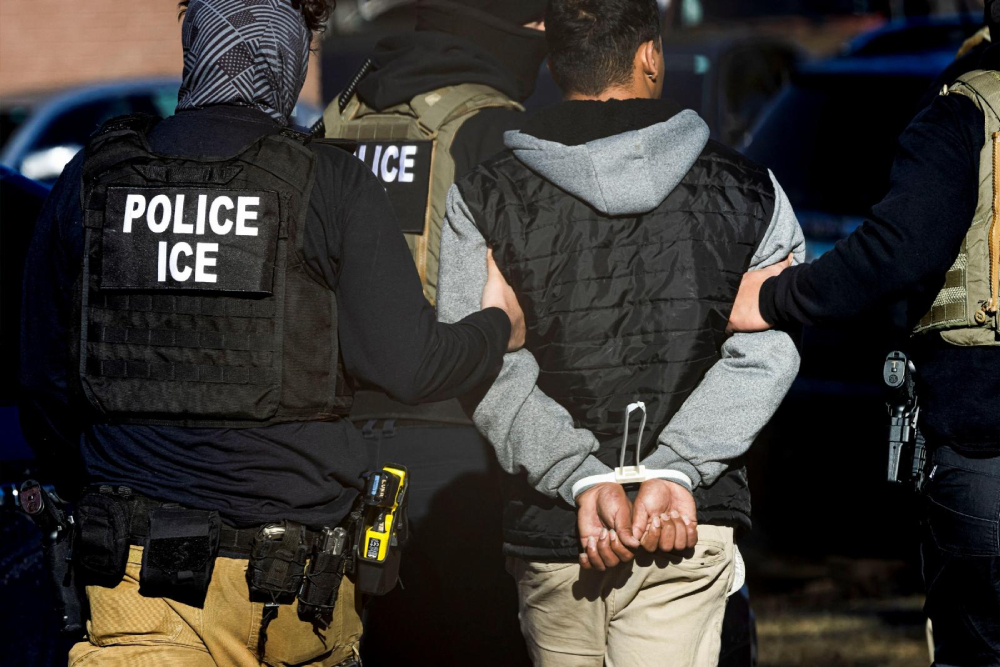
Agents with the Immigration and Customs Enforcement detain a man after conducting a raid at the Cedar Run apartment complex in Denver Feb. 5, 2025. (OSV News/Reuters/Kevin Mohatt)

by Kat Armas
It’s Latino Heritage Month. On Sept. 22, the White House issued its annual proclamation "recognizing the extraordinary contributions of Hispanic-American citizens past and present." Yet even as the administration celebrates our presence, it continues to orchestrate our disappearance.
Just two weeks before the proclamation, the Trump Administration carried out "Operation Midway Blitz" in Chicago, a multi-agency ICE operation that swept through Latino neighborhoods. The National Immigrant Justice Center and the American Civil Liberties Union of Illinois are now challenging the arrests in federal court, arguing that at least 27 of the arrests were made without warrants, without probable cause and in direct violation of an existing consent decree. According to lawyers and civil rights groups, those arrests included U.S. citizens and long-term residents with no history of violence. A top U.S. Border Patrol official admitted to WBEZ that agents were arresting people based on "how they look."
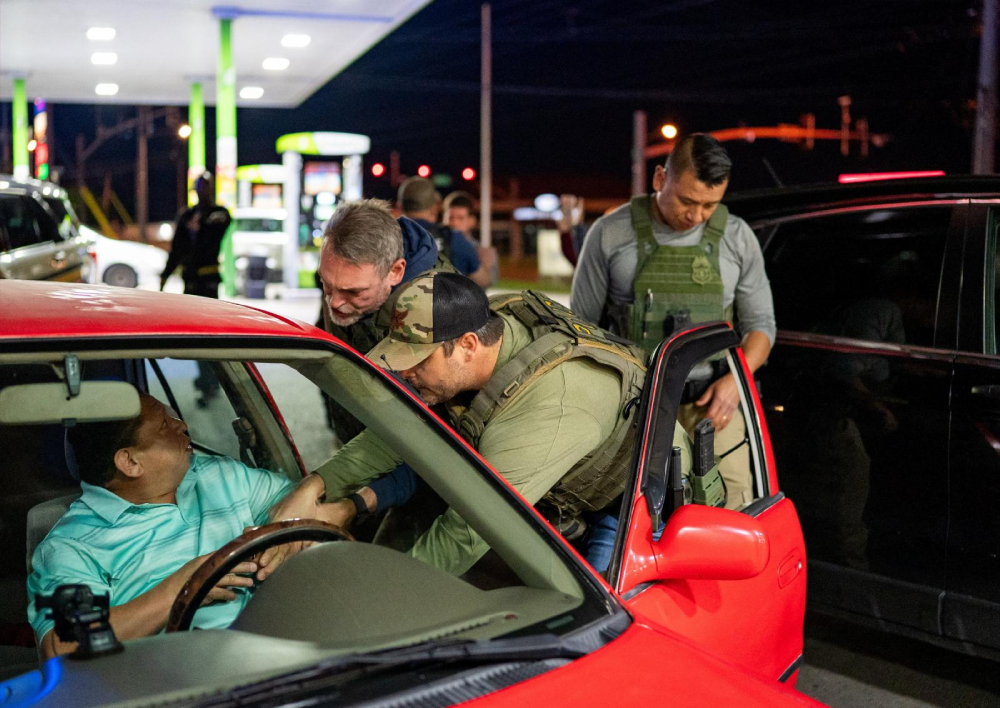
U.S. Immigration and Customs Enforcement officers detain a man from a car stopped by Tennessee Highway Patrol at a gas station in South Nashville, as he could not produce any alternative identification proof other than his expired driving license, during an operation conducted by ICE along with THP to detain noncitizens across the city of Nashville, Tenn., May 10, 2025. (OSV News/Reuters/Seth Herald)
This comes on the heels of another disturbing development: the Supreme Court granted an emergency request from the Trump administration to reinstate ICE roving patrols, allowing agents to stop and question individuals on the street based on appearance, language, line of work or even where they happen to be at the time. This isn’t "safety." It’s state-sanctioned terror.
The raids are escalating. On Sept. 30, nearly 300 federal agents descended on a South Side Chicago apartment complex. Using drones, helicopters, trucks and dozens of other vehicles, agents surrounded the building in the middle of the night. Snipers rappelled from helicopters onto the roof. By morning, the apartments were nearly empty. As of last week, more than 800 arrests have been reported from Operation Midway Blitz. But DHS and ICE have offered few details, making it nearly impossible to confirm alleged crimes or even the identities of those detained. People are being pulled off the streets and vanished into the system.
This latest wave of disappearances echoes what the Miami Herald uncovered earlier this year at Florida’s so-called "Alligator Alcatraz." Hundreds of detainees vanished from that site, with more than 450 people missing from official databases, some deported to countries they had never even lived in.
This isn’t "safety." It’s state-sanctioned terror.
Disappearance has always been part of the playbook of empire. In the 1970s, Chile was torn apart by a U.S.-backed coup. Thousands were killed or tortured, and more than 3,000 simply vanished into the night.
But their absence was not allowed to be forgotten.
Groups of women — madrinas, mamás, abuelitas — stitched their grief into resistance, embroidering arpilleras that told the stories the regime sought to erase. On scraps of cloth, they sewed the faces of their missing loved ones — sometimes using their clothes and even their hair — alongside the question: ¿Dónde están los desaparecidos?
Where are the disappeared?
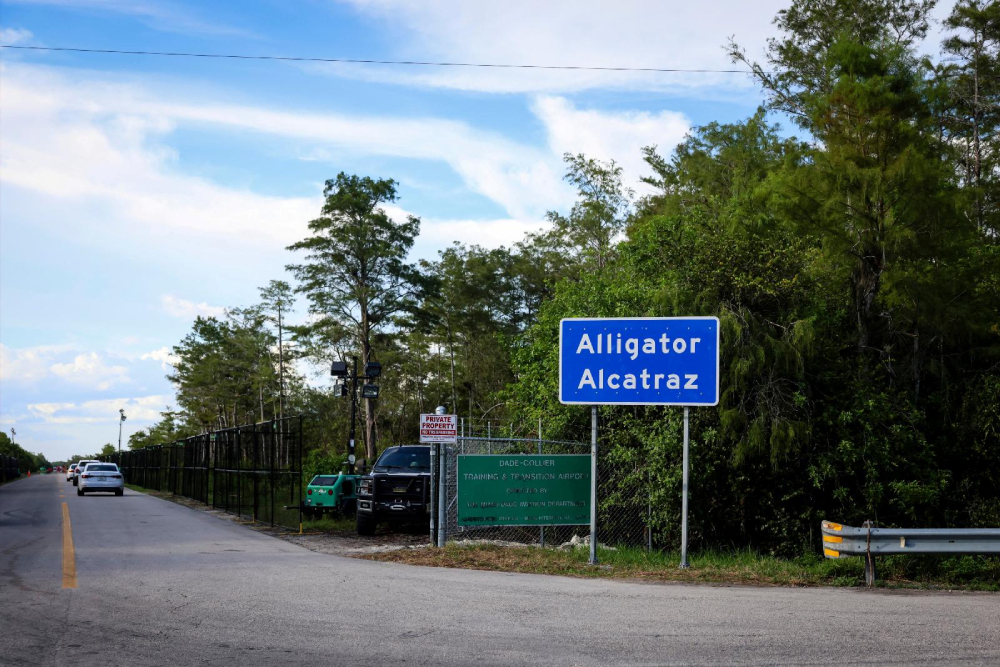
A sign is seen at the entrance of "Alligator Alcatraz" Immigration and Customs Enforcement, ICE, detention center in the Dade-Collier Training and Transition Airport in Ochopee, Fla., Aug. 3, 2025. (OSV News/Reuters/Marco Bello)
Their witness confronts us still. And it reminds us that what we see today in Chicago, in Florida, across the U.S., is not new. The empire disappears those it deems disposable. But like those abuelitas in Chile, we are called to resist the erasure; with memory, with truth-telling, with art and with faith that refuses to let disappearance have the final say. Their witness reminds us that survival itself is an act of resistance.
Scripture offers us a similar story. In Acts 9, we meet Tabitha, a disciple whose life was restored by Peter. We know little about her; we are offered no sermons, no miracles, no grand speeches. Only this: she made clothes. Acts 9:39 tells us, "Upon Peter’s arrival, he was taken to the upstairs room. All the widows stood beside him, crying as they showed the tunics and other clothing Tabitha made when she was alive." That was her testimony. Not titles or accolades, but the fabric she stitched with her own hands. The widows held her garments and wept, pleading for her restoration through the work that had clothed them in dignity.
Advertisement
Like the arpilleristas, Tabitha shows us that empire can be resisted not with sword or scepter, but with needle and thread. In a world where widows and orphans were discarded, where the weight of empire fell heaviest on those without protection, she carved out spaces of care through the creativity of her hands. Her garments were not merely fabric; they were signs of dignity. They were quiet protests against a system that deemed some lives disposable.
The theme for this year’s Latino Heritage Month is "Collective Heritage: Honoring the Past, Inspiring the Future." While our communities continue to be surveilled, detained and disappeared, we remember. We remember our abuelitas who stitched memory into cloth. We remember disciples like Tabitha, whose faith was woven into the very fabric of her community. And we remember that creativity itself — art, song, prayer, the work of our hands — has always been resistance.
We are called to see this not as sentiment but as vocation. The church proclaims that every person bears the imago Dei, the image of God, and Catholic social teaching insists on the dignity of every human life. To honor our collective heritage is to embody this truth: Empire does not have to have the last word. Resurrection does.