(Wikimedia Commons/Henryk Kotowski/CC BY-SA 3.0)

Traveling through Europe in recent years, we have all grown accustomed to seeing national flags flying alongside the flag of the European Union, its 12 gold stars on a blue background. After centuries of warfare amongst nation-states, most Western European nations view the EU as a necessary bulwark against nationalism and its pathologies.
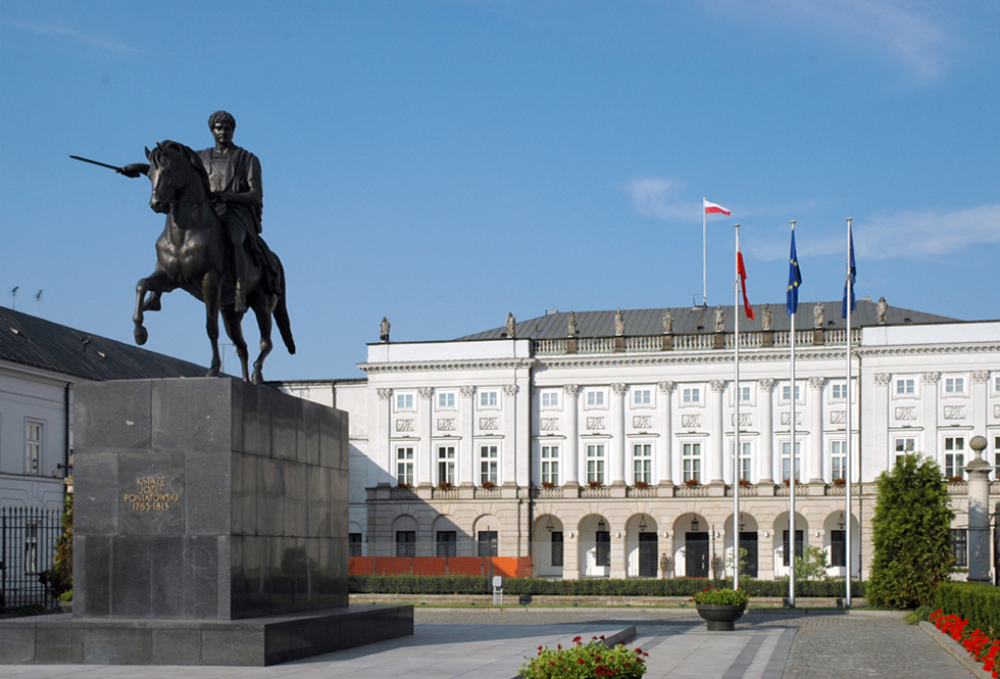
Only in Warsaw, however, have I seen the national flag flanked not only by the EU flag, but also by the NATO flag. It flies in front of the Namiestnikowski palace, so called because it served as the home of the Russian viceroy after the Congress of Vienna awarded the Duchy of Warsaw to the tsar. The Warsaw Pact, the Soviet answer to NATO, was signed there in 1955.
The neoclassical palace is now the home of the Polish president. My visit there this month came one day after the Warsaw airport had been closed when Russian drones invaded Polish airspace and one week before the grim Sept. 17 anniversary of the 1939 "stab in the back" when Russia invaded Poland from the East, meeting up with the Nazi troops who had invaded from the West at the start of the month. Thus did World War II begin. Of course, the Poles fly the NATO flag and look to the West for protection!
Advertisement
In Poland, everywhere you look, there are layers of history before your eyes. Flying in to Warsaw's Chopin airport, you can't help but notice the wide and fertile plains surrounding the city. The center of Poland has no natural barriers protecting it from its neighbors and so it has seen conquering army after conquering army through most of its history. Poland perdures not because of its armies or the instruments of state. Poland perdures because of its culture, a culture deeply intertwined with the Catholic faith.
I was in Poland to lead a seminar on Catholic social teaching. Sponsored by Sacred Heart University's Center for Catholic Studies and the subcommittee on aid to the Church in Central and Eastern Europe at the U.S. bishops' conference, six theologians, three from the U.S. and three from Europe, gave truly wonderful talks. When they are published later this autumn, I shall do a column about them.
The highlight for me, however, was not the theological talks but the sermon we heard on Sunday, September 14, the Feast of the Exaltation of the Cross. Bishop Peter Beno, the auxiliary of Nitra, Slovakia, preached and, after discussing the combativeness of contemporary culture, he said:
Even in the Church, some currents seem to be exchanging love for combativeness. We fight for Christian values, we fight against progressivism, we fight for this or that. We even call the rosary a weapon. Why do I have a problem with this? I will try to explain.
I believe in God, who is Love, who loves us to the extreme, so much so that he laid down his life for us, and who invites us to love one another, to show our love through service and forgiveness. I believe in Love, and I cannot reconcile it with fighting. Love and fighting do not go together for me. It is like light and darkness; they cannot exist side by side, they exclude each other. I cannot fight for love, I cannot force it, I can only give it or accept it... freely, humbly, not aggressively or by force. Just like Jesus on the cross. Jesus is not Napoleon, he is not a military leader, he does not need warriors. He needs people who love, those who are quiet and humble of heart.
Wouldn't it be wonderful if every Christian on the internet could follow the bishop's guidance!
After Mass, at breakfast, one of the Polish priests said "Our president is a good Catholic." Karol Nawrocki narrowly won the presidency in June with 50.9% of the vote. He belongs to the nationalist Law and Justice Party, which is supported by many Catholics. The Prime Minister, Donald Tusk, represents the more liberal, pro-Western, pro-EU party Civic Platform.
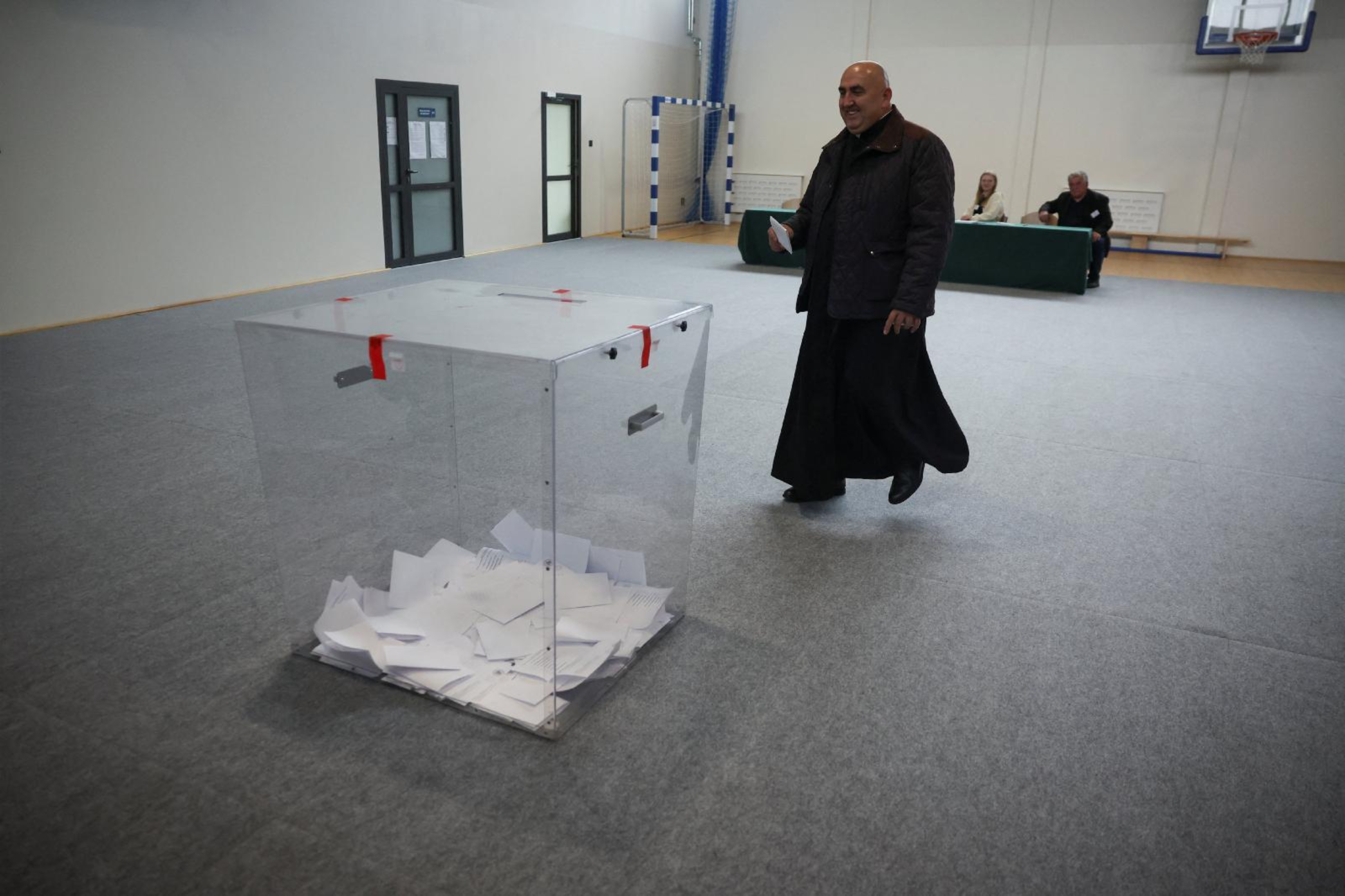
A priest votes in Olbiecin, Poland, during the first round of the country's presidential election May 18, 2025. Warsaw Mayor Rafal Trzaskowski, a liberal, won a narrow victory in Poland's presidential election, but a second-round run-off with conservative historian Karol Nawrocki will be required to decide the country's next president. (OSV News/Reuters/Kacper Pempel)
Throughout the West, a majority of Christians tend to align with populist, nationalist parties, rather than with parties identified above all with the preservation of liberal democracy. If we truly believe in the sensus fidelium, of the intuition of faith that is imparted to all the baptized, we cannot ignore this. The people who most often go to Mass, who are most likely to pray, who take their faith commitments most seriously — these people feel pulled, or pull themselves, to the political and cultural right.
In my conversations with those drawn to these parties, their attitude is almost always reactionary in the strict sense of the word. They are distressed at contemporary liberalism and its unwillingness to clearly articulate moral norms. They are suspicious of any public morality that is rooted in nothing more than volition. They worry about cultural stability in the face of massive economic and demographic changes. They almost always feel that the cultural elites look down at them. And they react against this.
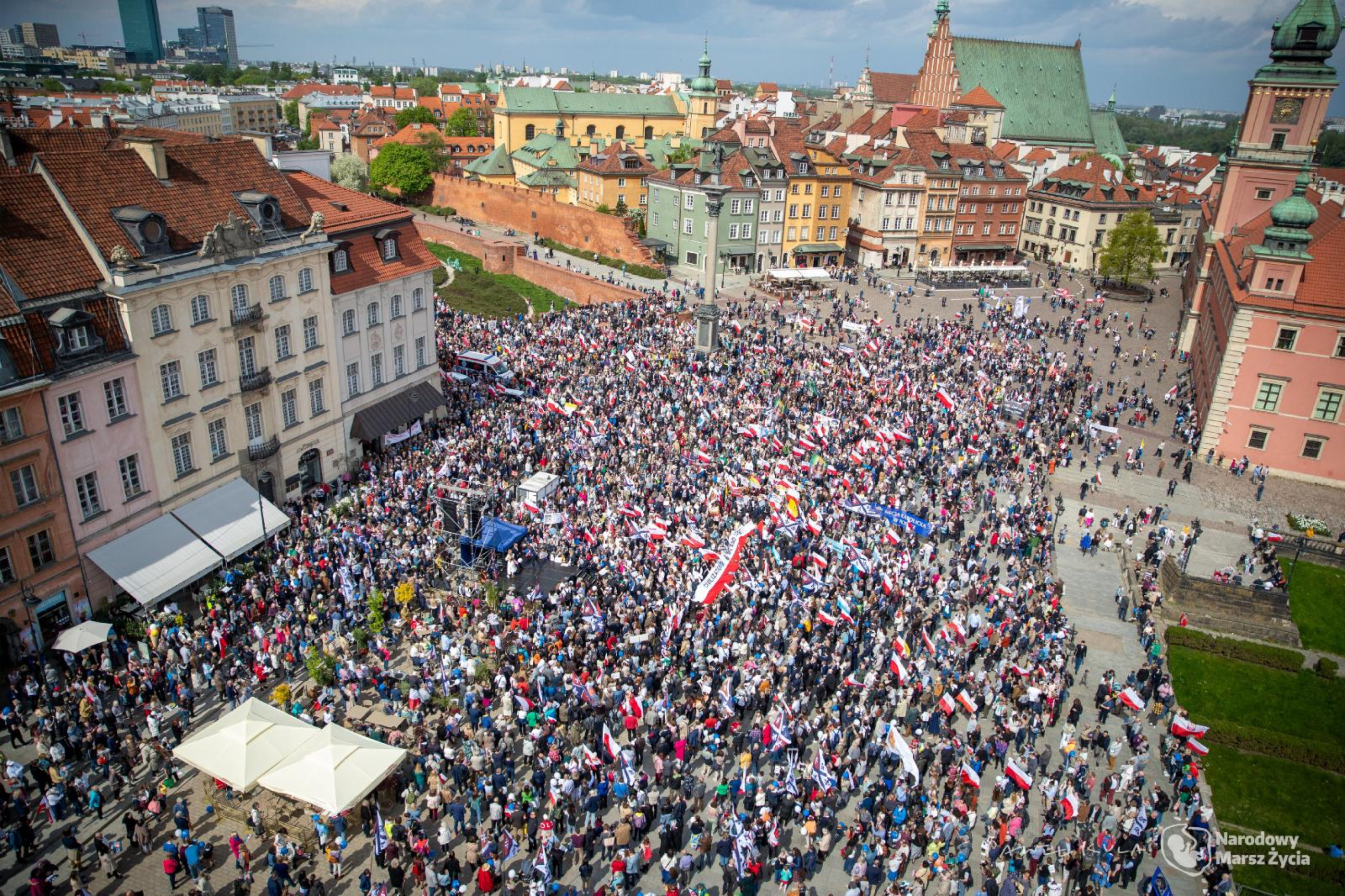
Amid plans by the government to liberalize abortion in the country, Poles organized a National March for Life in the capital, Warsaw, April 14, 2024, in which around 50,000 people participated. President of the Polish bishops' conference, Archbishop Tadeusz Wojda of Gdansk, called April 14 a "day of prayer in defense of conceived life" throughout the country. (OSV News/courtesy National March for Life/Pawel Kula)
I do not doubt that, for some, there is racism underneath these attitudes. Certainly, some slide too easily from a concern for the unborn into an embrace of pre-modern, anti-feminist attitudes. But I do not think most people who voted for Nawrocki — or for Donald Trump — are racists and misogynists. As a political matter, dismissing people as racists and misogynists is not likely to entice them to change their minds, but the problem here is deeper than political strategy. The problem is that leaders of Western thought and culture have become incapable of articulating a new cultural synthesis that embraces those whose faith makes them suspicious of libertarianism in all its forms.
Perhaps President Nawrocki is a good Catholic. Still I hope that in Poland, where national identity has so long been carried by culture and not politics, the church can find creative ways to align liberal democracy with the values believers bring to the table. I hope we can do that in the United States, too. Otherwise, the polarization of our time will simply increase until the vision of love and peace Bishop Beno articulated is swallowed up in violence and strife.