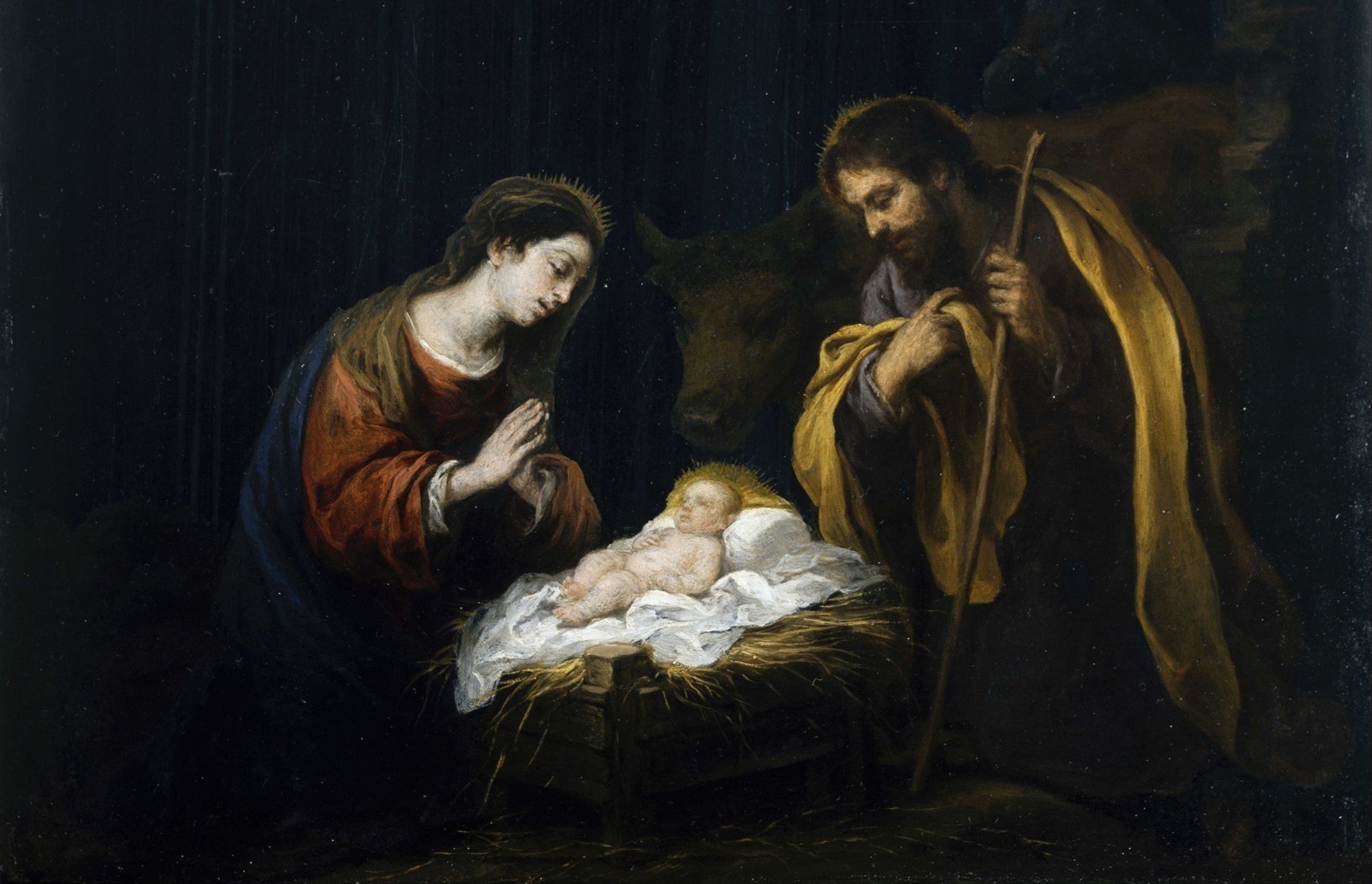
A portion of the painting "The Nativity" (c. 1665-1670) by the Spanish artist Bartolomé Estebán Murillo (Artvee)

The gift. Tomorrow, that word will mostly be rendered in the plural as we Americans have turned Christmas into an orgy of consumerism. The roads to the malls have been packed for weeks. Amazon trucks are everywhere. People spend hours thinking of the perfect gift to give to their loved ones.
How many stop to think about the one gift that got it all started, God's great self-gift, the gift of His only begotten Son? Alas, you can put gifts on the credit card, but there is no way to charge this great gift.
Losing the sense of gift, of the sheer gratuitousness of God's grace, has something to do with the shift from the humanism of the Renaissance, which still understood human beings as creatures, to the seraglio of the Enlightenment and its turn to the subject. We became self-defining. Our rights took precedence over our relationships. The horizon of human cognition expanded such that we forget there is always the great mystery beyond our cognition. Indeed, there is great mystery in the fact of our human cognition. That hideous poem "Invictus" and its final lines — "I am the master of my fate: I am the captain of my soul" — captures the mood of our time.
The consequences of this loss of a sense of gift are profound for Catholicism. The foundation of Catholicism's critique of capitalism is its lack of gratuitousness, its inability to admit that what is given has priority over what is manufactured. The church's steadfast opposition to abortion and euthanasia is based on the belief that life is a gift, an irrevocable gift. Clericalism is rooted in the forgetfulness that a vocation is a gift.
In our day, the cause of justice has taken precedence over other ethical claims, and justice is a good thing. After all, the synod of bishops in 1971 decreed, "Action on behalf of justice and participation in the transformation of the world fully appear to us as a constitutive dimension of the preaching of the Gospel, or, in other words, of the Church's mission for the redemption of the human race and its liberation from every oppressive situation." Constitutive, yes. Exhaustive, no.
Focusing exclusively or even excessively on our work for justice tends to shift the frame of reference away from God and onto ourselves. It takes sustained effort to remember that we are mere laborers in the vineyard. Besides, if we humans managed to rid the world of oppression and establish justice throughout the nations, we would still have to cope with sinfulness, and sin cannot be reduced to injustice. We would, in short, still need a savior.
Only God's grace can close the infinite distance between us and God, and that is precisely what God did at Christmas.
Perhaps we need to remember the price of the gift given us at Christmas. I have noted before the painting by the great Spanish artist Murillo "The Christ Child asleep on the Cross." That image should haunt us.
Many Christmas carols refer to the newborn Christ as the savior, which should prompt the question: Save us from what? One Christmas carol, "Joy to the World," is a bit more explicit. Its third verse is:
No more let sins and sorrows grow,
Nor thorns infest the ground;
He comes to make his blessings flow
Far as the curse is found.
I once heard a Christmas sermon on this verse, and it was one of the most powerful sermons I have ever heard.
Advertisement
The first verse of that hymn has another powerful theological lesson: "Let ev'ry heart prepare him room, And heav'n and nature sing." The heavenly and the earthly both sing and they sing together. Christmas, the Incarnation, is the end of dualism. (No wonder the Calvinist Puritans banned the celebration of Christmas!) Justice is not at odds with grace or mercy; it is a fruit of grace and a brother to mercy. The divine and the human, so different from one another, are now reconciled. "For the Son of God became man so that we might become God," stated St. Athanasius 1,700 years ago. Only God's grace can close the infinite distance between us and God, and that is precisely what God did at Christmas.
It is only when we recognize not so much our unworthiness as our simple inability to be reconciled with God apart from grace that we grasp the magnitude of the gift. That is when we are awestruck. It is only when we recognize the enormity of the gift that we can find joy. And it is only Christmas joy that permits us to rejoice that his grace pours forth "far as the curse is found."
A blessed Christmas to one and all.