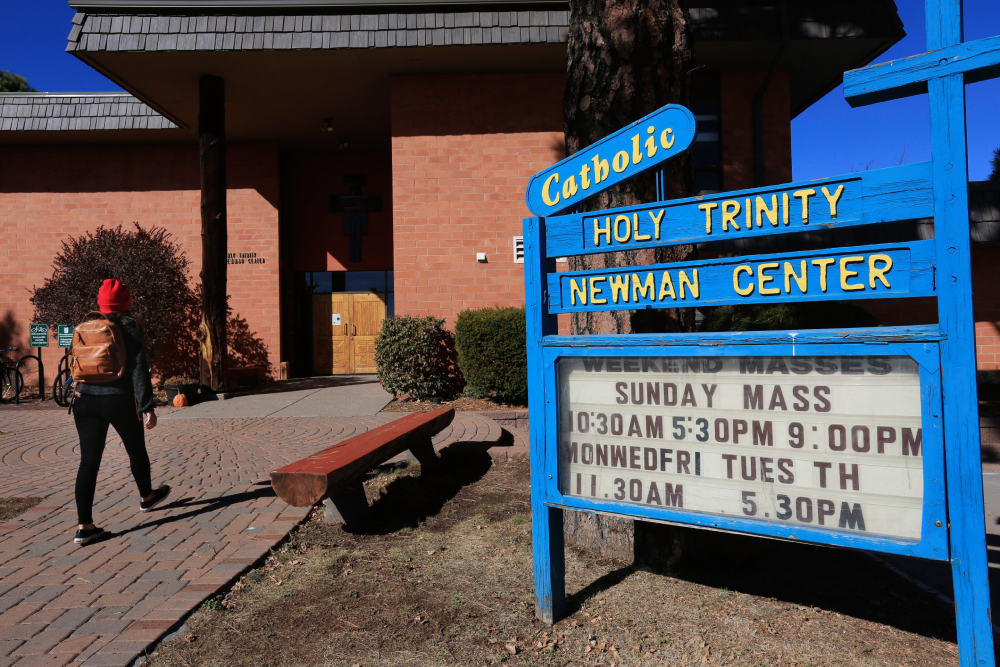
A student arrives for Mass at Holy Trinity Newman Center on the campus of Northern Arizona University in Flagstaff Nov. 25, 2019. When students first move to campus, finding the Newman Center will help them make new, supportive connections. (CNS/Nancy Wiechec)

by Jack Figge
Awe sweeps over me whenever I walk into the church on my college campus and find it full with fellow college students praying before the Blessed Sacrament.
This is not a one-time thing. It is almost a daily occurrence — between 8-10 p.m. the church is packed with students praying.
Could you chalk this devotion up to the fact that I attend Benedictine College, a small liberal arts school in Atchison, Kansas? Sure, you could, but I think that's a fallacy.
Look on social media, read news articles or talk to young Catholics at other colleges both secular and religious. Newman Centers are experiencing record high OCIA classes, campus churches are packed on Sundays and overall devotion and participation is up as a recent study by NCR and the Wittcoff Foundation also showed.
So what draws young people toward Catholicism?
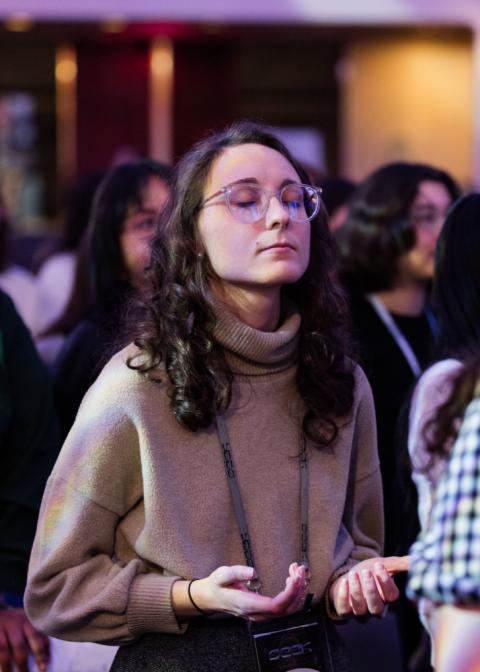
A young woman prays during SEEK25 in Washington, which brought together thousands of the Fellowship of Catholic University Students' campus missionaries and college students from across the nation, Jan. 3, 2025. (OSV News/Courtesy FOCUS)
Most of the stories I have heard seem to follow a similar narrative about how people my age have a dissatisfaction with the world and a desire for something greater, and we are finding that answer in Christ and the church. The sacraments and community offered by the church provide appealing antidotes for the loneliness-prone, relativism-obsessed world we call home.
Young people's overall dissatisfaction with the world is nothing new, but today's college students have lived through something that only exacerbated the qualms of the world: the COVID-19 pandemic.
COVID lockdowns prescribed that teenagers, now college students, were kept at home during their formative years. Deprived of community and exposed to the individual, relativistic, material worldview perpetrated by cultural politics, social media algorithms and a time of immense unrest, many were left dissatisfied.
It was around the pandemic when I found myself, a high school sophomore at the time, confused, lost and alone. So, I turned to prayer and the small community still accessible to me — my best friend Timmy.
During the pandemic, I found myself missing Mass, grateful whenever I had the opportunity to serve Mass for a priest friend as it meant I could receive the Eucharist. When my church opened again, I spent hours in adoration, falling in love with Jesus and flocking to the sacrament of confession.
When we could return to church, Timmy and I would attend Saturday morning Mass, grab coffee and sit for hours in the back of my truck, talking about life and the world and joking around.
Those mornings taught me the value of community and the sacraments, and they drew me out of the isolated world of social media and video games, forcing me to turn my attention to something greater — God — and to share that experience with others.
Advertisement
Two years later, when I started college, I found that many of my new peers had a similar post-pandemic experience: This year of isolation made us desire something greater. Thus, an encounter with the church propelled us to dive deeper, embrace prayer and find friends that too focused their life on pursuing Christ.
Through returning to Mass, meeting other young Catholics or simply beginning to pray, we fell in love with Christ and his church. We who had grown up in a society that told us we could do whatever we want, that nothing really matters, were left with hearts longing for something greater.
When we found that something, we dived all in.
Now, students pack the adoration chapel late at night, finding refuge from the world's chaos and bringing their fears, anxieties and worries to the Lord. Many attend daily Mass, pray the rosary and develop strong friendships centered on Newman Center activities, finding fun, wholesome activities and sitting down for long conversations with good friends over coffee or a beer.
We have fallen in love with Christ and with the church, realizing that a relationship with Christ, the sacraments and community are the antidotes to the woes of the world.
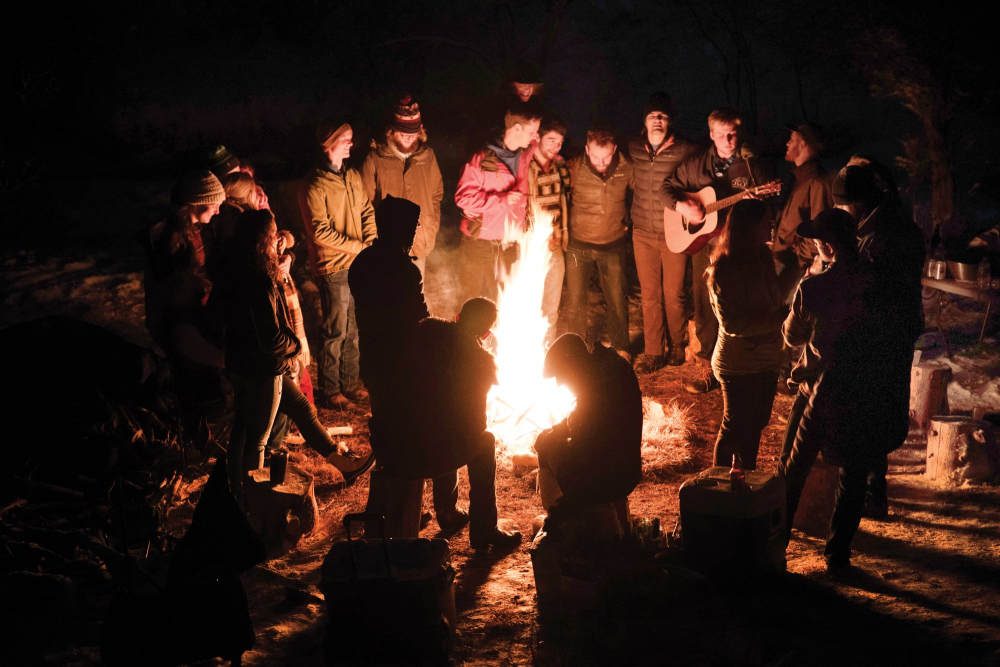
Wyoming Catholic College students memorize poetry, sing campfire songs, and embrace authentic face-to-face friendship in an entirely phone-free campus. (OSV News/Courtesy of Wyoming Catholic College)
It is like a pendulum — when the pendulum swings to one side, it must swing back with equal force. It seems like the youth are swinging back toward religion after the world swung hard toward materialism, relativism and individualism. The lack of direction of the world and meaning offered by these subjective worldviews became apparent, wore us down and led us to desire pursuing higher purpose instead — Christ.
St. John Paul II predicted this pendulum swing, writing in Veritatis Splendor:
Giving himself over to relativism and scepticism (cf. Jn 18:38), he goes off in search of an illusory freedom apart from truth itself. But no darkness of error or of sin can totally take away from man the light of God the Creator. In the depths of his heart there always remains a yearning for absolute truth and a thirst to attain full knowledge of it.
This is a swing to becoming human again. Young people have grown up in an inhumane world — filled with smartphones, isolation and now AI chatbots that attempt to remove the touchstones of community.
Now, when we encounter that which makes us human, we dive all in.
Young people today are being drawn to the church which stands as a great bastion of truth, the “pillar and foundation of truth” (1 Timothy 3:15). In Christ and his church, we have come to find the answers to our heart's deepest longings, the antidote to the worldly woes that weigh us down. We are realizing that trying to fulfill every earthly desire will not answer the cry of our hearts as the world has promised — only Christ can.