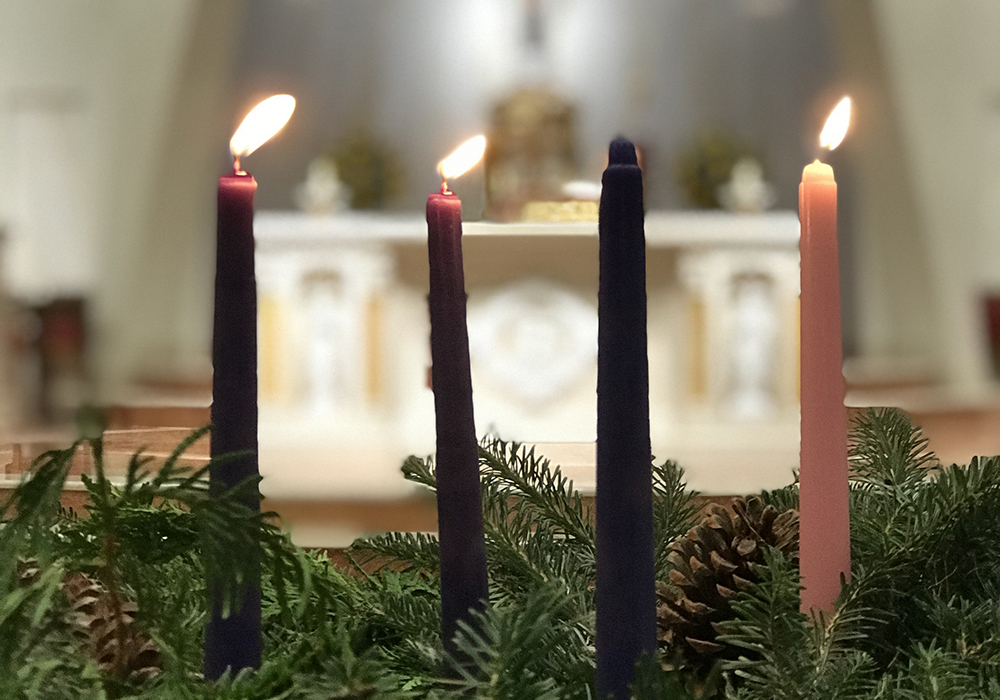
An illustration shows three of the candles lit on the Advent wreath at St. Agnes Church in Arlington, Virginia, Nov. 21, 2023. (OSV News file photo/Arlington Catholic Herald/Ann M. Augherton)

by Carol Zimmermann
Let's face it, the Christmas season comes at us hard and fast — and early! And once it does, it's full-on immersion: food, songs, shopping, decorations, parties, school concerts and presents — "not that there's anything wrong with that" — to quote "Seinfeld."
The holiday frenzy is almost like a carload of fun relatives who've stopped by for an annual monthlong (at least!) visit, fully intent on following every tradition from years past while also being open (of course!) to throwing in a few new ones.
It can be a lot.
Meanwhile, the Catholic Church spends most of December, until Christmas Eve, almost whispering: "Psst, hey, over here," reeling believers in its doors with nary a Christmas carol or hint of decoration beyond the purple (and one pink) Advent candles. The songs and readings are far from the peals of "Joy to the World," with their emphasis on the less joyous tasks of waiting, preparing and repenting.
It almost seems countercultural, as if the church isn't in on the party happening right outside its doors.
Except the church, of course, is very much aware because Christmas is a big deal in the Catholic tradition, even though theologians point out that the feast day is a runner-up to Easter, and some describe Advent as "little Lent."
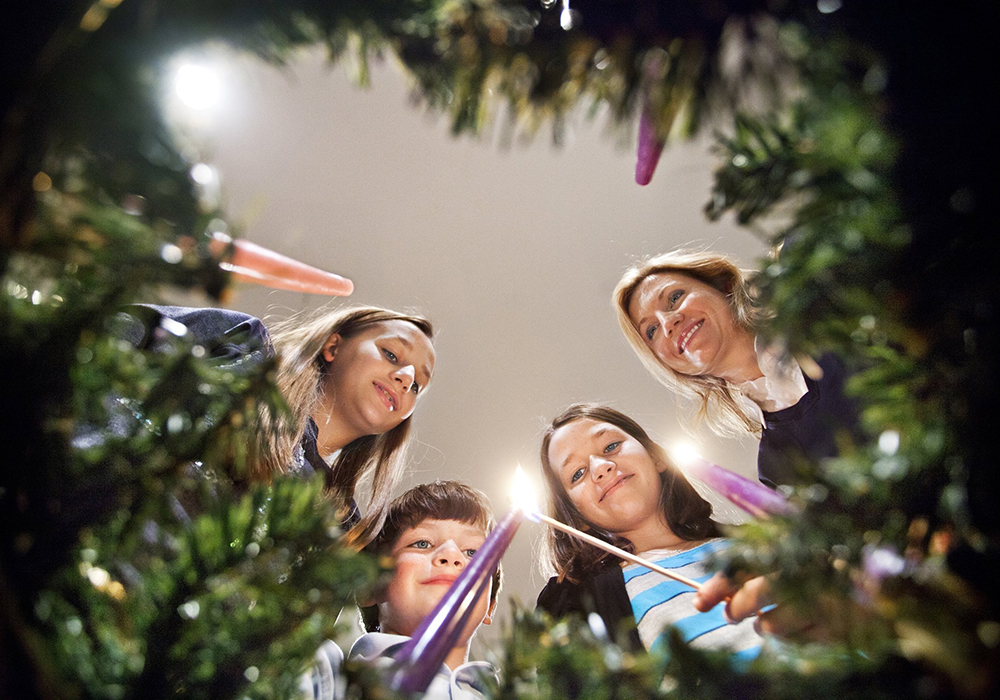
A family lights an Advent wreath at their Maryland home. (OSV News/Catholic Review/Tom McCarthy Jr.)
Advent's Lent-like waiting period is exactly why churches do not immediately whip out Christmas trees and dozens of poinsettias at the end of the liturgical season of Ordinary Time.
It's not just about being minimalist but instead following a long tradition of when the church celebrates what — spelled out in its "Universal Norms on the Liturgical Year and the Calendar" updated after the Second Vatican Council in 1969. This document very clearly distinguishes Advent from Christmas, describing these four weeks as "a time to prepare for the solemnity of Christmas."
It's hard to sometimes grasp that Advent is separate from the Christmas season when the lines are blurred all around us like swirled cookie frosting and seasonal music and decorations are peeking out pre-Thanksgiving.
When I was a kid, I certainly didn't get the "my soul in stillness waits" concept echoed in one of the old standby Advent hymns. And I particularly didn't get the very somber "O Come, O Come, Emmanuel" which we sang every Friday morning at the weekly Advent prayer service at my Catholic elementary school. At the time, I could have gone for more of a "O Come All Ye Faithful" vibe.
But now, I am fully on board with the hymn that likely tops the Advent song charts and I have also found out there is also a lot going on with this piece on multiple levels. Although it was written in the 1800s, the lyrics stem from an eighth century monastic tradition of chanting the O Antiphons — prayers stemming from Old Testament imagery — for the last seven nights of Advent from Dec. 17-23. The words tap into something deep with their message of asking God to lead us, show us the path, ransom us, dispel darkness, end divisions and bring comfort.
It is the warm-up essentially for "Hark the Herald Angels Sing." Instead of jumping right to full on angel choirs, this lets us think about the Incarnation mystery a bit and let that settle.
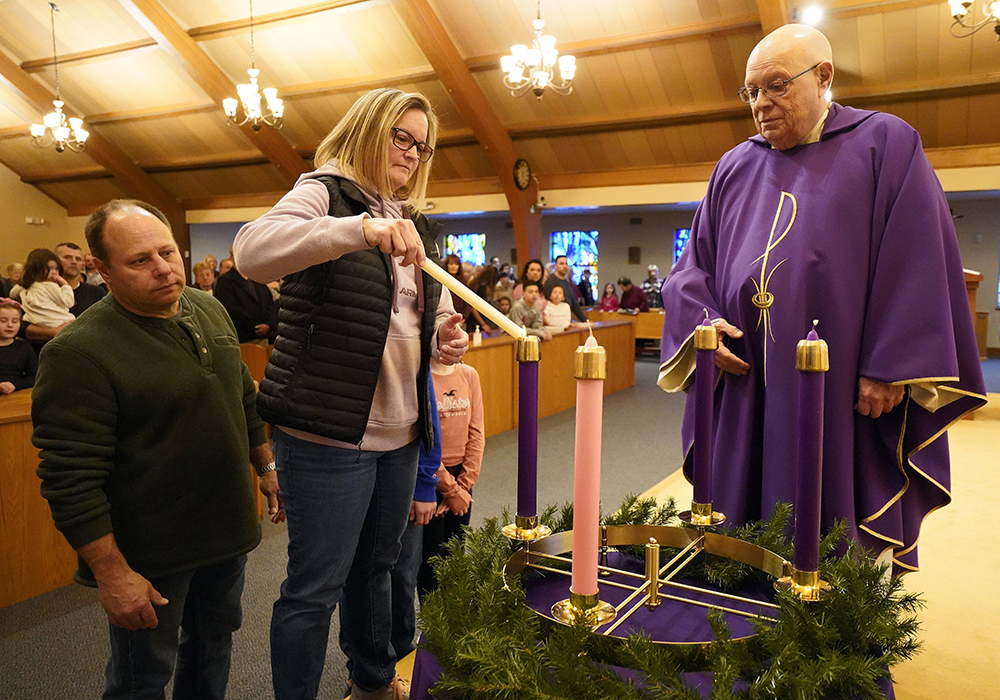
Laura Klein lights a candle on the Advent wreath as her husband, Bob Klein, and Msgr. Daniel Picciano look on during Mass on the first Sunday of Advent at St. Sylvester Church in Medford, New York, Nov. 27, 2022. (CNS/Gregory A. Shemitz)
When I asked a theologian for a quick Advent primer, his response was to quote another liturgical theologian — Alexander Schmemann, an orthodox priest and author who died in 1983 — who emphasized that people can only feast well if they fast well.
"Advent is meant to be a time of preparation," said Jesuit Fr. Bruce Morrill, the Edward A. Malloy professor of Catholic studies at Vanderbilt University Divinity School in Nashville, Tennessee. He also gave high marks for the Advent hymn I hadn't liked, saying the words speak of humanity's longing and also of God's consistency and faithfulness. Even if people don't pick all that up, it's there, he said.
And maybe we inadvertently sense this at a quiet church in December or at home where some families hold back on the full-on decor until Christmas Eve and extend the Christmas season long after the stores do.
Advertisement
Morrill had told me before how he remembers a family on the street where he grew up in Maine who put their Christmas decorations up on Dec. 24 and didn't take them down until Candlemas, commemorating the presentation of Jesus in the temple — the 40th (and last) day of the liturgical Christmas season — on Feb. 2.
A friend of mine similarly held back on Christmas decorating when both our kids were young, and at the time I just couldn't imagine not having a tree up and decorated by at least mid-December, and I still feel this way. When I asked her about this tradition now she said she still basically keeps it but she said if people are considering it they shouldn't wait until Dec. 24 to buy their tree!
When she and her husband got married, just weeks before Advent, she said they were adamant about not decorating soon, but when they shopped for a tree on Christmas Eve, well, as she put it: "There were slim pickings."
We can, and really should, have a time of waiting and celebrating and fully appreciate both.
In subsequent years, they have bought their tree earlier, just added lights and then decorated it on Christmas Eve. At the start of Advent they pull out the Advent wreath and a Nativity set, minus baby Jesus (of course) and over the years the family found a happy medium compromising on full-on Christmas decor and scaled back Advent by simply decorating a different area of the house each week of December.
Really, however it's done, making some kind of distinction between the Advent and Christmas seasons seems to reflect the best of both worlds or the both/and way of thinking that Catholics already get.
In other words: We can, and really should, have a time of waiting and celebrating and fully appreciate both.