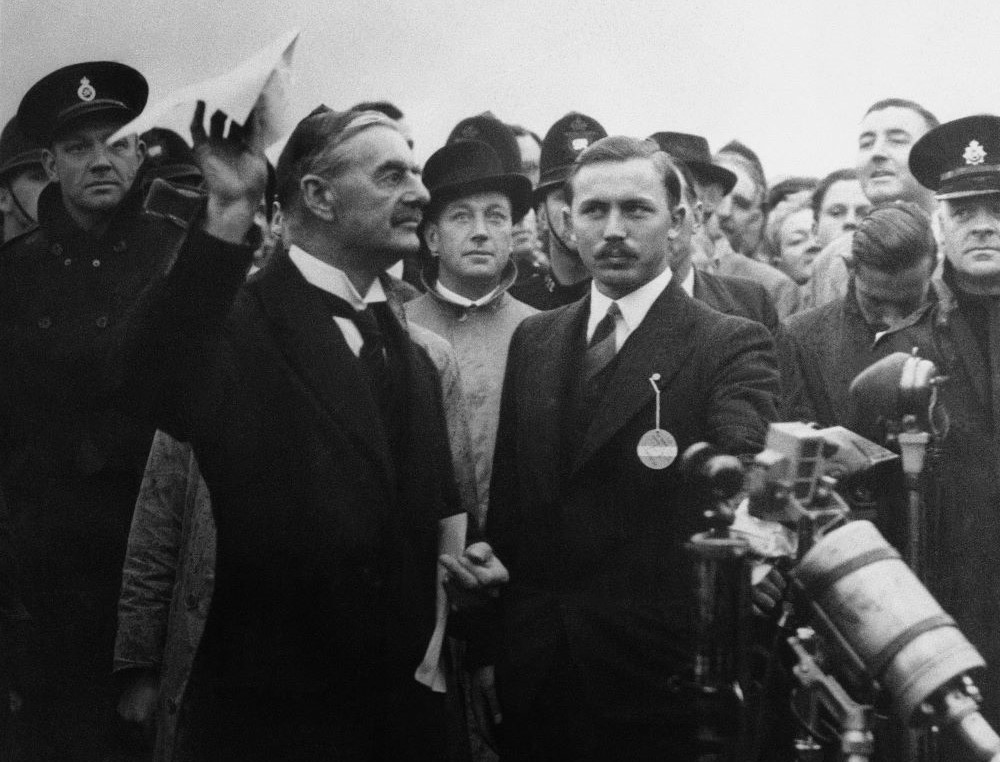
British Premier Neville Chamberlain waves what he called the "no war" pact at Heston Aerodrome in London Sept. 30, 1938, after meeting with Adolf Hitler. (AP)

Later today, President Donald Trump will hold a summit with Russian President Vladimir Putin in Alaska. Trump says he wants the war in Ukraine to end but didn't see the necessity of inviting Ukraine to participate in the summit. Commentators are worried that Trump seemed to be setting the stage to cave to Putin's demands, that this summit would resemble the peace efforts of British Prime Minister Neville Chamberlain and French Prime Minister Édouard Daladier at Munich in 1938.
Max Boot, at The Washington Post wrote: "If Trump was to agree to Putin's terms, it would be a reprise of the 1938 Munich Agreement in which British Prime Minister Neville Chamberlain handed over to Adolf Hitler the Sudetenland — a region of what was then Czechoslovakia that was heavily fortified and defended — without consulting the Czechs," Boot wrote. "In return, Chamberlain received nothing but empty promises of 'peace for our time.' "
In an interview at The Conversation, Donald Heflin of the Fletcher School of Law and Diplomacy at Tufts said he didn't like analogies to Nazi Germany, but drew the comparison anyway. "Czechoslovakia wasn't at the table. Ukraine's not at the table." He noted, too, that security guarantees had been given to the Czech government which were not honored, just as the Western powers gave security guarantees to Ukraine when they gave up their nuclear arsenal in 1994.
Let's return to 1938 to see if the analogy works.
On February 20 of that year, Hitler, in a speech to the Reichstag, said that the German government would interest itself in the welfare of those Germans who lived in countries adjacent to the Reich. The next month, Hitler perpetrated the Anschluss, occupying Austria without firing a shot.
Are we sure Russia will stop at Ukraine?
Czechoslovakia was different. Unlike Austria, most people in Czechoslovakia were Bohemian or Slovak, and they did not speak German. The nation had a highly fortified frontier and they were not keen to join the Reich. The German-speaking residents of the Sudetenland were not ill-treated but on April 21, Konrad Henlein, head of the Nazi Party in Czechoslovakia, set forth demands for autonomy in the region and appealed to Hitler for protection. In June, Daladier renewed his pledge to honor France's treaty obligations to Czechoslovakia but when the French asked what assistance they could expect from Britain in the event of war, the reply was disappointing.
Hitler was convinced that the French would not fight if he invaded Czechoslovakia. The French had done nothing when he reoccupied the Rhineland in 1936 nor when he swallowed Austria whole. After the war, during testimony at Nuremberg, we learned that his generals were not convinced and they knew the Czech border fortresses were formidable. Tensions continued to rise. Hitler denounced the Czechs at the Nazi Party rally in Nuremberg on September 12 and the Czech military was mobilized.
In order to avert war, Chamberlain called for a peace conference and flew to Munich. The Italian dictator Benito Mussolini joined the group but the Czechs were not invited. After much discussion, the Western powers decided to appease Hitler. The Sudetenland was awarded to Germany in exchange for security guarantees and Hitler's promise that he had no additional territorial ambitions in Europe. He lied.
Advertisement
Chamberlain's policy of appeasement has made that a bad word in the conduct of foreign policy. In one of my favorite TV moments ever, in 2008, when the Republicans were accusing then-candidate Barack Obama of desiring a foreign policy of appeasement, Chris Matthews on "Hardball" asked GOP talking head Kevin James what Chamberlain had actually done at Munich. "It all goes back to appeasement," James told Matthews, but the host would not let him off the hook. It soon became obvious that James had no idea what had transpired at Munich in 1938, and that for him, "appeasement" was simply the latest cuss word to throw at the other party's presidential candidate. Matthews' refusal to let him off the hook was brilliant.
In fact, appeasement is sometimes a perfectly fine policy. Lowering tensions with one's adversaries, seeking common ground, trying to see if the person threatening war might not be bought off with something short of war, these are all fine things for diplomats and statesmen to do, provided the person or regime threatening war actually seeks peace. Egypt appeased Israel by recognizing its right to exist and Israel appeased Egypt by returning the Sinai peninsula to Egyptian control as part of the peace negotiations in 1978. President John Kennedy's decision to remove nuclear missiles from Turkey in exchange for Russia's removing them from Cuba is another example of appeasement working. In both cases, all actors really did want peace and the appeasement was mutual.
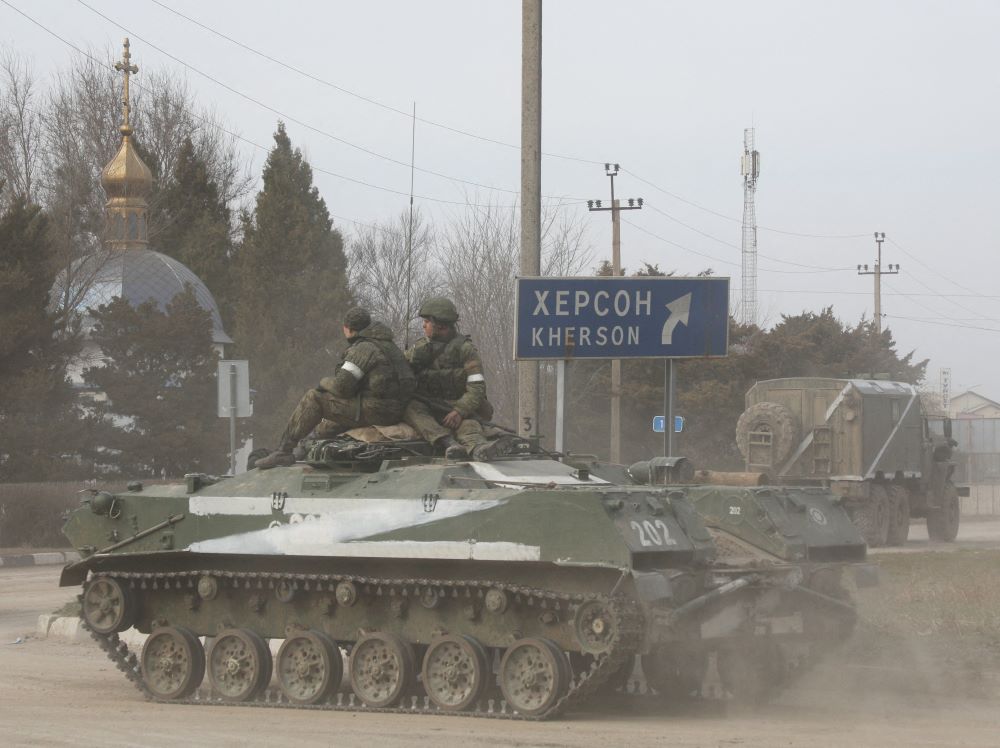
Servicemen ride past a church on a Russian army tank in Armyansk, Crimea, Feb. 24, 2022, after Russian President Vladimir Putin authorized a full-scale military operation in Ukraine. (CNS/Reuters)
In the case of the Alaska summit, any appeasement it produces can't be mutual because Ukraine's President Volodymyr Zelenskyy will not be present. Nor is there reason to think that Putin has abandoned his desire to eliminate Ukraine entirely. That is why he invaded in the first place. He hoped to get Ukraine in one gulp, like Hitler took Austria. The brave Ukraine troops have limited Russia's territorial gains to a section of Ukraine's coast along the Sea of Azov. That allows Russia a continuous land-route to Crimea, which it annexed in 2014. There is no reason to think Putin has abandoned his desire to recreate the Russian empire.
The question for the peace table is: Should Russia be allowed to keep legally what it has stolen illegally? If the answer is yes, or even a partial yes, how long will it be before Putin tries to capture the rest of Ukraine? It took Hitler less than six months after Munich to devour the rest of Czechoslovakia. Are we sure Russia will stop at Ukraine?
There was a time when I thought the lesson of Munich had been overlearned, that countries were so wary of appeasement they did not sufficiently seek peaceful means to resolve conflicts. In this case, however, where Ukraine is entirely in the right and Russia entirely in the wrong, when Putin cannot be trusted, when security guarantees are not worth the paper they are written on, appeasement would be wrong.
The Munich analogy fails, however, when one considers the personalities. Comparing Trump to Chamberlain is a slur against Chamberlain. Trump only cares about power and money. He may also like the idea of winning a peace prize. The only person at the Munich conference whom he genuinely resembles is Mussolini. Chamberlain and Daladier made serious errors in judgment, but they were men of honor and of substance. Daladier was imprisoned throughout the war. Chamberlain would step down on May 10, 1940, when the Germans attacked Belgium, France and the Netherlands, but he remained a member of the war cabinet and died later that year from cancer.
The analogy to Munich, then, works only to a degree. At the level of personalities, it fails but as a way of understanding the policy stakes, it works. Let's hope it works in one other way. Two years after Munich, Britain experienced its "finest hour" as it stood alone against Hitler from June 1940 until June 1941. America may yet have a "finest hour" but it will be at least three years hence, after Trump leaves office.