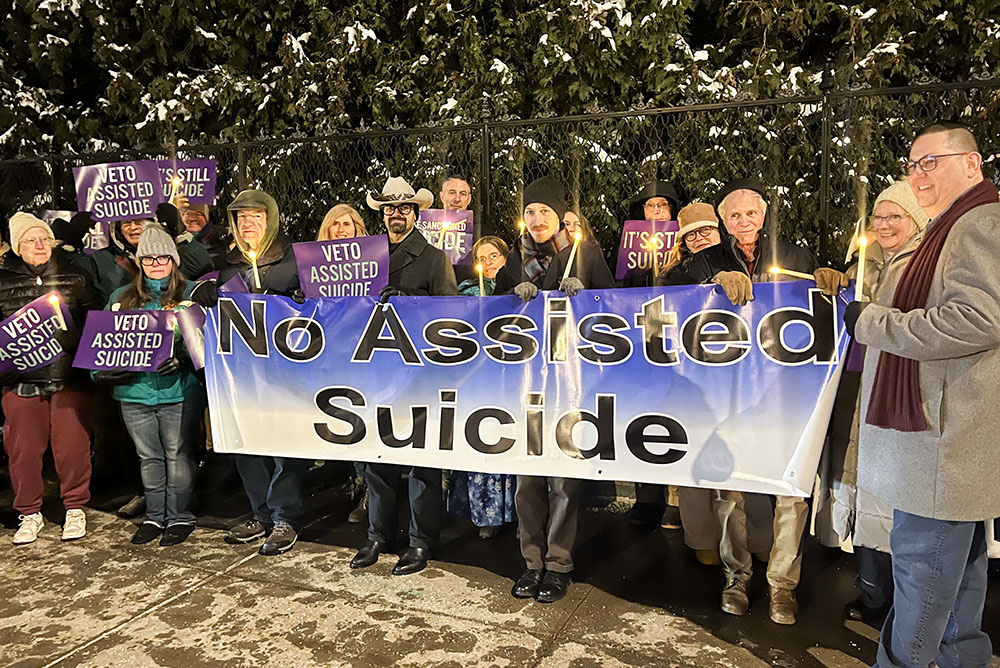
Opponents of New York state's proposed assisted suicide bill stand outside the governor's mansion in Albany, Dec. 3, 2025, for a candlelight vigil urging Gov. Kathy Hochul to veto the bill passed by the Legislature June 9. Hochul announced Dec. 17 that she would sign an amended bill in January. (OSV News/The Evangelist/Emily Benson)

Illinois Gov. JB Pritzker's statement when he signed an assisted-suicide law on Dec. 12 unwittingly tipped off a principal problem with contemporary liberalism.
The governor said: "I have been deeply impacted by the stories of Illinoisans or their loved ones that have suffered from a devastating terminal illness, and I have been moved by their dedication to standing up for freedom and choice at the end of life in the midst of personal heartbreak. ... This legislation will be thoughtfully implemented so that physicians can consult patients on making deeply personal decisions with authority, autonomy and empathy."
New York's Gov. Kathy Hochul struck a similar chord when she agreed to a similar law. "New York has long been a beacon of freedom, and now it is time we extend that freedom to terminally ill New Yorkers who want the right to die comfortably and on their own terms," Hochul said in announcing her decision Dec. 17.
In both instances, the idea that the decision is personal seems to require the conclusion that it is entirely subjective. Pritzker cites "autonomy" explicitly in his statement. Hochul calls it "a right." The two governors do not claim that these decisions lack moral significance but both agree that the individual should be able to make an autonomous decision, to be free to choose.

New York Gov. Kathy Hochul (OSV News/Reuters/Kent J. Edwards)
This is not liberalism. It is libertarianism. It is precisely how laissez-faire economics is invoked by plutocrats to justify their excessive wealth. It is precisely how pro-choice advocates speak about abortion. What matters is the individual's right to make decisions for themselves irrespective of the social significance of those decisions. Political philosopher Alan Wolfe's 2015 takedown of libertarianism in Commonweal remains essential reading, as he explores both the philosophic and sociological pathologies of libertarianism.
In this case of assisted suicide, the argument put forward by the two governors misunderstands the situation of a gravely ill person. They are weak. They can be manipulated. The nurses, whose ability to do their job requires the trust of the patient, could easily be compromised by doing something as normal as speaking with a visiting family member, if that family member is pressuring the patient in ways about which the nurse knows nothing. Does anyone think managed-care programs will not bring enormous pressure on people to end their lives, to not be a burden? And, as our friends in the disability community point out, and they are champions in the fight against assisted suicide, once we begin deciding which lives are worth living, their future is imperiled.

Illinois Gov. JB Pritzker (Wikimedia Commons/Gage Skidmore)
The Illinois bishops asked an important question in their statement after the governor signed the law: "How can we urge teens and young adults — knowing suicide is the second-leading cause of death in their age group — not to choose death, while our own laws say that suicide can be a 'medical option'?"
These objections are substantial but they focus on the consequences. There is a deeper problem with this moral libertarianism. It denies, functionally if not explicitly, that there is a moral order in the universe that makes claims upon humankind. Instead, morality is whatever a person wants it to be. This subjective understanding of human freedom is a corruption of liberalism. You can trace this corruption as an intellectual matter to British philosopher John Stuart Mill, but his writings could not have pulled it off without the assistance of laissez-faire capitalism. It was — and is — the wealthy who appreciate the way their power is advanced by such an intellectual reduction of freedom.
That is why Pritzker's and Hochul's embrace of a libertarian stance is lethal to the future of liberalism. If there is no moral order beyond the individual's personal decision-making, how can our politics aspire to a vision of justice? Whence does such a vision derive? "Politics must be a striving for justice, and hence it has to establish the fundamental preconditions for peace," said Pope Benedict XVI in his remarkable speech to the Bundestag in 2011. "Naturally a politician will seek success, without which he would have no opportunity for effective political action at all. Yet success is subordinated to the criterion of justice, to the will to do what is right, and to the understanding of what is right."
Advertisement
Later in that same speech, the pope, as he often did, put his finger on the underlying cultural issue. After praising the increased awareness of ecological concerns, Benedict said:
The importance of ecology is no longer disputed. We must listen to the language of nature and we must answer accordingly. Yet I would like to underline a point that seems to me to be neglected, today as in the past: There is also an ecology of man. Man too has a nature that he must respect and that he cannot manipulate at will. Man is not merely self-creating freedom. Man does not create himself. He is intellect and will, but he is also nature, and his will is rightly ordered if he respects his nature, listens to it and accepts himself for who he is, as one who did not create himself. In this way, and in no other, is true human freedom fulfilled.
That is why Pritzker and Hochul are not just wrong but are wrong in principle. They undercut the traditional role of liberalism in American history as the promotion of social justice, of promoting the interests ignored by the moneyed interest. Their stance implies there is no sure ground on which to make a moral claim for society. They ignore the fact that, historically, it is concern for the common good that tames liberalism's centrifugal forces.
They not only appear hypocritical. It is worse than that. They turn off religious voters who grasp that moral norms are discerned by human beings, not manufactured by them. If you want to know why religious voters lean right, here is your answer. Behind the governor's invocation of compassion and empathy, we see something altogether sinister, something Whittaker Chambers famously identified in libertarian hero Ayn Rand's most famous novel: "From almost any page of Atlas Shrugged, a voice can be heard, from painful necessity, commanding: 'To a gas chamber — go!' "
Editor's note: Starting Jan. 5, NCR columnist Michael Sean Winters will be adjusting the number of columns he writes each week in order to focus on other projects. You can read his now weekly column on Mondays. You can also sign up here for his weekly newsletter, appearing in your inbox each Wednesday. Over the coming weeks, NCR will introduce new voices to continue our long-standing mission of publishing engaging, compelling commentary on the church and society.