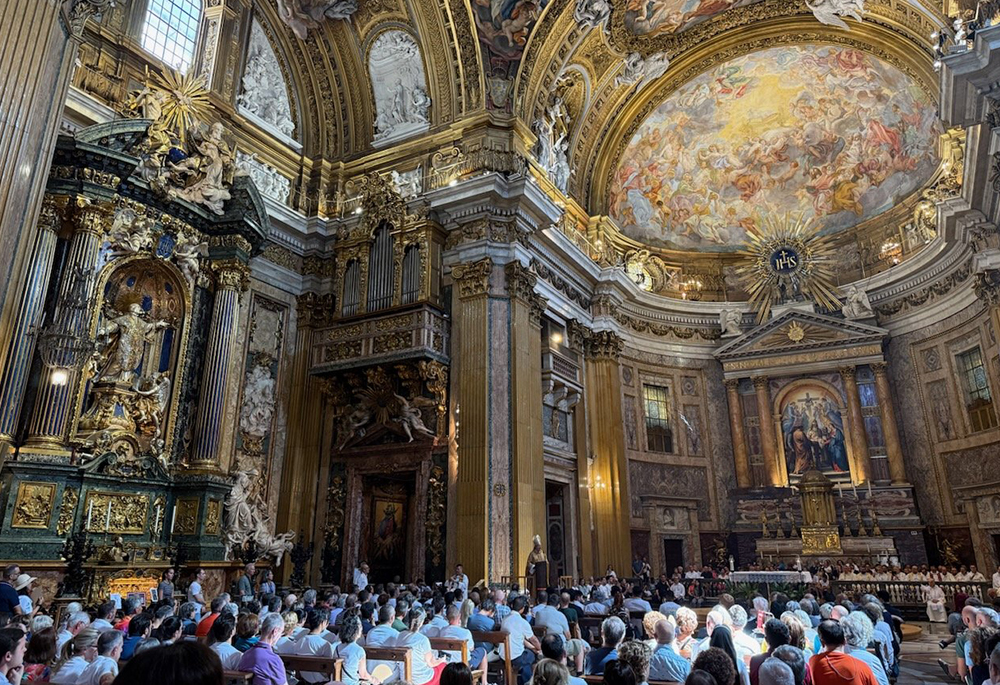
LGBTQ Catholics, their family, friends and people who minister with them attend a Jubilee Mass in Rome's Church of the Gesu Sept. 6, 2025, before walking in procession through the Holy Door of St. Peter's Basilica at the Vatican. (CNS/Courtesy of Outreach, Jack Consolie)

by Daniel P. Horan
Last month, the Catholic news website Crux released transcripts from two long-form interviews Pope Leo XIV gave to journalist Elise Ann Allen for her forthcoming book León XIV: Ciudadno del mundo, misionero del siglo XXI. These interviews, which total about three hours, cover a range of topics that have garnered extensive media coverage, including political polarization and United States politics, the war in Gaza and the state of affairs in China, Vatican finances and the Curia, women in the church and liturgical debates, as well as LGBTQ+ issues.
It's this last topic about the LGBTQ+ community and the church that captured my attention, not necessarily because of what he said about pastoral outreach and welcome — he explicitly stated that he would carry on Pope Francis' legacy of welcome and inclusion for LGBTQ+ persons — but what he said about the development of doctrine and its relationship to the need to "change attitudes before we ever change doctrine."
At first glance that sounded like a disappointing rejection of any theological and moral progress for LGBTQ+ individuals and their allies who have long desired a revision of the church's formal language around homosexual acts described as "intrinsically disordered" and perhaps a potential pathway toward recognition of same-sex marriage.
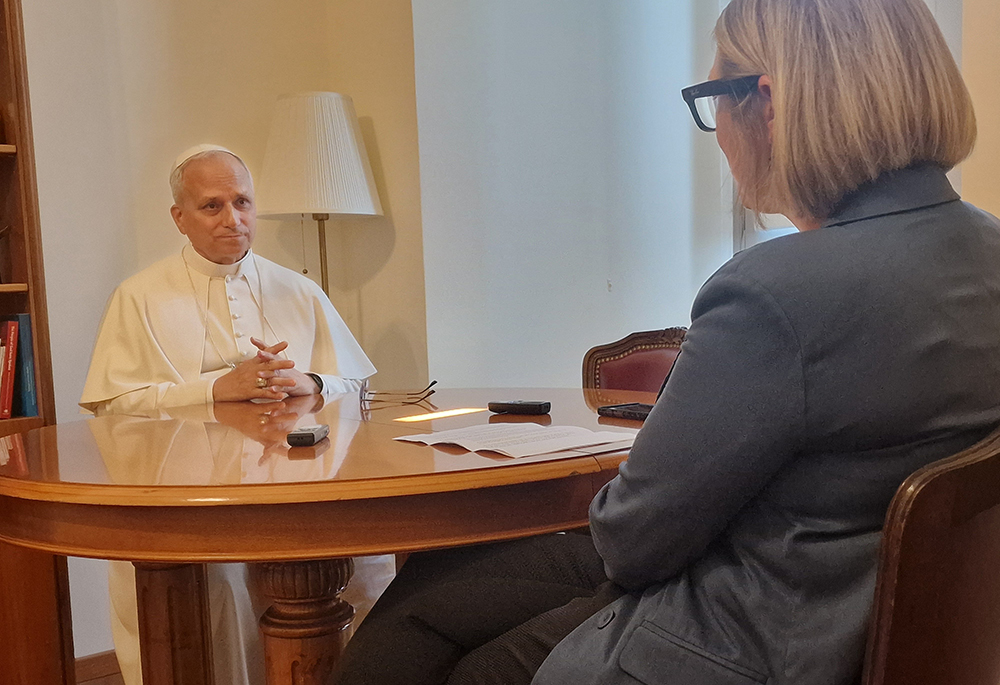
Pope Leo XIV sits with Elise Allen, senior correspondent at Crux, for an interview at the pope's residence inside the Vatican's Palazzo Sant'Uffizio July 30, 2025. (CNS/Courtesy of Crux)
I agree with my fellow Catholic theologian Ish Ruiz in his recent NCR opinion piece that this was "hurtful to hear." Ruiz is right to note the inherent injustice of claims to welcoming all, but refusing to recognize the full dignity and value of those invited in doctrinal formulations and moral exhortations. He writes movingly:
No matter how loudly we proclaim "todos, todos, todos" to try to welcome LGBTQ+ people, postponing doctrinal reform perpetuates our rejection. It suggests that LGBTQ+ Catholics may be seen but not fully embraced, welcomed but never celebrated, included but always conditionally. It expects us to take comfort in crumbs while we hunger for the full bread of communion. We don't just want to be inside the church building; we want our love and our identities to be cherished as integral parts of the Catholic story.
Ruiz is correct to emphasize the importance of synodality and to insist that if we really want to hear all voices, then the church must come to terms with the movement of the Holy Spirit in the lives and love of queer people and respond accordingly so that our doctrinal formulations and moral theological claims reflect those truths fully.
What I am proposing here is not merely an "add and stir" approach to LGBTQ+ folks and Catholic theology. Instead, I believe that something more substantial and theologically grounded is necessary. It's about moving toward a fuller understanding of the faith we profess in the spirit of St. Anselm's dictum fides quaerens intellectum and a recognition that there is not just an absence of queer people at the pastoral table but a lacuna in our current theological understanding of the human person.
So, how do we do that?
An LGBTQ flag is seen in an illustration photo. (OSV News/Reuters/Nadja Wohlleben)
Without dismissing the real and legitimate hurt that such statements about changes to doctrinal and ethical formulations being "highly unlikely, certainly in the immediate future" elicit, I wonder what happens if we take Pope Leo XIV's passing reference to attitudinal and cultural changes to heart. What if we took this opportunity to read his remarks through the lens of the church's longstanding teaching on the development of doctrine — which spans from St. Augustine through St. John Henry Newman through the Second Vatican Council and today? We can look to history for the ways in which changing attitudes did result in changing doctrine, sometimes in short order and sometimes over centuries.
For example, the development of the doctrine of the divinity of the Holy Spirit and the formulation of the Trinity took centuries and several ecumenical councils to clarify. Despite the assumption of some that the dogma of the Trinity and divinity of the Holy Spirit was clear from the time of Jesus and the first disciples, it wasn't until 381 C.E. at the Council of Constantinople that the phrase about the Holy Spirit, "With the Father and the Son, he is worshiped and glorified," was added to the creed.
It took more than 300 years for one of the pillars of Christian faith to be clarified and added to the universal doctrine of the church! How did this happen? It began with "changes in attitudes" that began, in many ways, at the grassroots.
Advertisement
It was the preponderance of belief among the faithful, the praying of the trinitarian doxology within liturgies, the invocation of the Trinity at baptism and a deeper understanding of the sensus plenior ("fuller sense") of Scripture over time that led theologians to explore the claims more rigorously to articulate the doctrine clearly and bishops then exercising their teaching magisterium at the council so that it could be held universally.
It's important to remember that, with the dogma of the Holy Spirit as with many christological doctrines over the centuries, "changes in attitudes" did not mean unanimity. On the contrary, there were always members of the faithful, theologians and bishops who disagreed or dissented. That has been true over the last two millennia, and it is true today. So, it should not be surprising that there may always be holdouts when it comes to the development of doctrine around LGBTQ+ issues.
But we don't have to wait three centuries for such attitudinal changes that lead to doctrinal development to unfold. One only has to look to the last century and the case of the doctrine of religious liberty at the Second Vatican Council to see how this can happen over decades rather than centuries.
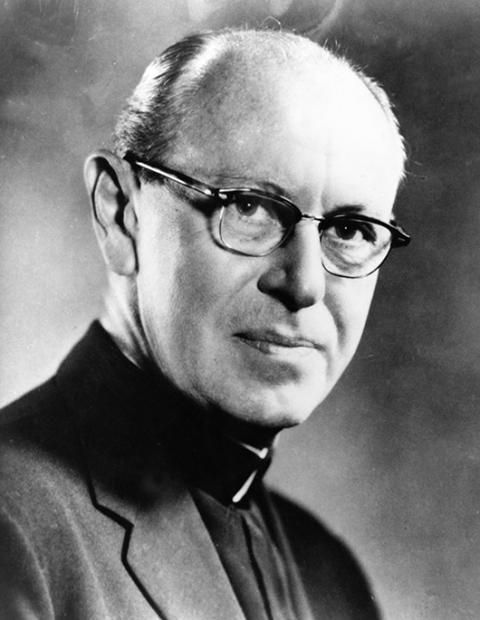
Jesuit Fr. John Courtney Murray is pictured in an undated photo. (CNS files)
In the 1940s, theologian and Jesuit Fr. John Courtney Murray began writing academic articles and books about the relationship between Catholic theology and the state, particularly exploring the so-called "American experiment" of religious freedom (something that Catholic doctrine explicitly rejected at the time). His writings were seen as controversial and he was forbidden from speaking or writing about the subject, that is until he was named a theological peritus ("expert") at the Second Vatican Council and served as a key adviser in the articulation of the church's outright reversal on the doctrine of religious freedom.
Attitudes changed during the time between 1945 and 1965, which led to real changes in doctrine, and those attitudes could only have changed because of the work of theologians like Murray against the headwinds of theological inertia and an antiquated view of Catholic triumphalism that was quietly and inevitably foundering.
As impossible as it may seem for real change to occur that recognizes the full dignity and value of LGBTQ+ people in the church, and as painful as it can be for theologians and pastoral ministers doing this work in the face of rejection and threat, the Holy Spirit will inevitably prevail.
I believe that today we are in a place not unlike the 20 years between 1945 and 1965, that as impossible as it may seem for real change to occur that recognizes the full dignity and value of LGBTQ+ people in the church, and as painful as it can be for theologians and pastoral ministers doing this work in the face of rejection and threat, the Holy Spirit will inevitably prevail.
But the Holy Spirit doesn't act unilaterally in the world; we are called to cooperate with God's grace. We have a lot of work to do. As St. Thomas Aquinas reminds us, God works through secondary causes and that includes through theologians and activists and bishops. The Spirit begins by inspiring the baptized to live their faith fully, to embrace their true selves authentically, to deepen their relationships with one another and God, and to share that truth with others.
In a synodal church, theologians and bishops must hear and recognize the truth witnessed through the diverse lives of the people of God and make sure that the way we understand and express our doctrines about the human person has room to reflect all people adequately and truthfully.