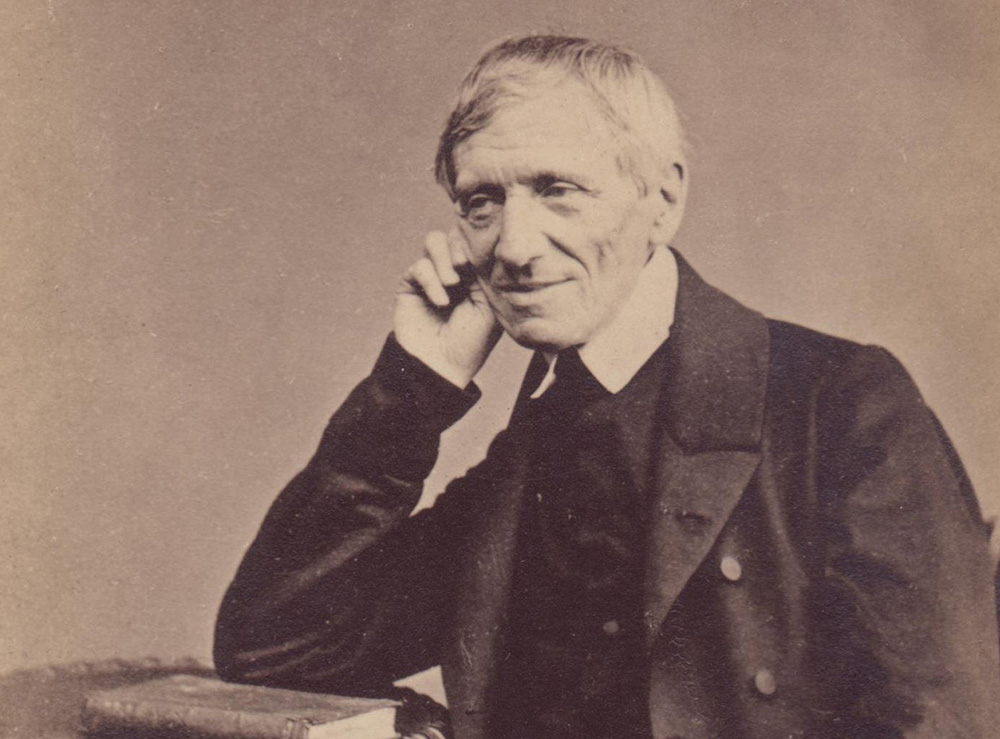
St. John Henry Newman in an undated portrait (OSV News/Courtesy of Fathers of the Birmingham Oratory)

Tomorrow, Nov. 1, Pope Leo XIV will officially proclaim St. John Henry Newman a doctor of the church. The pope's namesake, Leo XIII, created Newman a cardinal in 1879. In 2019 in a Mass at the Vatican, Pope Francis canonized Newman, who had been previously beatified by Pope Benedict XVI in a Mass in 2010 at Cofton Park of Rednal, England, not far from the oratory where Newman lived and where he is buried.
That Mass began with the singing of one of Newman's great hymns, and one of my favorites, "Praise to the Holiest in the Heights," set to the tune "Billing." Newman was not only the greatest prose stylist of his time, and the outstanding theologian of his time, and one of the most compelling preachers of his times, he was a fine poet, and several of his verses have been set to music. Another favorite is "Lead, kindly light, amid the encircling gloom."
Lovely hymns they are, but it is surely the case that the contribution Newman made to the Catholic faith that is most relevant to our own time was his "Essay on the Development of Christian Doctrine." Newman's time was not our own and his Victorian prose can be a challenge to the modern reader. He was careful and precise in his thought. The analogical imagination that is, at some level, the necessary method of doing theology, is a method that needs to be balanced by clarity and rigor.
This passage from "Development" exemplifies these characteristics of his thought perfectly and highlights the essence of his argument, that doctrine must develop because it is the nature for ideas to develop:
The idea which represents an object or supposed object is commensurate with the sum total of its possible aspects, however they may vary in the separate consciousness of individuals; and in proportion to the variety of aspects under which it presents itself to various minds is its force and depth, and the argument for its reality. Ordinarily an idea is not brought home to the intellect as objective except through this variety; like bodily substances, which are not apprehended except under the clothing of their properties and results, and which admit of being walked round, and surveyed on opposite sides, and in different perspectives, and in contrary lights, in evidence of their reality. And, as views of a material object may be taken from points so remote or so opposed, that they seem at first sight incompatible, and especially as their shadows will be disproportionate, or even monstrous, and yet all these anomalies will disappear and all these contrarieties be adjusted, on ascertaining the point of vision or the surface of projection in each case; so also all the aspects of an idea are capable of coalition, and of a resolution into the object to which it belongs; and the primâ facie dissimilitude of its aspects becomes, when explained, an argument for its substantiveness and integrity, and their multiplicity for its originality and power.
Alongside this dense reasoning, we find an accessible analogy that brings the point home: "It is indeed sometimes said that the stream is clearest near the spring. Whatever use may fairly be made of this image, it does not apply to the history of a philosophy or belief, which on the contrary is more equable, and purer, and stronger, when its bed has become deep, and broad, and full."
Advertisement
Two of Newman's insights — that different aspects of an idea "are capable of coalition" and that "whatever be the risk of corruption from intercourse with the world around, such a risk must be encountered if a great idea is duly to be understood, and much more if it is to be fully exhibited. It is elicited and expanded by trial, and battles into perfection and supremacy" — these could make him the patron saint of synodality.
This process of development, Newman held, was no free-for-all. He abhorred what was called religious "liberalism" in his day, the idea that "that all [religious ideas] are to be tolerated, for all are matters of opinion. Revealed religion is not a truth, but a sentiment and a taste; not an objective fact, not miraculous; and it is the right of each individual to make it say just what strikes his fancy." Newman was committed throughout his life to the dogmatic principle that God had revealed himself positively, first to his people Israel, and then in the life, death and resurrection of Jesus Christ and that this revelation is both binding and liberating.
What kept the process of development on track was both a set of "notes" distinguishing true development from its corruption, and ecclesial authority. The notes take up most of the volume; they constitute Newman's theological method. So, for example, his second note is "continuity of principles," noting points of continuity such as this: "The divines of the Church are in every age engaged in regulating themselves by Scripture, appealing to Scripture in proof of their conclusions, and exhorting and teaching in the thoughts and language of Scripture."
His sixth note is that "a true development is that which is conservative of its original, and a corruption is that which tends to its destruction" and, as is the case with each note, he roams across Christianity's greatest thinkers — and greatest enemies — to examine how and why a particular "note" helps distinguish the Catholic faith from its counterfeit.
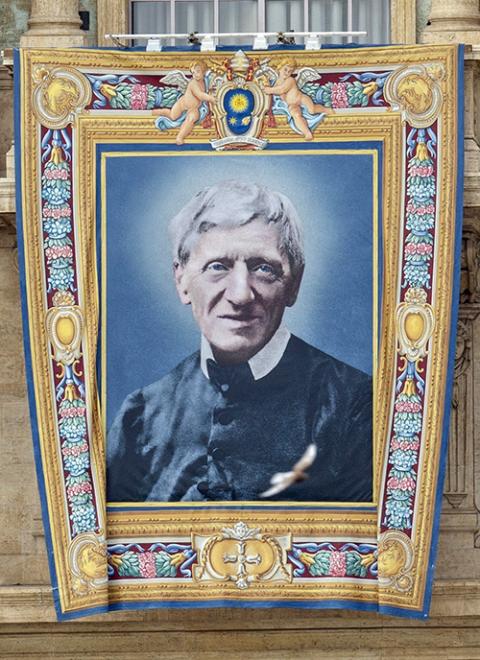
A banner of Blessed John Henry Newman hangs on the facade of St. Peter's Basilica at the Vatican Oct. 10, 2019, ahead of his Oct. 13 canonization that year. (CNS/Junno Arocho Esteves)
As for authority, Newman perceives its need as surely as he sees the need for development, because "an authority is necessary to impart decision to what is vague, and confidence to what is empirical, to ratify the successive steps of so elaborate a process, and to secure the validity of inferences which are to be made the premisses of more remote investigations." He goes so far as to state "a revelation is not given, if there be no authority to decide what it is that is given." The frequent complaint that the bishops of our time have squandered their authority finds no ally in Newman: A bishop or a body of bishops might have squandered their authority in a sociological or political sense, but doctrinal authority from God is not diminished by the failings of those to whom it is entrusted.
It is difficult to overstate the range of Newman's knowledge of Christian doctrine, his sympathy with contrary points of view, his tenacious pursuit of clarity, a living clarity, not a museum piece. That knowledge permits him — and requires him — to explain in detail and with ample examples his arguments and conclusions. Sadly, too much of what passes for Christian theology today is mere assertion, the work of an activist not a scholar, cloaked in the claim to "find" a prophetic voice when it is God's work to decide who will, and will not, be a prophet. Newman was as allergic to fads as he was to falsehoods. He would be horrified at the way some, on both the left and the right, cherry-pick his writings.
Tomorrow, Newman will officially be what he has been for a long time unofficially, a doctor of the church. Theologians and thinkers the world over should turn to his writings again and again to see what their vocation can be at its best, and to refresh our acquaintance with the insights he shares. He is a light for our time, leading kindly to a greater love for the church to which he converted.