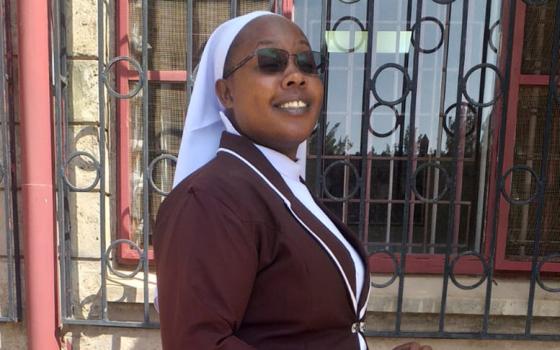
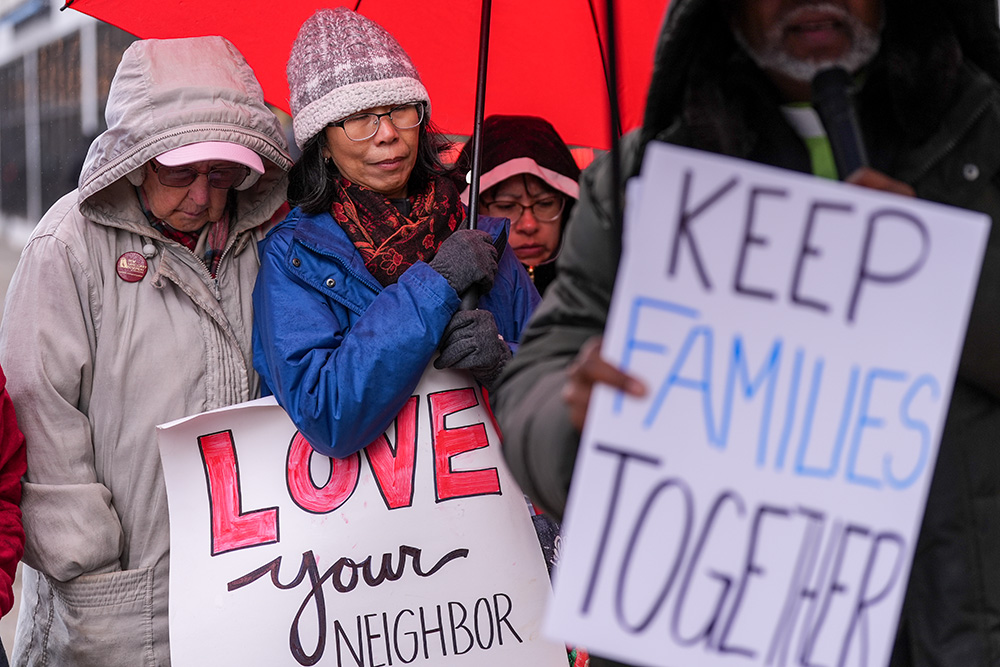
Mercy Sr. May Cronin, left, and Missionary Servant of the Most Blessed Trinity Sr. Christine Ma participate in a prayer vigil near the U.S. Immigration and Customs Enforcement Field Office Nov. 19, 2025, in Philadelphia. (AP/Matt Slocum)

by Daniel P. Horan
This Sunday marks the beginning of the season of Advent and, therefore, a new liturgical year. While this short but significant period in the life of the church can often sneak up on us, especially in the shadow of Thanksgiving and the hustle-and-bustle of "shopping season" and holiday activities, it is a time meant to be taken slowly and contemplatively.
Ideally, Advent is a season that invites us to reflect and renew ourselves, to pause and consider the "already, not yet" of the coming of Christ into the world and into our lives, to wait in joyful hope.
But for far too many people today, this moment in history feels rather hopeless and the opportunity to pause, reflect and renew feels like a luxury too costly to afford. We are living in dehumanizing times marked by attacks on immigrants and refugees, increasing transphobia and anti-LGBTQ+ sentiments, abandonment of the poor and vulnerable, and rising political and cultural polarization that results in the vilification of our neighbors.
In moments like this, I find myself again returning to the source of spiritual wisdom and prophetic truth contained in the late Trappist monk, author and social critic Fr. Thomas Merton's writings about Advent.
His 1965 essay "The Time of the End Is the Time of No Room," from the book Raids on the Unspeakable, opens with an acknowledgement of how chaotic and broken our world can be. The context in which he reflects on the coming of Christ into the world is one of distraction and harried schedules, of division and misunderstanding, of hostility to strangers and those "uninvited" by our communities.
This theme of the uninvited, the outsider, the other, is a meditation on our human siblings who are disdained by the powerful and pushed to the margins of our society: immigrants, refugees, the poor, any minoritized population. Drawing on centuries of biblical wisdom, especially from the Hebrew prophets, Merton reminds us that it is with these peoples that God sides and it is their cries that God hears (Psalm 34).
Advertisement
In fact, it is their place in our broken and dehumanizing world that God deliberately and willfully chooses to enter and occupy, incarnating divine solidarity with the voiceless and forgotten. Playing with the themes of the Christmas story at Bethlehem, Merton recounts that Christ — like the undocumented immigrant or refugee seeking asylum at our country's border — comes unannounced and unwanted. "Into this world, this demented inn, in which there is absolutely no room for Him at all, Christ has come uninvited."
Merton continues his poetic reflection, identifying Christ with those dehumanized and unwanted in our world.
But because He cannot be at home in it, because He is out of place in it, and yet He must be in it, His place is with those others for whom there is no room. His place is with those who do not belong, who are rejected by power because they are regarded as weak, those who are discredited, who are denied the status of persons, tortured, exterminated. With those for whom there is no room, Christ is present in this world. He is mysteriously present in those for whom there seems to be nothing but the world at its worst. For them, there is no escape even in imagination. They cannot identify with the power structure of a crowded humanity which seeks to project itself outward, anywhere, in a centrifugal flight into the void, to get out there where there is no God, no man, no name, no identity, no weight, no self, nothing but the bright, self-directed, perfectly obedient and infinitely expensive machine.
In light of Merton's reflections, the haunting message of Jesus' words in Matthew 25 indicts self-professed Christians today: "Amen, I say to you, whatever you did for one of these least brothers of mine, you did for me" (Matthew 25:40).
Not only is there the absence of charity and love for the least among us, but too often we witness overt hostility, dehumanizing rhetoric, and cruel policies and practices. If the would-be goats in the Matthean parable were condemned for their sins of omission, for failing to bother to love, as the Jesuit ethicist Fr. James Keenan once described sin, then what might God have in store for those who actively terrorize immigrants or persecute our transgender siblings?
May we dedicate ourselves to spending the next four weeks of Advent as a time to renew our faith, recalibrate our perspective, and open wide our hearts.
Like other major liturgical seasons, Advent offers us space to examine our individual and collective consciences, to repent and return to the Gospel, and to strive ever more sincerely to embody the light of Christ who freely entered into our broken and wounded world. As we in the Northern Hemisphere experience an increase in literal darkness during these weeks, we are invited to reflect on Christ's exhortation that we be a light in the metaphorical darkness of our violent and distressing times.
For many people, this is indeed a challenge. For those who are comfortable and secure, who are gainfully employed or hold permanent residency status or citizenship or experience their gender aligning with the sex they were assigned at birth, it can be easy to dwell contended in spaces where the plight of the threatened and vulnerable are ignored.
This is what Merton means when he says that there is "no room" for those with whom Jesus most closely identifies. These neighbors and siblings of ours "are the remnant, the people of no account, who are therefore chosen — the anawim," Merton explains.
As we begin to prepare for the solemnity of the coming of the Lord, may we dedicate ourselves to spending the next four weeks of Advent as a time to renew our faith, recalibrate our perspective, and open wide our hearts. Indeed, this is truly a season of "already, not yet" when Christ is already present to us in the poor and vulnerable, but we have not yet embraced Christ's call to love one another with the radical, self-sacrificing, agapic love of God. There is still time. There is time to change and begin to bother to love.