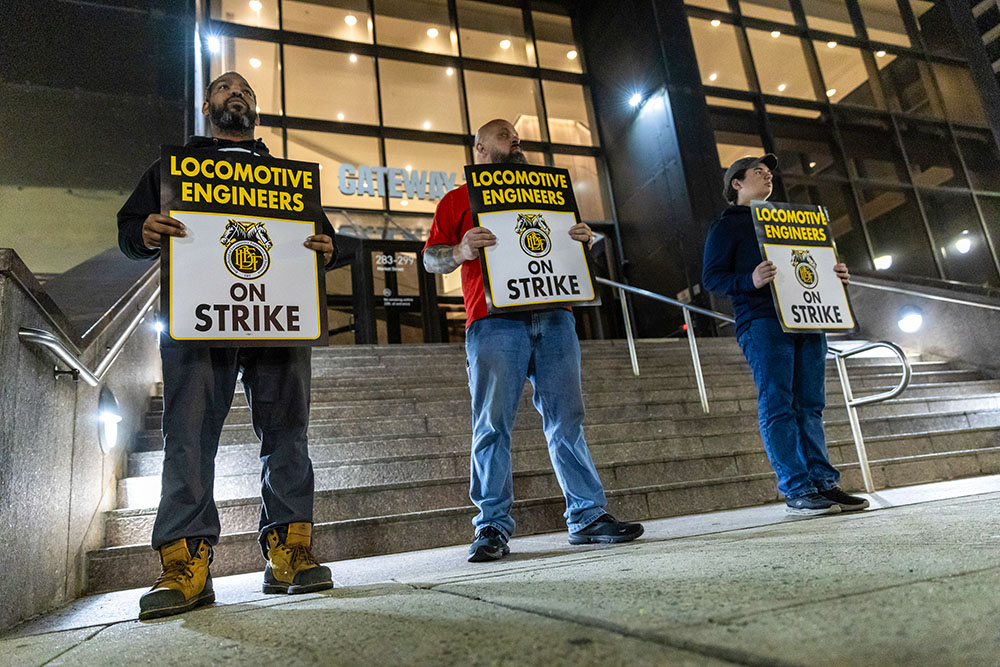
Union members from the Brotherhood of Locomotive Engineers and Trainmen form a picket line outside the NJ Transit headquarters on May 16, 2025 in Newark, New Jersey. (AP/Stefan Jeremiah)

Ten years ago, Cardinal Donald Wuerl spoke about Catholic teaching on solidarity at a conference held at the headquarters of the AFL-CIO on 16th Street in Washington, D.C. The conference was co-sponsored by the AFL-CIO and the Catholic University of America's Institute for Policy Research and Catholic Studies, where I served as a visiting fellow.
Wuerl, then Washington archbishop, recalled leaving the chancery in Pittsburgh one day as a young priest to go to a convenience store. He needed to buy toothpaste. He recalled that he was preoccupied with a letter he had to write when he got back to the office. "All of a sudden, I heard a voice say, 'Father, please,' and I looked up and I was about to walk into a picket line." In southwest Pennsylvania, no decent person ever crossed a picket line. The cardinal went on to say that we needed to consider what should be the picket lines of our own time, the things one never does because they offend against the virtue of solidarity.
As we celebrate Labor Day, what are the picket lines that we in the church should consider recognizing? Where do we start? Both because of our explicit social teaching and for practical reasons, we start with supporting organized labor.
Organized labor is not as strong as it was in the middle of the last century. A June 2023 U.S. government report found that union density had declined to 10.1% of all workers in 2022. More alarmingly, in the private sector, the rate was down to 5.7%. By contrast, the report says, "Following the passage of the NLRA [National Labor Relations Act], union density increased steadily from 12.8% in 1935 to a peak of 34.2% in 1945. Despite some minor annual variations, union density remained above 30.0% every year from 1943 until 1961, when it dropped to 29.2%."
Advertisement
Those years of high union membership also marked the expansion of the American middle class and greater inclusion of, and relative prosperity for, African Americans. "In 1940, the typical black male earned around $4,500 (in 1984 dollars); a similarly employed black male earned almost $19,000 by 1980," said a 1986 Rand study for the Department of Labor. "Between 1940 and 1980, black male wages increased 52 percent faster than white. The typical black male worker in 1940 earned only 43 percent as much as his white counterpart; by 1980, the figure was 73 percent." Of course, there should be no such racial disparity, but there was progress. The involvement of organized labor in the civil rights movement was not accidental but essential.
When organized labor shrinks, the middle class shrinks, and working-class jobs do not provide an adequate livelihood. The decline in union membership also tracked with a decline in manufacturing jobs as factories moved overseas. This was the double whammy — fewer blue-collar jobs and fewer unions able to make sure the jobs paid well — that began the alienation of working-class Americans, whose fortunes were failing, from middle-class and upper-middle-class Americans, who continued to prosper. That polarization led those who shower after work to begin their exodus from the Democratic Party and, eventually, become the base of Donald Trump's Republican Party.
There is no more urgent task for the country, and especially for the Democrats, than to reconnect with working-class Americans, and the best way to do that is with increased efforts to unionize workers. Unions not only guarantee better pay and better working conditions, they help provide the kind of social solidarity without which our nation will continue to be polarized.
Returning to the cardinal's question, what should be the new picket lines of our time?
We don't have to reinvent the wheel here. Do you patronize aggressively anti-union firms? Amazon is one of the most aggressive union-busting firms in the country. Starbucks is another. Do you use them because they are convenient? Is your convenience more important than supporting workers' right to organize? If you style yourself a "social justice Catholic" and you do not avoid union-busting firms, isn't that hypocritical?
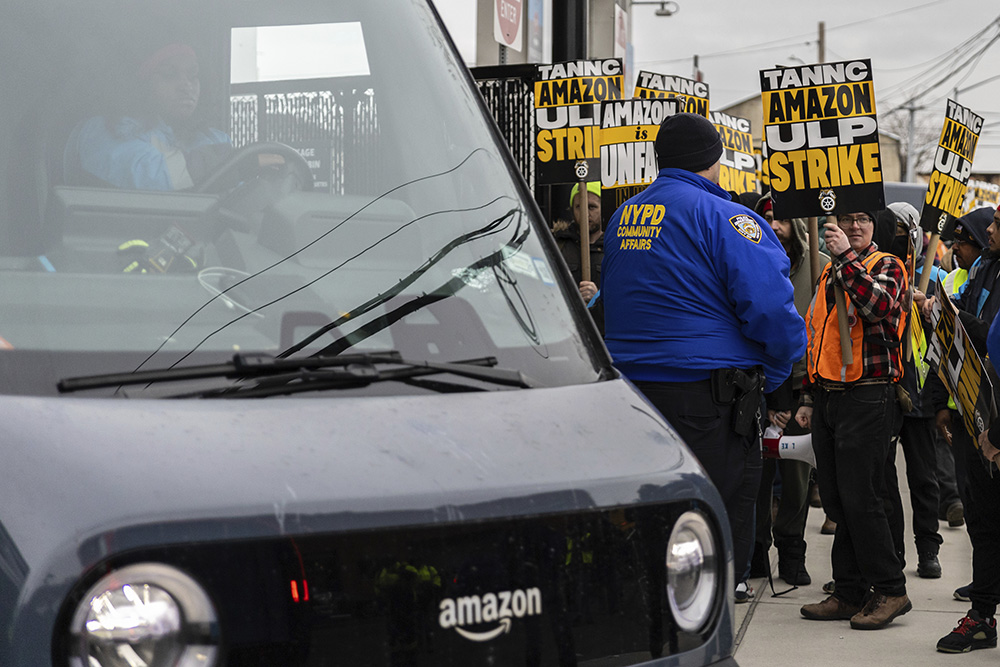
Amazon workers and members of the International Brotherhood of Teamsters picket in front of the Amazon fulfillment center in the Queens borough of New York Dec. 20, 2024. (AP/Stefan Jeremiah)
I live in rural Connecticut and many people in my town rely on Amazon to deliver goods. You have to drive 50 minutes to Hartford or Providence to find brick-and-mortar stores that sell certain items, so I understand how convenient Amazon must be. But I have managed to get by eight years back here without using it once.
I have written previously about Uber and Lyft, both of which have faced massive settlements due to wage theft. How much? In New York state, it's $328 million. That is a lot of stolen wages. Why would you use a company that exploits its workers that way?
As late as the 1992 election, it was axiomatic that if voters went into the voting booth thinking of themselves as workers, they voted for the Democrats. If they thought of themselves as taxpayers, they voted Republican. Now, everyone's primary sense of identification is as a consumer, so it is vital that we let the church's pro-union stance convert our consumer practices.
Church organizations can take the lead, for example, by refusing to use Amazon and refusing to reimburse employees who do use it, except in extraordinary circumstances. We are Catholics, not Puritans. Still, boycotts work only when they are widely honored, like a picket line. Dioceses should have contract labor agreements so that any construction over, say, $250,000, must go to a contractor who employs union labor. The solar panels at the chancery of the Boston Archdiocese were installed with union labor and every electrician in the Boston area knows that and is grateful for it. That is how you build solidarity.
This Labor Day, Catholics should reflect on what they can do to support a revival of organized labor, and confront economic actors who oppose workers' rights. We can look forward to Pope Leo XIV championing the rights of workers like his namesake did. We can put our teaching into action. Let's heed Wuerl's advice and name some new picket lines in our time.