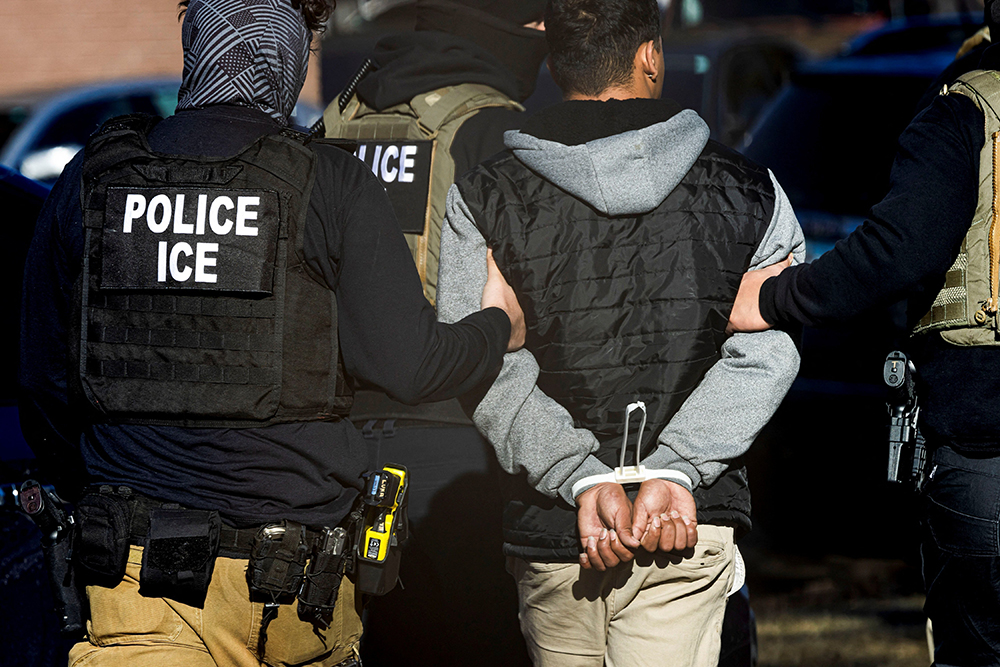
Agents with the Immigration and Customs Enforcement detain a man after conducting a raid at the Cedar Run apartment complex in Denver Feb. 5, 2025. (OSV News/Reuters/Kevin Mohatt)

In recent weeks, you can sense the tide has begun to turn on one of President Donald Trump's signature issues: immigration. I no longer trust polling, but there is plenty of anecdotal evidence to suggest the ground is shifting, from conversations with Trump supporters to the White House's own behavior.
There are three basic reasons for the shift.
The first is not very satisfying. During the campaign, Trump railed against the "open border" and charged that President Joe Biden was responsible. Trump has effectively shut down the border, so his principal complaint lost its currency.
The second reason for a shift in attitudes is the long-standing American dislike of government overreach involving the military. When agents from Immigrations and Customs Enforcement (ICE), with no uniforms and their faces covered, abduct people off the streets, the image strikes a deep, negative chord in the American psyche.
Advertisement
At Politico magazine, Joshua Zeitz recounts the reaction of Northerners to the deployment of federal agents to enforce the Fugitive Slave Act of 1850, and how the issue galvanized support for ending slavery altogether. "In response to the Fugitive Slave Act, many Northern states enacted so-called personal liberty laws, designed to shield free Black residents and accused fugitives from what they saw as unconstitutional federal overreach," he writes.
He recalls an incident in Christiana, Pennsylvania in 1851 when a Maryland slaveholder brought an armed posse to recapture four slaves who had fled to the free state north of the Mason-Dixon line. Fighting broke out and the slaveholder was killed. Zeitz writes:
Federal authorities responded by indicting more than 30 people for treason — the largest such prosecution in U.S. history up to that point — arguing they had levied war against the United States by resisting the fugitive law. … The jury acquitted the first defendant after only 15 minutes of deliberation, reasoning that resistance to one law could hardly constitute treason, and the government dropped all remaining charges.
One data point to confirm this growing reaction against the draconian ICE raids? When Trump ended the deployment of Marines to Los Angeles there was no fanfare, no "Mission Accomplished" banner. Someone in the administration recognized that the deployment had not gone over as planned and downplayed their departure.
The third reason for the decline in support for Trump's immigration policies is the gross injustice of ICE ensnaring those here legally, deporting them, and then the administration pleading that they have no power to compel their return. This is what happened to Kilmar Abrego Garcia, a union worker and family man living in Maryland with his wife and child. Here was not only the face of injustice. Here was a human face on a complex problem.
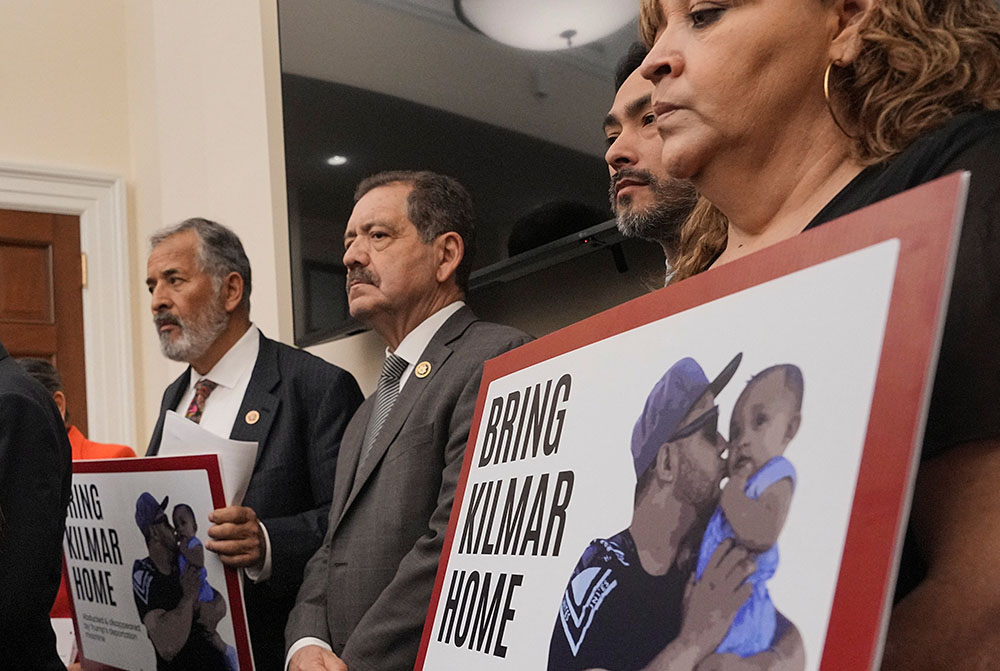
U.S. Rep. Juan Vargas, D-Calif., and U.S. Rep. Jesus "Chuy" Garcia, D-Ill., members of the Congressional Hispanic Caucus, join family members and supporters of Kilmar Armando Abrego Garcia, a Salvadoran migrant who lived in the U.S. with legal protection from deportation until he was erroneously deported to El Salvador, at a press conference in Washington April 9, 2025. (OSV News/Reuters/Ken Cedeno)
After multiple prevarications, the Trump administration finally secured Abrego Garcia's return but charged him with human smuggling so he remains incarcerated. We will see how his trial plays out.
How do we know Abrego Garcia's return shows the turning tide of public opinion? Fox News barely mentions him and the White House's talking heads change the subject when his name comes up. They know deporting someone to a horrible prison — by mistake! — is never a good look. They thought anti-immigrant animus was so strong, it wouldn't object, but they guessed wrong.
Again, there is a historical parallel. After the passage of the Fugitive Slave Act, the thing that really galled Northerners who had not necessarily cared much about the fate of slaves in the South were instances when free Blacks were captured as part of a federal sweep. Sound familiar?
"Voters who, on paper, support the deportation of undocumented persons are beginning to see just what Trump's dragnet looks like, in close and intimate terms," Zeitz writes. "Some are recoiling at the idea that law-abiding people with legal or protected status, even citizens, might be detained by masked, unidentified agents and deported or swept away to brutal prisons in South America or Africa, without the benefit of a trial."
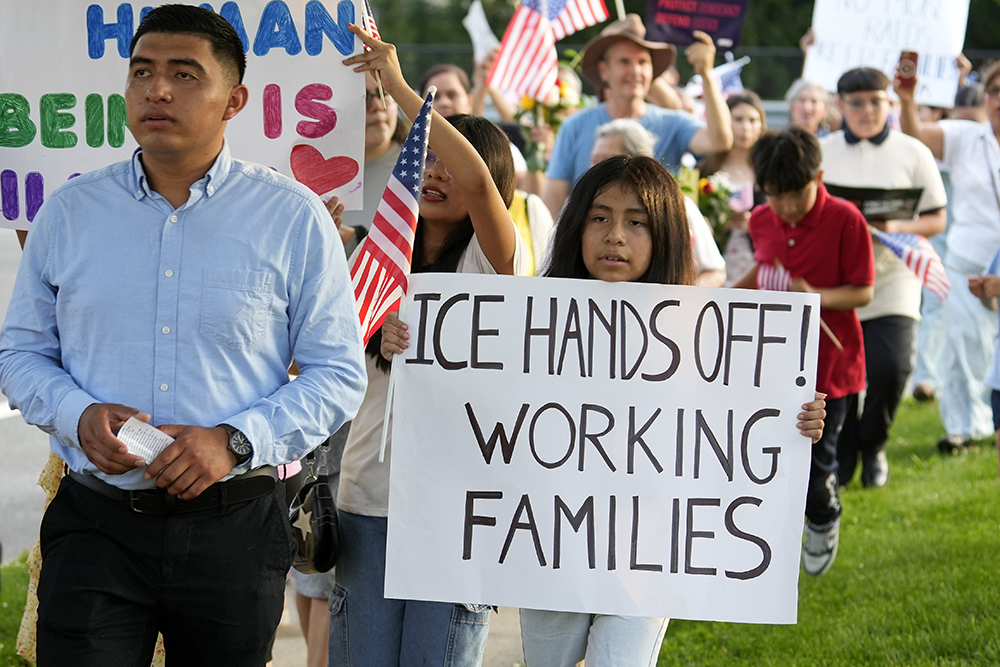
People attend a pro-immigrant march and rally following a Spanish-language Mass at St. John the Evangelist Church in Riverhead, N.Y., June 22, 2025, the feast of the Body and Blood of Christ. (OSV News/Gregory A. Shemitz)
When public attitudes are shifting is the best time to try and shape the future of a debate. Church leaders should find creative ways to change the narrative around immigration and, most especially, around migrants themselves. Accompanying migrants who go for court-ordered appointments but risk being picked up by ICE, as Bishop Michael Pham of San Diego and others have done, should continue. Another idea is to hold Masses at the border fence as Cardinal Sean O'Malley did back in 2014. Both examples send two vital messages: The body of Christ is stronger than any border enforcement or fence and the church stands with migrants no matter what.
Highlighting the constructive role migrants play in the U.S. should be another focus of our messaging. And, at every turn, we need to argue for comprehensive immigration reform.
Trump has not dialed back his pledge to deport 1 million people per year. The "big, beautiful bill" is now law, and it provides billions of additional funding to ICE. Now is the time to make that pledge and that funding look as inhumane as they are. Now is the time to encourage Americans to remember our immigrant roots and celebrate how they have contributed to the fabric of the nation. And the Catholic Church is in a perfect position to move the debate forward, to help the nation listen to the better angels of our nature.