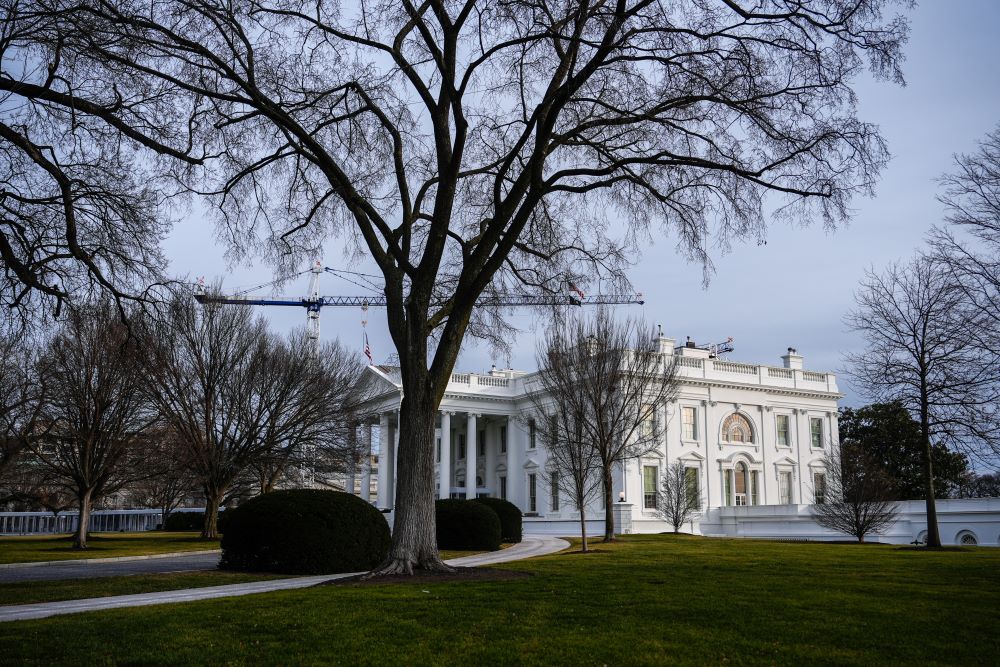
Construction cranes are seen over the White House Jan. 24 in Washington. (AP/Julia Demaree Nikhinson)

"The threat has been neutralized and there is no danger to commercial travel in the region," Transportation Secretary Sean Duffy said Feb. 11, announcing with great relief the reopening of the airspace over El Paso, Texas. That airspace had been closed when the Customs and Border Patrol agency shot down what they thought was a drone used by drug cartels. In fact, they took out some party balloons.
A few days later, the inimitable Paula Poundstone was making a joke about the incident on the NPR comedy show "Wait, Wait … Don't Tell Me." Discussing what people planned for Valentine's Day, Poundstone said, "I was going to give someone special a balloon, but I was in Texas. It got away." The audience roared.
President Trump announced he was appointing his executive assistant, 26-year old Chamberlain Harris, to the U.S. Commission of Fine Arts. Harris may be the best receptionist on the planet, but she apparently falls short of the standard Congress set for board membership when it created the commission: "well-qualified judges of the fine arts." The commission is overseeing, among other things, plans for Trump's gargantuan ballroom.
Last autumn, when Trump demolished the East Wing and revealed plans for the new ballroom, "Saturday Night Live" ran a hilarious skit featuring the Property Brothers. The demolition made headlines for a few days before fading as the news cycle moved on.
Trump is a poseur, and his most essential pose is that he cares about anyone but himself. That is the kind of framing that will help voters understand what Trumpism is really about.
Trump invites mockery. His grandiose self-image combines with his vulgar taste to provide an almost endless number of targets. Comedians should be donating to his campaigns.
The mockery, however, points to something deeper about the current administration: its sheer incompetence. The president's political strategy rests in large part on his ability to "flood the zone," every day giving the media something else to talk about. Even if what the media says is negative, they are still talking about Trump. No president has ever dominated the airwaves as Trump does.
The problem — not the moral problem, but the practical one — with Trump's approach is, as Ezra Klein pointed out in a really brilliant essay earlier this month, is this: "Attention is limited. The media, the opposition, the electorate — they can only focus on so much. Overwhelm their capacity for attention and you overwhelm their capacity to think, organize and oppose. But what you are doing to the opposition you are also doing to yourself." If the Biden administration lost the ability to communicate its political vision, but still had a policy apparatus to affect governance, the Trump administration's policy implementation can't keep up with its own communications strategy.
This disconnect between communications and political reality was on full display in the hours after the murder of Alex Pretti by ICE agents in Minneapolis. Secretary of Homeland Security Kristi Noem said Pretti "attacked" the agents and White House deputy chief of staff Stephen Miller called Pretti "an assassin" who "tried to murder federal agents." Simultaneously, millions of Americans were watching the horrific video that disproved these claims. The talking points did not describe what actually happened.
What the three incidents — the balloons, the ballroom and the murder — demonstrate is not merely the administration's incompetence, although they certainly demonstrate that. They give the lie to the broader narratives that Trump relies on to justify his governance. The administration says ICE is helping to keep America safe from crime, but killing citizens is not keeping them safe. The president says he cares about the working class but is building a ballroom while people are losing their health care subsidies. Poor Sean Duffy wants to ensure the American people that he is protecting the airspace but no sane person feels threatened by party balloons.
Highlighting Trump's incompetence, like regretting the loss of civility, is not enough of a political program for the opposition to Trump. President Joe Biden was competent, but he was unable to deal with inflation. President Barack Obama was competent, but he did nothing for struggling homeowners after the 2008 economic meltdown, even though the banks got bailed out. President Bill Clinton was competent, but he signed NAFTA, off-shoring millions of good-paying manufacturing jobs. All three men conducted themselves with civility in office. Still, the people who look to Trump to restore the American dream that neoliberal economics wrecked can rightly say that competence and civility did not help them very much.
Advertisement
Mockery must be linked to a larger narrative about Trump and Trumpism if it is to be politically salient. The connective tissue of these three incidents is found in the old fairy tale about the emperor with no clothes. Trump and his acolytes want to look like tough guys who care about working-class Americans, but they are poseurs obsessed with their own appearance. Duffy's militaristic phrasing — "the threat has been neutralized" — was meant to demonstrate he was protecting the American people. Alas, we don't need protecting from balloons. Trump cares more about his ballroom than he does about people's rising utility bills and health care costs. ICE isn't making anyone safe and it is inflicting grave, even lethal, harm on people who are harmless.
Trump is a poseur, and his most essential pose is that he cares about anyone but himself. That is the kind of framing that will help voters understand what Trumpism is really about. Mockery can get the ball rolling but the opposition needs to paint a picture that will make future such incidents be understood as indictments.