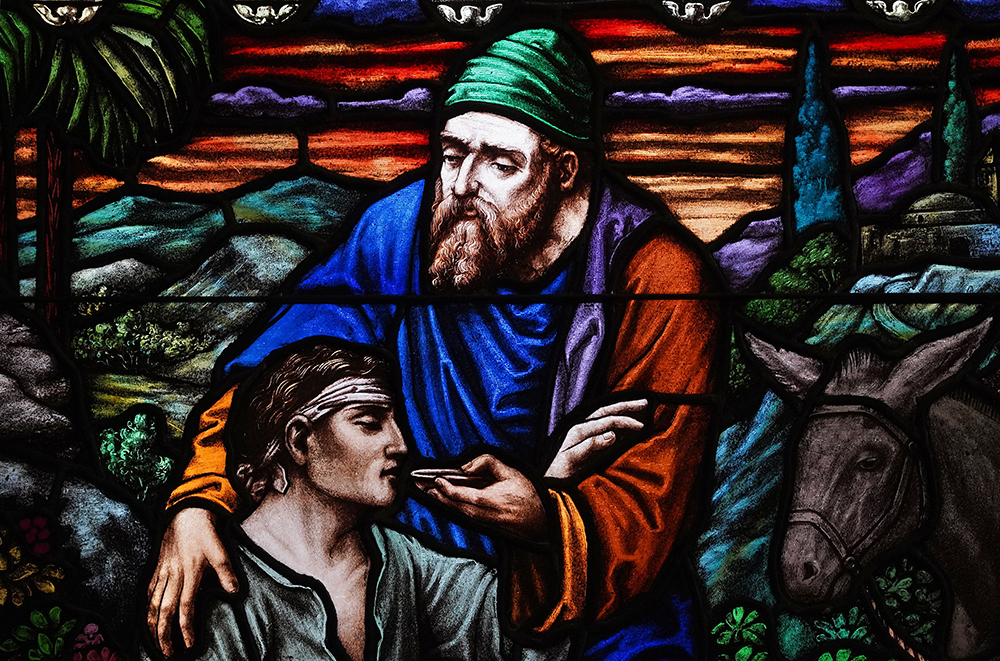
The parable of the good Samaritan is depicted in a stained-glass window at Good Samaritan Hospital Medical Center in West Islip, N.Y. (CNS/Gregory A. Shemitz)

Sebastian Gomes and his team at America Media produced a short (12 minutes) video of March's gathering of bishops, theologians and other church leaders at Fordham University. The gathering focused on Pope Francis' encyclical Fratelli Tutti and explored how the church can help cultivate a politics of communion and compassion. Full disclosure: I am one of the organizers of these annual gatherings.
Gomes' video captures both the discussions about Fratelli Tutti and the unique nature of these annual gatherings. Fratelli Tutti has a lot to unpack but its core insight is that politics must start with human compassion if it is to be genuinely humane.
The video starts with bishops and scholars reading from the parable of the Good Samaritan, which plays such a central role in the encyclical and which elucidates this core insight. The video ends with Jesuit Fr. Mark Massa reading from Paragraph 70 of the encyclical: "Now there are only two kinds of people: those who care for someone who is hurting and those who pass by; those who bend down to help and those who look the other way and hurry off … it is the moment of truth. Will we bend down to touch and heal the wounds of others? Will we bend down and help another to get up?"
We all face such moments of truth and often fail. At least I do. But do we, as individuals and as a church, walk by on the other side when it comes to our political decision-making? How in the current political climate, when one party is indifferent to the unborn and the other is hostile to the undocumented, how do we make political choices?
Advertisement
The focus of the discussions was not abstract or even academic, although academics play a central role on the panels. Like Jesus' parables, the conversations dealt with practical realities.
One of the best panels looked at how our moral theology impacts our understanding of our political obligations and on the formation of conscience. Boston College professor Cathleen Kaveny reprises her presentation by asking on the video, "What does Fratelli Tutti say to theologians and bishops and Catholics in general in the United States about how our obligations to one another, to our brothers and sisters is reflected through our discernment about voting?" Victor Carmona who teaches theology at the University of San Diego, adds, "Fratelli Tutti's turn to experience to ground the discernment of conscience is mostly missing from Faithful Citizenship."
These were the kinds of insights that emerged in the panels and in the dialogues that followed. The goal is not to solve any particular problem, nor to discern a definitive answer to any question. Instead, we dive more deeply into a magisterial text and discuss how it can enrich our understanding of the church's mission and of our particular roles in achieving that mission.
What is most remarkable about Gomes' videos — he also produced a video of our gathering at Boston College focused on synodality and of our meeting at the University of San Diego which took Laudato Si' as its focus — is the way he captures not just some of the highlights of the conversations but the tenor of the gathering itself. They are exercises in synodality, of bringing together people with distinct roles in the church, and allowing them to speak with one another in an atmosphere of trust and inquisitiveness.
Virtually every day, I get emails complaining about "the bishops" and the tone is usually dismissive or even sneering. I also get emails complaining about theologians who chase the latest intellectual fad. There is none of that in these gatherings. There is, instead, a profound respect for each other as fellow laborers in the field. The conversations are lively but never nasty, instructive but never pedantic. At Mass each morning, we celebrate our common identity in the paschal mystery, and that sense of common identity permeates the conversations that follow.
In this video, you hear the Sacred Heart University liturgical choir singing Mozart's "Ave Verum" in the background. When the choir sang it at St. Paul the Apostle Church that morning, we were all moved by the beauty of the young voices and, of course, the beauty of the music itself. Mozart's motet.
The opening words "Ave verum corpus" translate as "Hail, true body" and refer to the Eucharist, which is the body of Christ. The church, too, is the body of Christ, and in the conversations that followed the Mass, we conversed about the responsibilities and challenges of the body of Christ, the church, in this moment of political polarization.
What makes these gatherings so special is that as they unfold, the conversations are not just about the body of Christ, they are conversations by the body of Christ. They are as charitable as they are instructive, as faithful as they are lively, and as hopeful as they are realistic. Faith, hope and charity must always be marks of the church of Christ and, in these gatherings, we experience those virtues profoundly.
And congratulations to Gomes and his team for another home run.