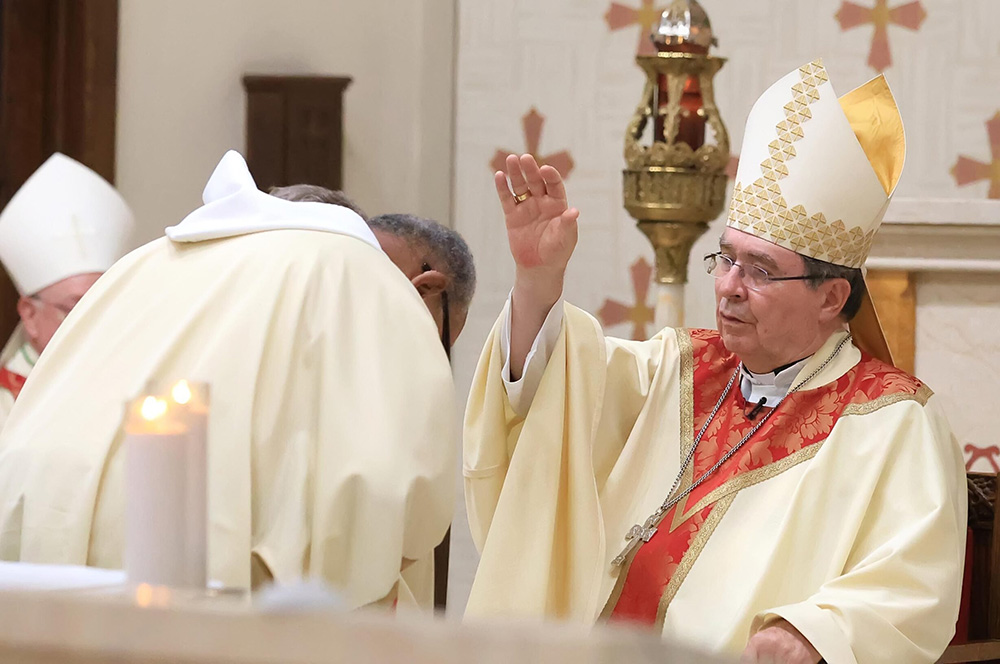
Cardinal Christophe Pierre, papal nuncio to the United States, blesses Deacon Robert Cousar before he reads the Gospel during the Raskob Foundation Family Mass at St. Joseph Church in Wilmington, Del., Sept 20, 2025. (OSV News/The Dialog/Don Blake)

A colleague recently called my attention to a talk given by Cardinal Christophe Pierre, apostolic nuncio to the United States, entitled: "Woke Culture and Post-Liberalism: The Response of the Social Doctrine of the Church." It is well worth reading.
Pierre starts by recognizing that, whatever their differences, both "woke culture" and "post-liberalism" arose from a dissatisfaction with the classical liberal project. He forthrightly — and correctly — summarizes both illiberal tendencies:
The first insists on the centrality of identity and the need for a restorative historical memory but is often subject to relativism and disconnection with reality. The second stresses the importance of the common good (understood as the good of my community), and of the so-called ordo amoris (first me, then my family, and then my country, not worrying much about the fate of the rest of the world), sliding towards authoritarian temptations or towards a fundamentalism that contradicts the legitimate plurality of modern life.
He labels both of these alternatives to liberalism "incomplete and problematic" and proposes, instead, the "more complete vision" found in Catholic social doctrine.
Pierre notes that from Pope Leo XIII's seminal 1891 encyclical Rerum Novarum through Pope Francis' 2020 encyclical Fratelli tutti, the church "has insisted on the inseparability of the dignity of the human person and its social dimension." The church's problem with liberalism was, and is, its false anthropology.
Advertisement
The problem with both woke culture and post-liberalism is that they also suffer from "partial or flawed anthropologies," the cardinal said. "The former emphasizes identity to the point of fracturing universality, and the latter runs the risk of instrumentalizing religion for power purposes. The proposal of the Gospel, on the other hand, developed in the Social Doctrine of the Church, makes it possible to keep together respect for each person, openness to all peoples and the search for a common good that excludes no one."
The nuncio's explanation of the historical and cultural contexts that produced the crisis in liberalism is well done. He cites "excessive confidence in individualism," the "dynamics of globalized capitalism," the tendency of liberalism's neutrality about ultimate questions to create a "kind of moral vacuum." After the turn of the millennium, "disenchantment with politics, polarization, distrust of institutions, the expansion of populist and nationalist movements, and the impact of the digital revolution accelerated the perception that liberalism had lost its ability to integrate societies."
In examining "woke culture," the cardinal acknowledges that although "the root of the phenomenon is legitimate — the defense of the dignity of historically marginalized people and communities — the way in which woke culture has expanded reveals both significant successes and limits." He commends the concept for "raising awareness of historical injustices" and its "empowerment of minorities" as well as expanding the notion of solidarity globally. Pierre also praises the "critical review of history." I would quibble. Critical race, or feminist, theory was always a misnomer because it carried both an ideological agenda and became intertwined with deconstructionist ideas about history that were uncritically accepted and promoted.
In any event, Pierre argues that the social doctrine of the church can mitigate woke culture's problems and excesses: "In the face of the reduction of identity, it proposes universal fraternity; in the face of relativism, the truth of the Gospel; in the face of cancellation, forgiveness and dialogue; in the face of fragmentation, the common good."
"In the face of the reduction of identity, it proposes universal fraternity; in the face of relativism, the truth of the Gospel; in the face of cancellation, forgiveness and dialogue; in the face of fragmentation, the common good."
— Cardinal Christophe Pierre
At no point in his examination of "woke culture" does the nuncio identify any particular writer or thinker. When he turns to his critique of post-liberalism, he names names: University of Notre Dame's Patrick Deneen, Harvard University's Adrian Vermeule and R.R. Reno, editor of First Things magazine. While post-liberalism "is not a single ideology" according to Pierre, its exponents share the conviction that "liberalism has reached the limit of its own logic, producing multiple forms of failure: political, by generating paralyzed and fragmented societies; economic, by increasing inequalities and concentrating wealth in a few hands; moral, by eroding the traditional values that sustained Western civilization."
Here is one example of Pierre's approach: Speaking of post-liberalisms claims to prioritize the common good, he observes "it is not always clear whether it is understood as the set of conditions that allow the flourishing of all, or as an ideological project defined by a dominant group." Bingo.
As in the case of his treatment of woke culture, in discussing post-liberalism, Pierre acknowledges certain sympathies with Catholic social teaching but also some insuperable difficulties. For example, "the Catholic Church cannot endorse a return to models of Christianity that confuse the spiritual and the temporal" as some post-liberals do.
Turning to our Christian anthropology of grace and communion, the cardinal draws out some "practical consequences" of the church's teaching, then concludes, "Christian anthropology offers a criterion of discernment in the face of the reductive anthropologies of liberalism, woke culture and post-liberalism. Only by recognizing the human being as a person, endowed with dignity, relationality and vocation towards communion, is it possible to build a just and humane social order."
The final section of the text is a focused discussion of the concept of the "common good" and the light it sheds on the inadequacies and possibilities of liberalism and of these illiberal alternatives. It is well worth reading.
Pierre will turn 80-years-old in January, so his time as our nuncio is coming to an end. He has become a keen observer of American culture and politics and brings that learning to bear in this extraordinary discernment of not only the U.S.'s problems but points a way forward out of those problems. He is to our time what another Frenchman, Alexis de Tocqueville, was to his: The foreigner who sees what we Americans have trouble seeing for ourselves. He will be missed.