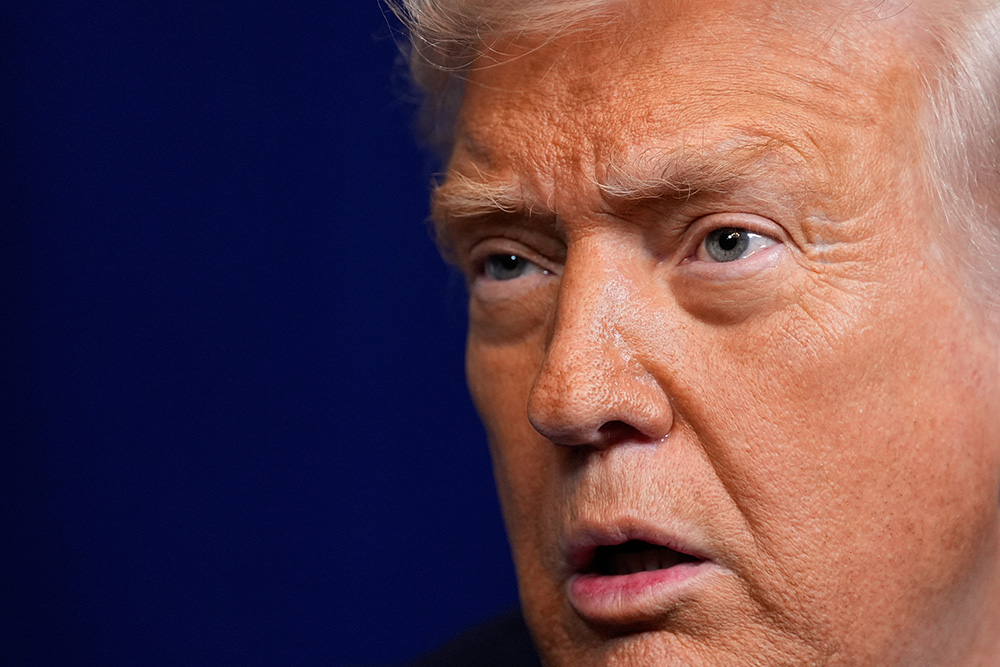
President Donald Trump speaks during a news conference at Mar-a-Lago Dec. 29, 2025, in Palm Beach, Fla. (AP/Alex Brandon)

If the political landscape in 2025 was grim, and it was, the prospects for 2026 do not appear much better. 2025 was the Jubilee Year of Hope and it was filled with bad news. How bad could 2026 be?
The dominant figure in the new year, as in the last decade, will be President Donald Trump. It is shocking how thoroughly he commands the political dialogue. No opposition figure has emerged in the U.S. to challenge his ability to drive a particular narrative and distract from stories that hurt him politically. On the world stage, Chinese leader Xi Jinping wields enormous power, but his job does not require him to dominate the media, so when he challenges Trump, it is with deeds, not words, and Trump still frames Xi's actions for political consumption here in the U.S.
It is difficult to know what issues will animate the second year of Trump's second term. We can expect the immigration crackdowns to continue, without discrimination between criminals and non-criminals, without any sense of due process, without any concern for the human cost to the immigrants themselves or to the communities in which they have lived and to which they have contributed. The issue serves Trump insofar as it permits a stark contrast with the Biden administration and generates enthusiasm among that part of his base that is genuinely nativist. Unless the courts begin reining him in, there is as yet nothing the Democrats can do to stop him.
The courts will remain one of the principal barriers to Trump's acquisition of more and more power, and 2025 ended with a happy note: The U.S. Supreme Court ruled that the president overreached his authority when he deployed the National Guard to Chicago to assist Immigration and Customs Enforcement agents in their raids.
Advertisement
The ruling was a mixed blessing. The majority accepted the argument contained in a brief from Georgetown University law professor Marty Lederman that the statutory requirement for deploying the guards, namely, that "the president is unable with the regular forces to execute the laws of the United States," refers not to local law enforcement as Trump's lawyers argued, but to the U.S. military. The question of deploying the U.S. military to assist ICE was not addressed, although the court said such instances would be "exceptional." Seeing as Trump thinks he is exceptional, we can expect him to push the envelope on using the U.S. military domestically in ways that further divide the country.
Such deployments will not divide the military. The leaders of the nation's military are profoundly committed to the armed forces and its traditions, and they know that efforts to politicize them risk causing divisions within the ranks and friction between the military and the civilian population they serve. They will follow lawful orders, but they will not abandon the Constitution to which they pledged their loyalty.
If the economy continues to falter, Trump and the GOP are facing a shellacking in the midterms. The party that controls the White House usually loses seats in the midterms, and in the House, the margin is so narrow, the GOP can only afford to lose four seats. Their margin in the Senate is more secure: The Democrats would have to win both Maine and North Carolina, as well as a state that Trump won handily in 2024, say, Ohio or Iowa.
If the Democrats regain control of one chamber, and the subpoena power that comes with it, the first and largest question is how the president will react. He has enjoyed the idea that he can govern by executive order. Any president wields enormous power but this president seems always to want more. The problem is psychological. In a wildly different context, in the new book Inversion: Gay Life After the Homosexual, political philosopher Ran Heilbrunn observed, "narcissistic not in the sense of self-centeredness but in the psychoanalytic sense of a tendency to confuse inner and outer reality, to treat the world as if it were nothing but a reflection of oneself." This latter sense of narcissism is precisely the quality Trump displays. And as his power wanes, and all presidents become lame ducks at some point in their second terms, he might react in ways that are even more unhinged than what we have seen this year.
As for the Democrats, that "if" at the start of the last paragraph is larger than it should be. The Democrats seem incapable of uniting behind an agenda that might appeal to a majority of the American people. Indeed, Democrats continue to make rookie mistakes. At a time when they are clamoring for the release of the complete files regarding sexual predator Jeffrey Epstein and also demanding the Pentagon release video of a likely illegal airstrike on survivors of a prior strike, the Democratic National Committee decided it would not release the results of a study about why they lost the 2024 election. Transparency is a good issue for the Democrats, but they have to practice what they preach.
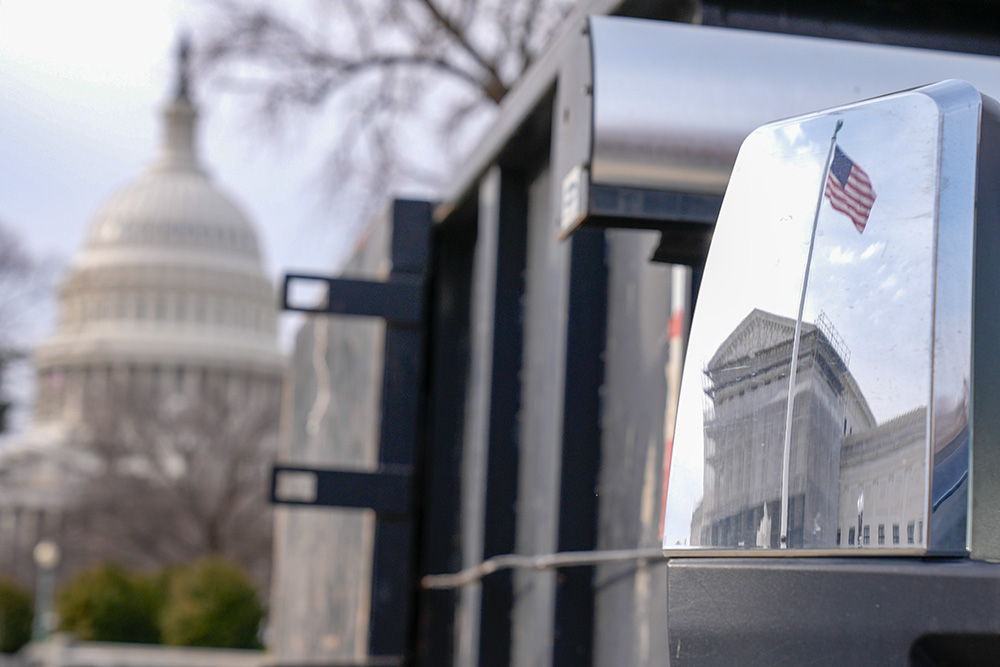
The reflection of the U.S. Supreme Court is seen as the U.S. Capitol, left, is visible Dec. 12, 2025, in Washington. (AP/Mariam Zuhaib)
The worry is that the people who make decisions about elections, the professional class of election "experts," do not want to risk losing campaign cash from either Wall Street or from the party's activist base, which has dragged the party to extremes on cultural issues like abortion, gender issues and race-related policies. The party is now the party of the educated establishment and those are not people prone to questioning themselves. Until the party figures out how to reconnect with working-class voters and their concerns, there is no guarantee it can rise to challenge Trumpism.
Polarization, then, is likely a price both parties are willing to pay rather than question their assumptions. There was one ray of hope at year's end. In Montana, nine GOP state senators balked at their party's hardline stances, and sided with the chamber's 18 Democrats to pass several pieces of bipartisan legislation. If they can do it in Montana, maybe it can happen nationwide.
The more likely scenario is that 2026 will be even more divisive than 2025, culminating with a public rebuke of the president in the midterms that may lead him to even more outrageous actions. There will be no action on the most important issue facing the nation, the growing inequality of wealth and opportunity that puts the Gilded Age to shame. There will be no let up in the draconian attacks on immigrants. There will be no action on climate change, just more and more examples of extreme weather events. Our foreign policy will continue to be more closely aligned with the president's business interests than with the nation's values. The best hope I can muster as I look at the year about to begin is the old adage: It's always darkest before the dawn.