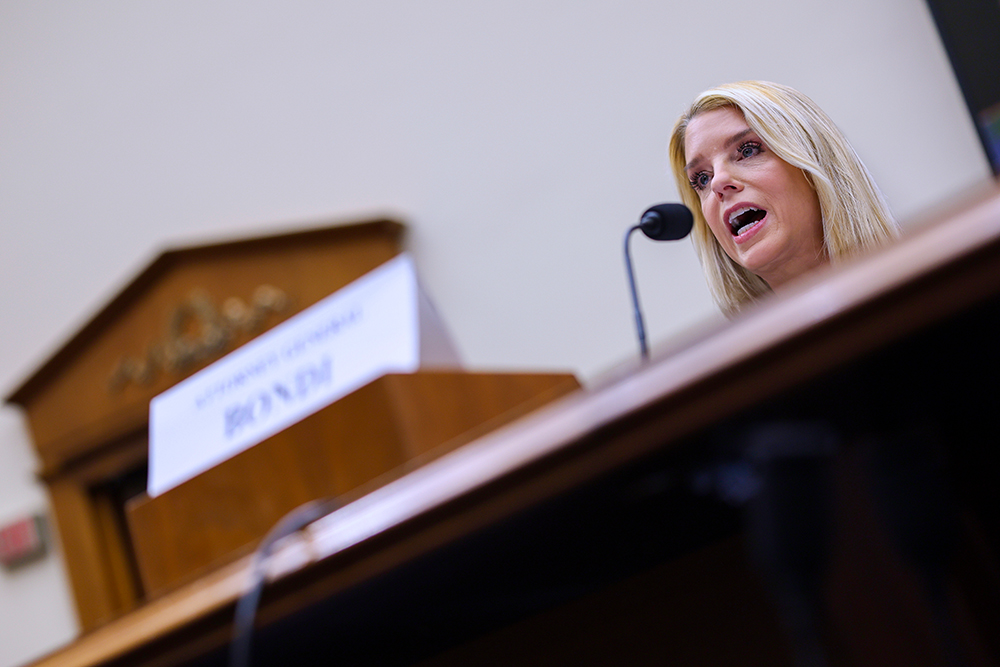
Attorney General Pam Bondi testifies before a House Judiciary Committee oversight hearing on Capitol Hill in Washington, D.C., Feb. 11, 2026. (AP/Tom Brenner)

The professional wrestling match, I mean the House Judiciary Committee hearing with Attorney General Pam Bondi, was a series of nasty verbal insults and partisan attacks that did nothing to advance the cause of justice. It also did nothing to help disaffected Americans think that getting involved with politics would be worth it.
Congressional hearings have grown increasingly fraught over the past few decades. In 1987, Democratic senators grilled Judge Robert Bork, who had been nominated for a seat on the U.S. Supreme Court. Four years later, the Senate Judiciary Committee's hearing on the nomination of Clarence Thomas to the high court got very ugly. Anita Hill had accused Thomas of sexual harassment, which Tomas denied, calling the allegations and subsequent political firestorm "a high-tech lynching." The exchanges among the senators were a foretaste of the increasingly nasty partisanship we have today. Sen. Dianne Feinstein's famous "the dogma lives loudly within you" comment during Amy Coney Barrett's nomination to the federal bench in 2017 was seen by many as crossing a line that was wrong to cross.
These exchanges seem like exercises in civility when compared to Bondi's encounter. Even Sen. Joshua Hawley's heated exchange with University of California at Berkeley Law Professor Khiara Bridges over the professor's repeated use of the phrase "people with a capacity for pregnancy" did not entail shouting. The episode disclosed a different threat to democracy, the reduction of those with differing points of view to a caricature. As Washington Post columnist Megan McArdle commented at the time, the exchange "quickly became a Rorschach test. Many progressives cheered to see Professor Bridges school a reactionary Republican. But conservatives also cheered, because they see a gift to Republican election campaigns."
The demise in civility is not the result of today's lawmakers being reared badly by their parents. Some of it has to do with the rise of technology and the chance members of Congress have to say something that goes viral. Most of it has to do with our democratic sclerosis.
Gerrymandering, as we discussed last week, has resulted in most House districts being tilted to one party or the other, so an incumbent only has to worry about a primary challenge and those always come from the extremes. Highly motivated, often single issue, voters are disproportionately likely to vote in off-year elections, and incumbents need to keep them happy. Viral video clips are perfect for riling up the base.
Advertisement
The Senate is different because you can't gerrymander a state boundary but most states are now decidedly in one party's camp or the other. Only seven swing states actually decide a presidential contest. Senators in deep blue and deep red states confront the same political calculus as House members in safe districts, a calculus that never rewards compromise and moderation.
Another problem is that campaigns for both chambers are entrusted to professional campaign managers who may have no tie to the area represented. For them, burning bridges doesn't matter. The need to pay for campaign ads only increases the influence of special interest extremists and deep-pocketed individuals. The former demand ideological orthodoxy and the latter demand lower taxes, neither of which characterized the postwar period of economic growth and political stability.
These dynamics threatened democracy long before Donald Trump came down that escalator and announced his candidacy in 2015. He is both a consequence and an accelerant of the bitterness that is consuming democracy.
The decisive cause in the creation of Trumpism, however, was not the loss of civility. It was the loss of something different and deeper: Both parties failed to deliver the renewal of the American dream they promised and working-class voters especially felt that the social contract that had governed American politics since FDR's New Deal no longer promised them a better life for their kids if they worked hard and played by the rules.
Important legislation like comprehensive immigration reform has been impossible to enact. Reform of the health care system has been partial, and prices continue to eat into the savings of working-class voters. Worse, politicians of both parties accepted as normative the neoliberal approach to economics. The economy became financialized through Wall Street, good-paying blue-collar jobs were offshored, and changes to the tax code all created the worst income inequality in American history.
The question now is how to save and then repair our democracy? Here I fault the Democrats on the House panel questioning Bondi. Yes, she was evasive if not outright deceitful. Yes, she was rude and demeaning. Still, the old adage applies: "Never wrestle with a pig. You both get dirty and, besides, the pig likes it." The Democrats need to conduct themselves in such a way as to convince disaffected Americans that politics is not a pigsty.
And they need to do more than that. They need to think big. Yes, the loss of health care subsidies is harming millions of Americans, and Democrats were right to fight to retain them. Yes, U.S. Immigration and Customs Enforcement agents are out of control and Democrats are right to demand reforms. Yes, the Trump tax cuts undermine the working-class voters who put Trump in the White House. Each of these policy debates are important. But unless the Democrats embrace a larger vision, these debates amount to rearranging the chairs on the Titanic. The Democrats need to create and campaign on a new social contract for Americans, one that undoes the harm neoliberal economics has wrought on the American people. Whichever aspiring presidential candidate realizes that only such a bold proposal will renew democracy is the candidate for whom the nation is looking.