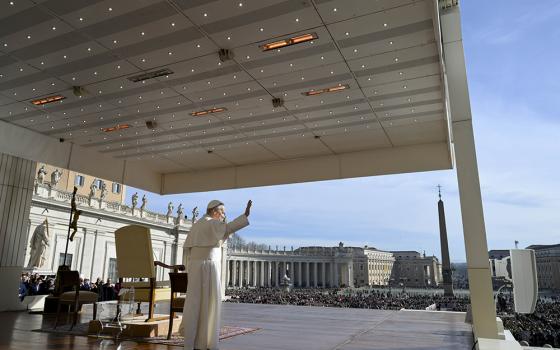
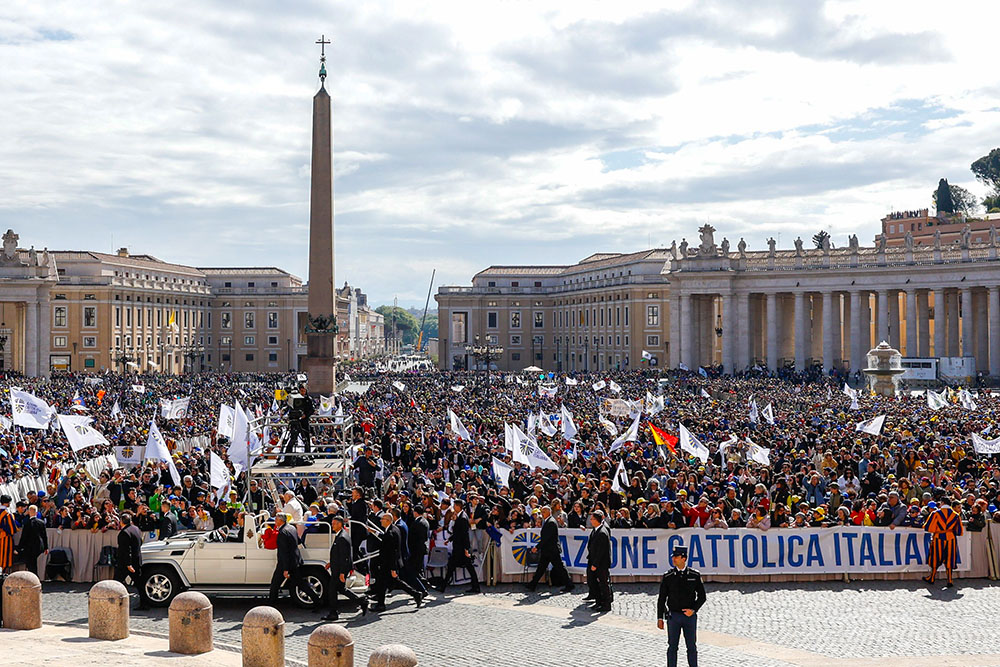
Pope Francis greets people as he rides the popemobile around St. Peter's Square before a meeting with members of Italy's Catholic Action lay association at the Vatican April 25, 2024. (CNS/Lola Gomez)

On Monday, I cited a quote from an important article from 2015 at U.S. Catholic by Paulist Fr. Bruce Nieli. Today, I would like to return to Nieli's article, which was a call to retrieve and renew Catholic Action in our time and examine some of the theoretical issues that could help achieve a revival.
As Nieli notes, the movement started in the late 19th century to combat rampant anti-clericalism, but in the 20th century, it took on a different trajectory. Catholic Action became the effort of Catholic laity, working with the hierarchy and local clergy, to bring Catholic social teaching into the public square. It involved everything from community organizing along the lines of the Back of the Yards Council in Chicago to the Legion of Mary to Cursillo and to the Young Trade Unionists.
Catholic Action, as Nieli wrote, laid some of the groundwork for the emphasis on the role of the laity that emerged at the 1962-65 Second Vatican Council, but there has been "a subsequent lull" since then.
This is counterintuitive. If the council called for increased lay participation, why did Catholic Action not grow?
There are many and complex reasons for the decline. In the first place, widespread prosperity in the postwar era accompanied the reforms of Vatican II. Affluence, not so much as a demographic fact as an attitude, kills faith. In the fourth chapter of the Gospel of Luke, Jesus announces his ministry, saying he has come to "proclaim good news to the poor." When we are no longer poor, when we become acquisitive, when we begin to measure ourselves by the size of our bank accounts and the quality of our wardrobe, faith loses its central claim on our hearts and its central place in our culture.
Advertisement
Vatican II also put a great emphasis on ecumenism and interreligious dialogue, which was especially important to those of us who live in a pluralistic society. Gone were the days when Catholic clergy were forbidden from participating in civic rituals alongside Protestant and other clergy.
Many efforts at social justice became less distinctly Catholic and more ecumenical in character. Too often, this resulted in their being disconnected from the animating beliefs of our faith. Because there are doctrinal disagreements with non-Catholics, we left the dogma at the door. A common, shared ethic was enough, or so it seemed, but Catholic ethics, be they social ethics or sexual ethics, cannot be divorced from their rootedness in our dogmatic claims.
Besides, bringing our dogmatic beliefs with us need not result in any poisoning of ecumenical dialogue. You only have to spend five minutes with a smart rabbi to understand that Jewish understanding of law is far more vital and expansive than our Catholic experience and understanding of law.
There are three specific dogmatic claims that are especially animating to any effort to renew Catholic Action, and they are intimately related.
The first is our belief that humankind, created in the image and likeness of God, possesses a transcendent dignity that can never be violated. When we bring our concern for the poor and the migrant into the public square, it must be grounded in this belief. Otherwise, it is reduced to an interest, a perspective, an opinion. Concern for the migrant becomes divorced from concern for the unborn and our witness becomes compromised, hypocritical.
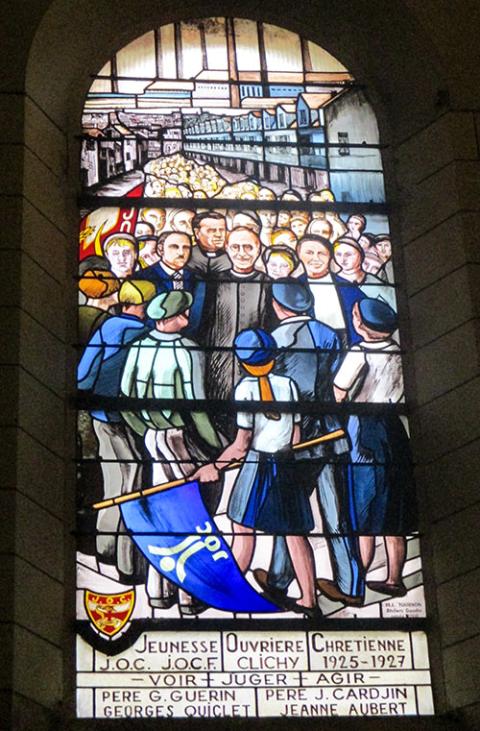
A stained glass window in Saint-Vincent-de-Paul de Clichy Church in France honors the Young Christian Workers, founded as the Young Trade Unionists in the early 20th century. (Wikimedia Commons/Thomon)
We cannot make headway against that more volitional morality that insists a person is free to do whatever he or she wants to do — with their wallet, with their body, with their political choices. No. Catholics believe our choices must cohere with a moral order that is built into creation because the whole of creation was created in Christ.
"The truth is that only in the mystery of the incarnate Word does the mystery of man take on light," we are taught in Gaudium et Spes. In short, without this belief in the transcendent dignity of the human person, we can imagine ourselves to be gods, not creatures, and men who think they are gods are the most dangerous of things.
The second dogmatic belief is that we are created in the image of a triune God and, just so, our individual selves can only be understood in relation to other selves. When we confess our belief in the Holy Trinity, we assert that at the heart of all reality, at the very foundation of the world, is not an atomistic individual, not an abstract first mover, but a relationship defined by love.
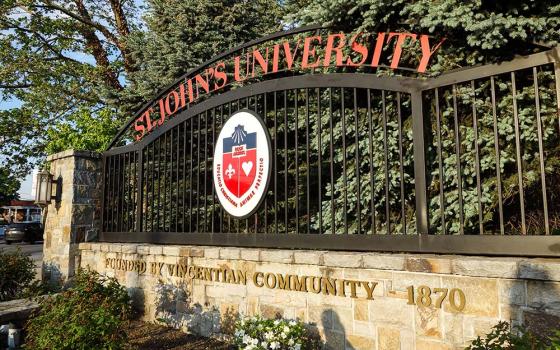
To be created in the image of that triune God is to be created in, by and for relationships with one another. There is no hyper-individualism in the Trinity and, just so, any hyper-individualism in ourselves is a consequence of sin. The church will be forever indebted to Professor Meghan Clark of St. John's University for her wonderful book The Vision of Catholic Social Thought: The Virtue of Solidarity and the Praxis of Human Rights, which drew out this connection between Catholic social thought and the Trinity. I reviewed the book here.
The third dogmatic belief on which we build our social commitment is the communion of the saints. Through our baptism, we belong to one another in Christ. One of the great achievements of Vatican II was to refocus the prayer life of Catholic Christians on the Eucharist. Regrettably, and unintentionally, we too often left popular piety behind.
Much of that popular piety was rooted in devotion to particular saints and it served as the buttresses of our shared belief. Workers had particular devotions: St. Barbara is the patroness of miners and St. Florian is the patron of firefighters and St. Lawrence is the patron saint of cooks.
If Catholic Action is to be reborn, it will be from this faith. At a practical level, our commitment to the transcendent dignity of all human persons will provide clear coherence to our political positions, coherence that defies and upends current political orthodoxies. Our commitment to the belief that we are created in the image of a triune God is the ground from which true community can be born. And rekindling devotion to particular saints can help make these dogmatic commitments vibrant.
On Friday, we will look at some additional, and less theoretical, ways we can help rebuild the spirit of Catholic Action. The starting point, however, must be our faith itself and all that our faith has to teach us.