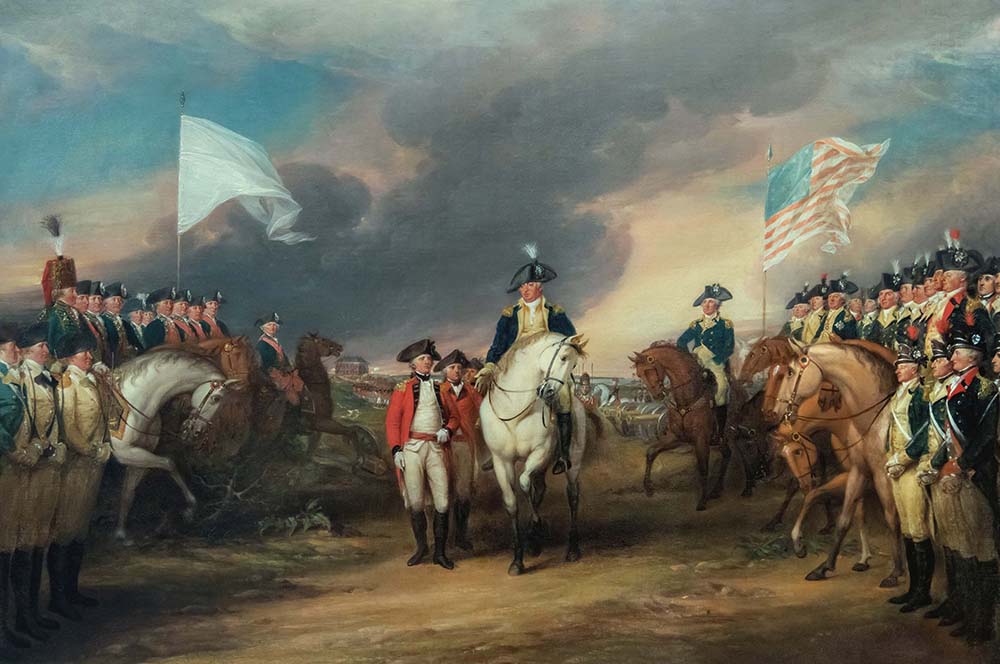
"The Surrender of Lord Cornwallis at Yorktown, October 19, 1781," a painting by John Trumbull, ca. 1787-1828. (IanDagnall Computing/Alamy Stock Photo/PBS)

Yesterday, in my newsletter, I wrote about Ken Burns' documentary "The American Revolution" and the many, many things the program did exceedingly well. (If you are not signed up to get my newsletter, it is free and you can sign up here.) The only glaring omission was a lack of attention to religion and the role it played in shaping different outlooks among the colonists from those of the mother country.
At the very beginning of the 12-hour documentary, when discussing the start of the Seven Years' War, there is a brief mention that "Protestant Britain" was fighting "Catholic France." But there was no explanation why the difference in religion had political significance or consequences.
In fact, English, and later British, politics had long been profoundly shaped by religion in both the mother country and its colonies. New England had been settled by Puritans who found the Romanizing tendencies of King Charles I too much to bear. The Roundheads who executed Charles I in 1649 and eliminated the monarchy were the religious and ideological cousins of the New England establishment.
When the monarchy was reestablished in 1660, the executed king's son, Charles II, took the throne but he left the colonial charters granting extensive self-rule alone. As he aged without offspring, his brother James, Duke of York, became the heir apparent but James was a Catholic. The labels "Whig" and "Tory" came originally from the Exclusion Crisis which sought to exclude James from the throne because of his Catholicism. The prospect of a Catholic king filled many Protestants on both sides of the Atlantic with dread. Once James became king and started appointing Catholics to prominent posts, he was overthrown in the Glorious Revolution of 1688, which had its corollary in New England where the royal governor Sir Edmund Andros was ejected and the colonies' right to select their own governors restored.
Advertisement
When Scotland was joined with England by the Act of Union in 1707, Protestantism and parliament were seen as key parts of the essential glue uniting the previously distinct nations, and distinguishing Britons from France, with whom Britain was at war. Britons were free from "priestcraft" and "arbitrary government" unlike the French who were subjected to both. Among the various pieces of propaganda from that age that is still with us is the patriotic song "Rule, Brittania" with its rousing chorus: "Rule Brittania, Britannia rule the waves; and Britons never, never, never shall be slaves." White Britons and Americans were not afraid they would wake up in the morning as enslaved Africans working on plantations in South Carolina or Jamaica. For them "slavery" meant being subjected to priestcraft and arbitrary government.
A series of pamphlets in the late colonial era shaped the attitudes of the generation that would lead the revolution. One of the principal themes, drawn from what was termed the "Country Whig" politics of Britain, was the idea that the British government was aiming to reduce the colonies to slavery. In its treatment of the lead up to the revolution, the documentary did not mention this ideological backdrop, nor did it discuss the controversial suggestion that an Anglican bishop be appointed for the American colonies, a move that was opposed as too papist. Nor was there mention of the Anglican Society for the Propagation of the Gospel in Foreign Parts which caused deep resentment when it established an office next to the Puritan seminary at Harvard University. These were not major sources of the revolt when compared with, say, the Stamp Act, but they kept the fire of whiggish sensitivities alive, conflating religious and political beliefs.
The documentary did mention the Quebec Act of 1774, which granted some civil rights to Catholics in the formerly French province and the anger and fear this produced among the Protestants in the 13 colonies. It did not mention the First Continental Congress' response, its "Address to the People of Great Britain" which stated, "That we think the Legislature of Great-Britain is not authorized by the constitution to establish a religion, fraught with sanguinary and impious tenets, or, to erect an arbitrary form of government, in any quarter of the globe." That sanguinary, impious religion was Catholicism. The address warned that Catholic immigrants to Canada would "be fit instruments in the hands of power, to reduce the ancient free Protestant Colonies to the same state of slavery with themselves." It asserted Catholicism "has deluged your island in blood, and dispersed impiety, bigotry, persecution, murder and rebellion through every part of the world." This document was passed by Congress less than eight months before fighting broke out at Lexington and Concord. It was not discussed in the documentary.
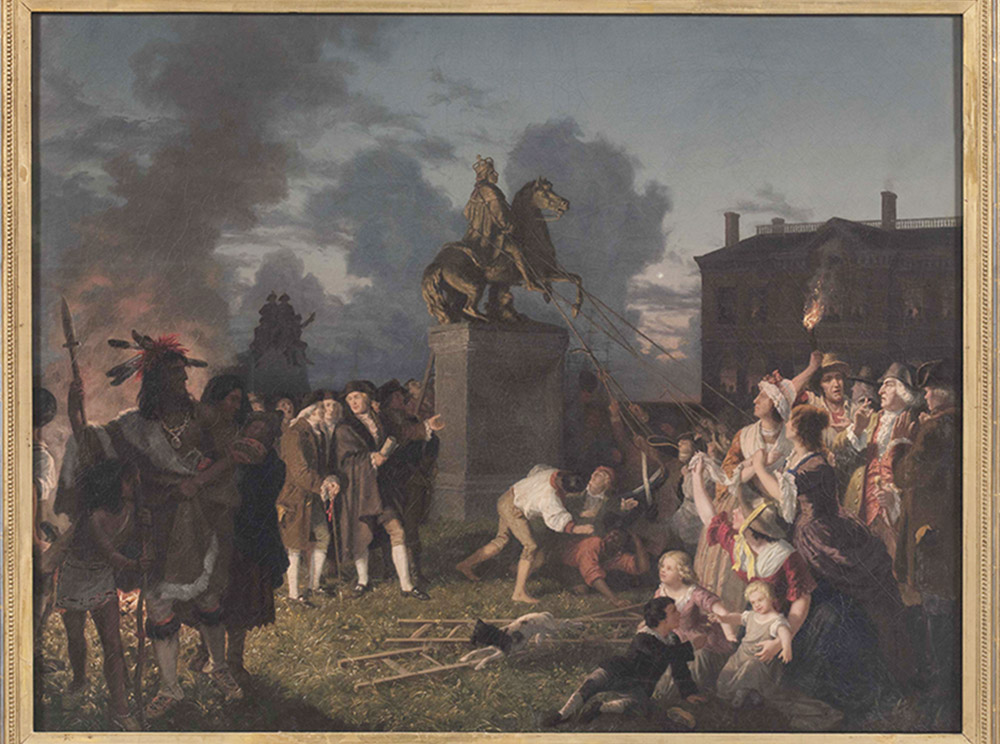
"Pulling down the statue of King George III, New York City," painting by Johannes Adam Simon Oertel, ca. 1852-1853. (The New York Historical/PBS)
Back in 2014, I published a weeklong historiographical look at books which, in part, examined the ways anti-Catholicism was in the political air the American colonists breathed and which shaped their increasing hostility to British rule. Linda Colley's Britons: Forging the Nation 1707-1837 considered the ways anti-Catholicism was deployed to overcome differences between the Scots and the English, fashioning British identity. Bernard Bailyn's seminal work, The Ideological Origins of the American Revolution, argued that country whig ideas united the various ideological currents of the time, and created a narrative that was especially potent in New England's colonies. Bailyn was in Burns' documentary but did not discuss religion. Patricia Bonomi's Under the Cope of Heaven: Religion, Society, and Politics in Colonial America examined the ways religious belief and practice stoked the fires of the American Revolution. And, Robert Emmett Curran's Papist Devils: Catholic in British America, 1574-1783, looked at the ways anti-Catholic prejudices were fed by, among other things, the French and Indian War and the British parliament's passage of the Quebec Act.
Once the Revolution began, and the few Catholics in Maryland and Pennsylvania rallied to the patriot cause, anti-Catholicism became largely dormant until the 19th century. Anti-Catholicism was not a central force driving the colonists to revolt, but it played a role, shaping their political beliefs in profound ways. Even enlightenment figures like Thomas Jefferson were deeply prejudiced against Catholicism: There simply were not enough Catholics in the early United States to sustain any substantive fear of their influence.
When waves of Catholic immigrants arrived at our shores in the 1800s, that prejudice came to the surface again, still shaping political ideas, still suspicious of Catholics' ability to be loyal to both the Constitution and the pope. Not until President John F. Kennedy's election can we say that anti-Catholicism ceased to be a political factor. During the revolutionary era, it still was, and my one complaint about Burns' documentary was that he did not pay enough attention to it.