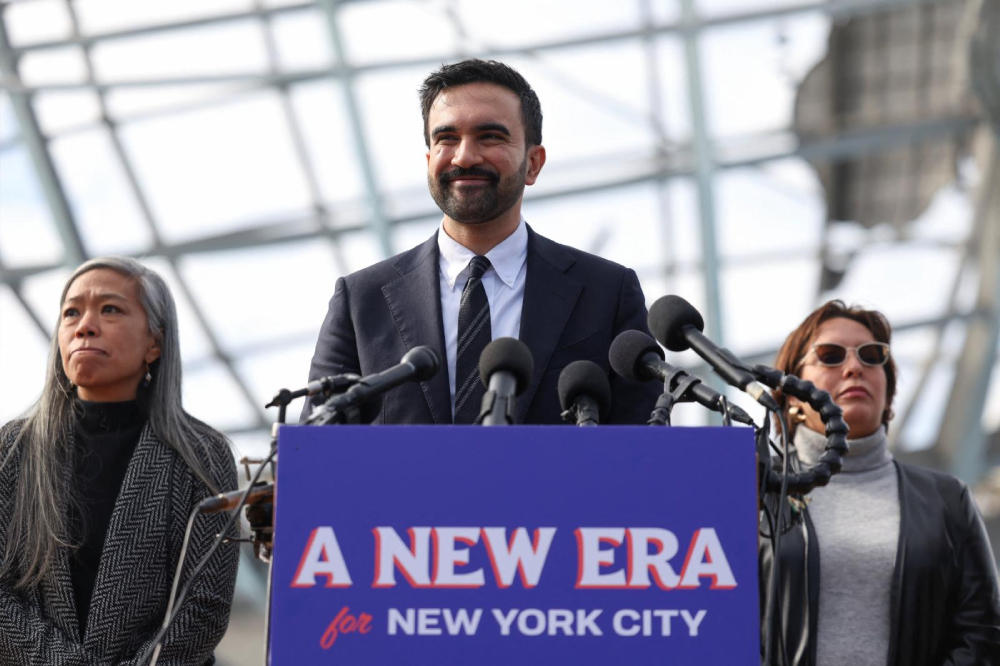
New York City Mayor-elect Zohran Mamdani speaks during a news conference at the Unisphere in the Queens borough of New York City Nov. 5, 2025. (OSV News/Reuters/Kylie Cooper)

The repercussions from Tuesday's off-year elections are still being felt. The challenges each political party faces after the results are quite different, but the Democrats have the stronger hand.
President Donald Trump was entirely predictable. As I wrote late Tuesday night, "The president will, as is his wont, vacillate between denial and blaming others for the losses." He did not disappoint.
In fact, Trump said the worst possible thing he could say from a strategic point of view. "They say that I wasn't on the ballot and was the biggest factor," he said Wednesday morning at a breakfast with Senate Republicans. "I don't know about that. But I was honored that they said that."
Trump also will not be on the ballot next year when one-third of the Senate and all 435 members of the House of Representatives will face the electorate, which is why highlighting the significance of his not being on the ballot Tuesday was so stupid. GOP congressional leaders now know that Trump's coattails did not protect GOP candidates, that the voters he mobilized in 2024 did not show up on Tuesday. The swing voters who picked Trump last year as the candidate of change picked Democrats this year as their change agents.
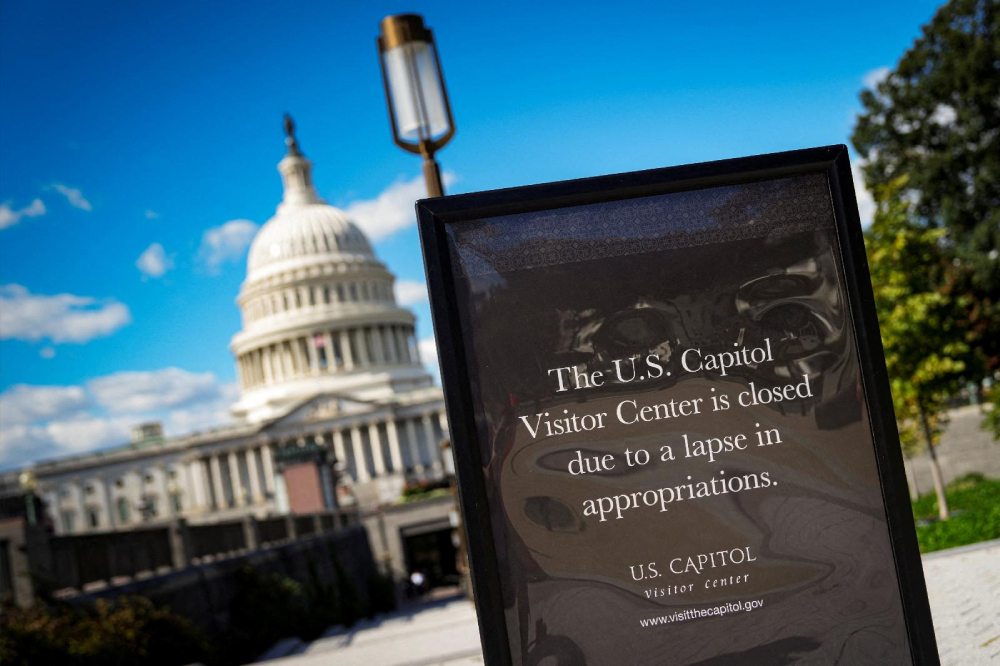
A sign indicating that the U.S. Capitol is closed for tours is seen Oct. 20, 2025, weeks into the continuing U.S. government shutdown in Washington. (OSV News/Reuters/Al Drago)
Is there an immediate consequence for congressional Republicans? Wednesday morning they were looking to find a compromise to end the government shutdown and ignoring Trump's call to end the filibuster in the Senate. A bipartisan proposal from four members of the House touches all the key points that have so far created the stalemate. It will be a surprise if the shutdown does not end before Thanksgiving.
Trump now will have less and less influence with congressional Republicans, especially once the deadlines to file primary challenges are reached early in 2026. He may still have enough political capital to take down a Republican opponent in a primary, but otherwise he looks like a lame duck. N.B. If the economy turns around, the duck becomes a lot less lame.
For Democrats, the challenge is different and more ideological. NYC's mayor-elect, Zohran Mamdani, ran unapologetically as a democratic socialist who wanted to move the Democratic Party sharply to the left. When Mamdani took to the stage Tuesday night, he did not use his speech to reach out to those who had voted for his opponents: "I wish Andrew Cuomo only the best in private life. But let tonight be the final time I utter his name, as we turn the page on a politics that abandons the many and answers only to the few."
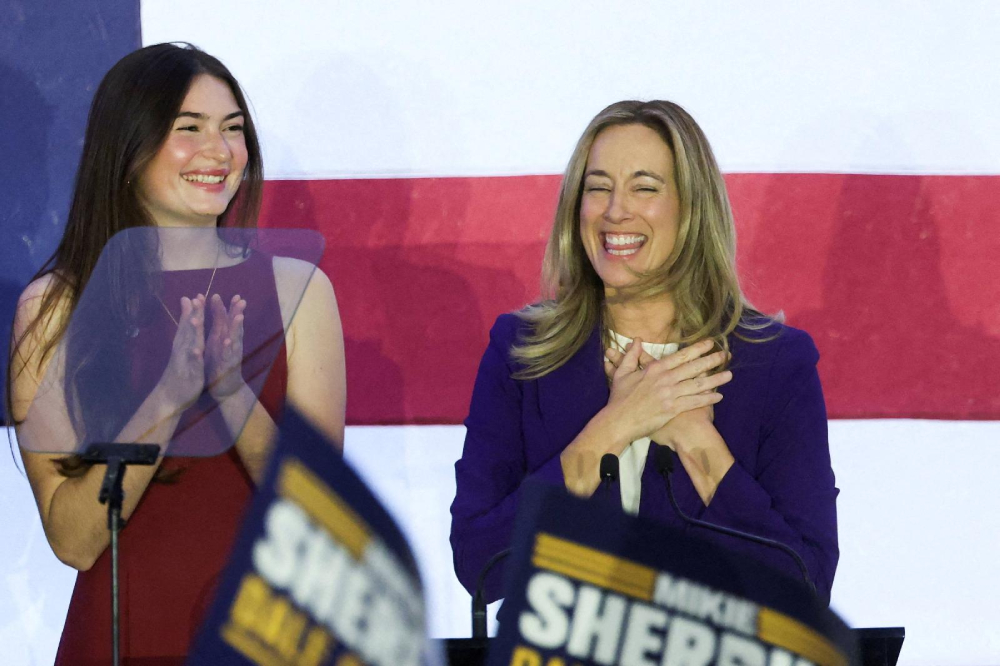
Democratic Rep. Mikie Sherrill, gubernatorial candidate for New Jersey, reacts on stage at her election night rally in East Brunswick, N.J., Nov. 4, 2025, after U.S. media projected her the winner. Now governor-elect, Sherrill received 56.2% of the vote to Republican Jack Ciattarelli's 43.2%. Ciattarelli, a former member of the state Assembly, was making his third try for governor. (OSV News/Reuters/Mike Segar)
And Mamdani did not exactly seek to lower expectations, saying: "Years from now, may our only regret be that this day took so long to come. This new age will be one of relentless improvement" and "we will prove that there is no problem too large for government to solve and no concern too small for it to care about." His enthusiasm was understandable given the improbable campaign he had run and won. But he shouldn't promise the moon and the stars.
Conversely, the two successful gubernatorial candidates, Governor-elect Mikie Sherrill in New Jersey and Governor-elect Abigail Spanberger ran and won as moderates. In Virginia, House Speaker Don Scott "vowed to keep disciplined focus on voter concerns about the high cost of living, education and public safety — but offered no specific plans for doing so" according to the Washington Post. "The word of the day is restraint. We can't overreach," Scott said. "We have to be wise with the gift that the voters have given us to govern." The tone could not be more different from that emanating from Mamdani HQ.
These different sensibilities will make themselves manifest, but it is a good problem to have when all a party's candidates, the moderates and firebrands, found a way to win. What worked in New York City might have bombed in Virginia. This has always been the case. New York's greatest progressive politician, Franklin Delano Roosevelt, relied on the votes of conservative, Southern senators, to enact the New Deal. So long as the party stays united in its pursuit of economic policies that address the challenges working people face, the party can tolerate some ideological diversity.
Advertisement
Democrats cleaned up elsewhere. Democrats in Georgia took two seats on that state's public utility board from the GOP. In Pennsylvania, they held off Trump's efforts to replace three members of the state Supreme Court. In Mississippi, they ended the supermajority Republicans held in the legislature.
In Marlborough: His Life and Times, Winston Churchill observed:
Battles are the principal milestones of secular history. Modern opinion resents this uninspiring truth, and historians often treat the decisions of the field as incidents in the dramas of politics and diplomacy. But great battles, won or lost, change the entire course of events, create new standards of values, new moods, new atmospheres, in armies and in nations, to which all must conform.
Elections are the principal milestones of politics, and Tuesday's results have indeed created "new standards of values, new moods, new atmospheres … to which all must conform."