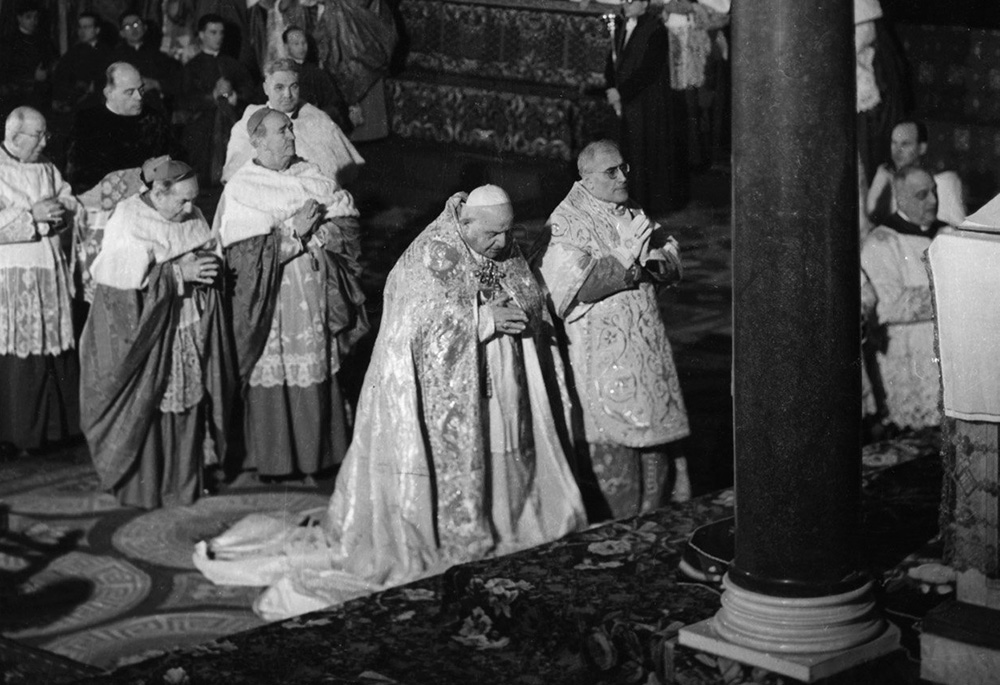
Pope John XXIII prays in the Basilica of St. Paul Outside the Walls Jan. 25, 1959, just before announcing his plans to convoke the Second Vatican Council. The pope cited a need to update the church and promote Christian unity. (CNS file photo)

The Order of Christian Initiation of Adults is in full swing at parishes across the world. The restoration of the adult catechumenate is a fruit of the Second Vatican Council and one priest friend asked if I could recommend a short article that he could share with his OCIA class about what led up to the calling of Vatican II. I couldn't think of one, so I wrote it, and share it today in case other pastors and OCIA leaders find it helpful.
Vatican II did not drop out of the sky. There were three essential precursors to St. John XXIII's decision in 1959 to announce he was calling an ecumenical council: The first was spiritual and theological; the second was pastoral and existential and the third was personal and historical.
The French Revolution and the Napoleonic conquests were a disaster for the church. Thousands of priests were killed. Pope Pius VI died in custody and his successor spent several years under house arrest outside Paris. The religious orders were disbanded through much of Europe and its empires beyond. The intellectual currents of the Enlightenment were anticlerical and often anti-religious: Écrasez l'infâme — crush the infamy — was Voltaire's approach to religion and it was widely shared by the leading thinkers of the time. When Pope Pius VII returned to the Vatican in 1814 after the fall of Napoleon, the church was a wreck.
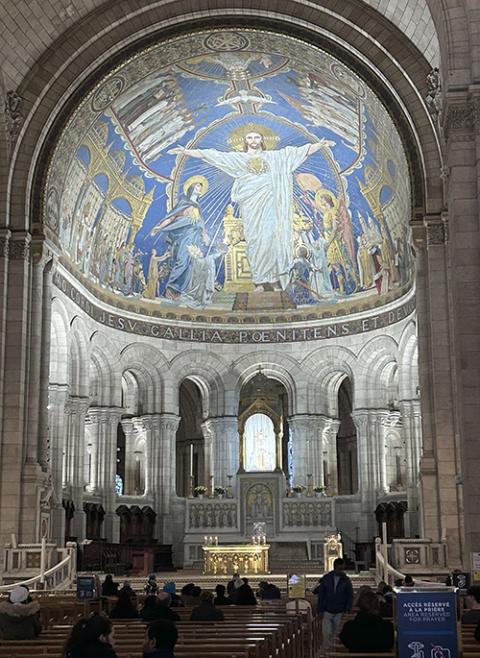
A mosaic of the Sacred Heart of Jesus greets pilgrims as they walk into the Basilica of Sacré Coeur de Montmartre in Paris Jan. 28, 2024. (OSV News/Gretchen Crowe)
As is often the case in the life of the church, this season of persecution led to a flowering of spirituality, especially in France, that was as comprehensive as it was surprising. New religious orders were founded and old ones restored. The apparitions at LaSalette and Lourdes and Knock focused an increasingly widespread devotion to the Blessed Mother. Major shrines, such as the Basilicas of Sacre-Coeur in Paris and Brussels, were built and became objects of pilgrimage.
The First Vatican Council, in 1870, was interrupted by the outbreak of the Franco-Prussian war, and the subsequent loss of the Papal States. The council's ecclesiological work was unfinished but the council fathers managed to publish decrees on the primacy and infallibility of the pope. These texts were among the first religious documents that reached the people by means of the media, not the pastors, and secular reporters failed to grasp the many nuances of the documents. People inside and outside the church concluded that the pope was infallible about everything, a distortion of what Vatican I had taught. Further, the loss of the Papal States further entrenched the rejectionist stance Pope Pius IX took towards all things modern.
This anti-modern rejectionism was not universal. In the Benedictine monastery of Solesmes, the abbot Prosper Guéranger (1805-1875) began a liturgical renewal with the blessing of the Holy See, which called on the monks to "revive pure traditions of worship." This was the first of several renewals all of which were characterized by returning to the sources of the tradition in order to forge a way forward, a dynamic that became known as "ressourcement," or "returning to the sources." Pope Pius XII restored the Easter Vigil liturgy in 1951 and restored the rest of the Holy Week liturgies in the following years. This invited a renewed focus on the foundational role of baptism and its relationship to the Eucharist.
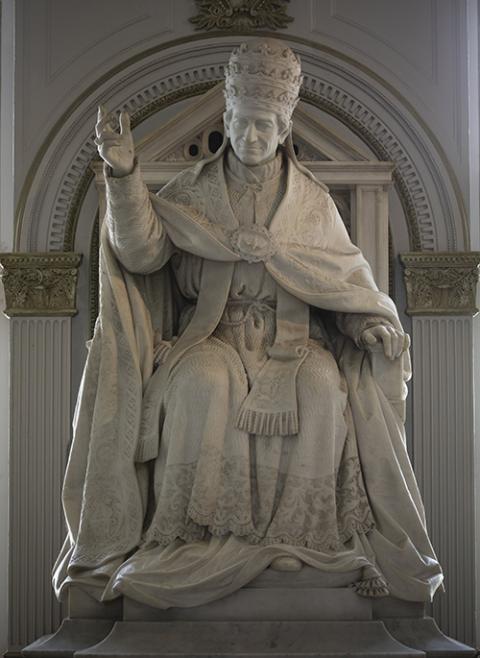
A statue of Pope Leo XIII is displayed at The Catholic University of America in Washington May 25, 2021. (CNS/Tyler Orsburn)
In 1879, Pope Leo XIII called for a renewal of Thomism in the encyclical Aeterni Patris. The neoscholastic thinking that was then taught in the Roman seminaries had become stale, overly intertwined with canon law, an exercise in apologetics not evangelization. Leo was also concerned about the rise of secular philosophies like Marxism that were vigorously atheistic. He called for theologians to study St. Thomas Aquinas' writings directly, and theologians began realizing what a treasure trove they were.
In 1893, Pope Leo XIII issued an encyclical, Providentissimus Deus, that called for a renewal of biblical studies. In 1902, he established the Pontifical Biblical Commission. This effort at renewal would get further encouragement from Pope Pius XII whose confessor was a biblical scholar.
In the years between the two world wars, a return to the sources began throughout the theological world. Often called the "nouvelle théologie," it entailed rereading the early church fathers, both the great Eastern fathers like Gregory of Nazianzen and St. Basil as well as Western fathers like St. Ambrose and St. Augustine. Again, as with the rediscovery of Thomism, these 20th-century theologians encountered a different theological landscape. These early church fathers were still awed at the outrageous claims of the Christian faith, that God was born of a virgin and had become man, had died and been raised from the dead, that God desired a relationship with all people and established a church to bring that about, etc. They did not reduce Christian to a checklist of ethical claims. For the church fathers, the Christian faith was revolutionary and these 20th-century theologians realized the degree to which the church had taken, over the centuries, those astounding claims for granted.
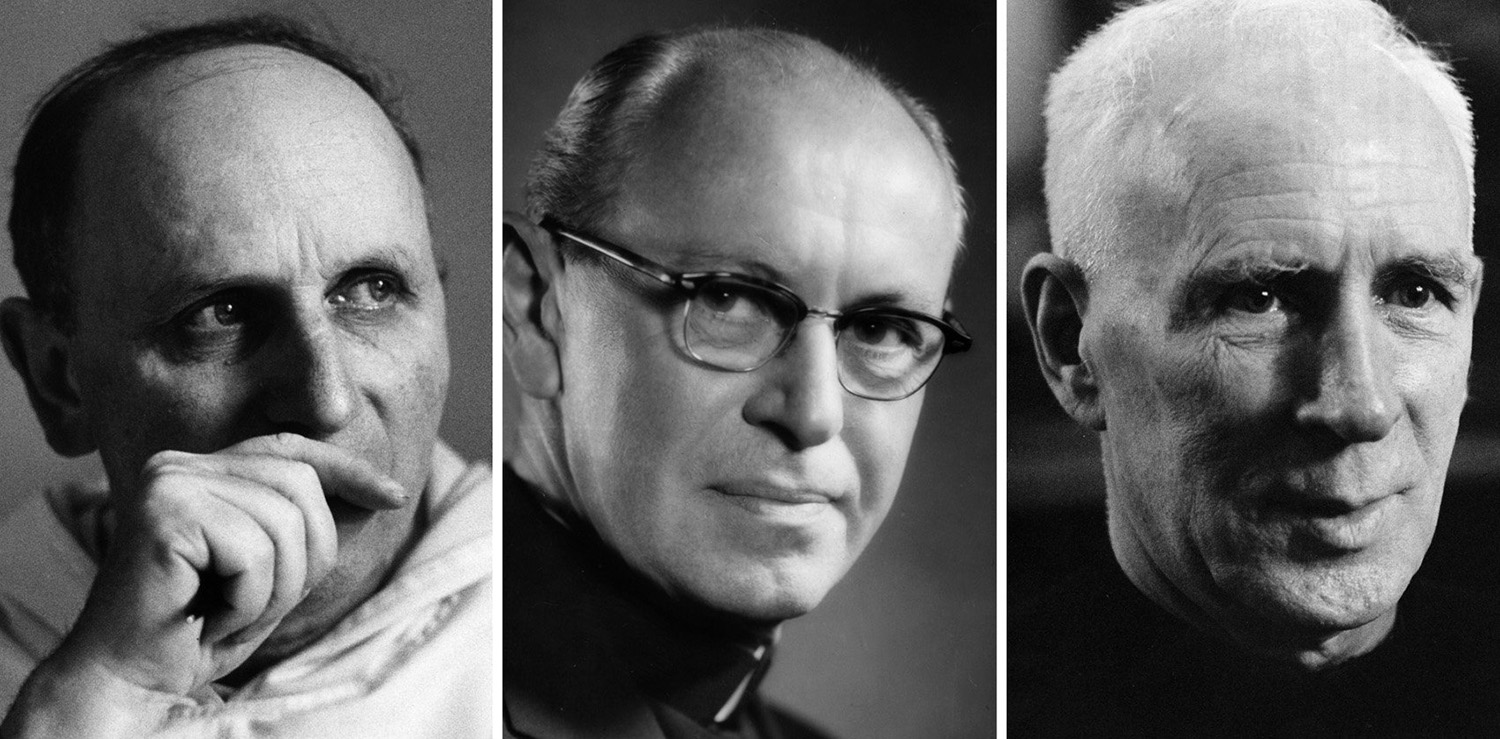
Dominican Fr. Yves Congar and Jesuit Frs. John Courtney Murray and Henri de Lubac are pictured in undated file photos. All three of the late theologians were silenced by the Vatican during the 1950s, but re-emerged to become important voices of the Second Vatican Council. Congar and Lubac were named cardinals late in life. (CNS file photos)
Their path was uneven and uneasy. Some strayed into error, even leaving the church. Others were found suspect by Roman authorities and silenced. This was a time when the Vatican could still ban a theology book and the ban stuck whereas today, any attempt to ban a book only increases its sales! Some of the most prominent theological experts at Vatican II, Yves Congar, John Courtney Murray and Henri de Lubac, were silenced and forbidden to publish because their theological writings were considered too avant garde by Rome, even though their theology was rooted in the patristic writings of the early church. They accepted these censures in obedience and they would all be rehabilitated and play vital roles at Vatican II.
Alongside these intellectual developments, groups like Catholic Action brought the Gospel into society and the world of politics. Catholics dominated most labor unions in both Europe and in the United States. Charitable organizations like the St. Vincent de Paul societies and the Knights of Columbus sprang to life, all modeled on the call to sanctity.
In each case, the church did not hold a brainstorming session to devise new patterns of thought and worship. Instead, the theologians and other church leaders looked back at the wellsprings of her own tradition and found therein the seeds of renewal. They retrieved what had been lost and applied that tradition to the circumstances of the contemporary world.
Advertisement
The second key development that made Vatican II necessary was more existential and far less hopeful. The experience of two world wars raised profound existential questions for all of Western society.
It is difficult to overstate the horror of these wars. The U.S. came late to World War I and still suffered 116,516 soldiers killed. The British Empire lost almost a million men. France had 1,357,800 men killed. 1,773,700 German soldiers died. In each case, the number of wounded was far greater. Year after year, this carnage occurred while neither side advanced more than a few miles along the Western Front. The Eastern Front collapsed after the Russian Revolution and it, too, had been drenched in fruitless blood. The future John XXIII was a military chaplain during World War I and he saw how war had mixed people from different ethnicities and religious traditions, but also how religion was manipulated by political leaders.
World War II was even worse. Although fewer soldiers were killed on the battlefields of the Western Front, some 11 million Russian soldiers died on the Eastern Front. Some three and one-half million Germans soldiers were killed in the war. And, the civilian death rate far outpaced that of the First World War. About 350,000 French civilians died, over 5 million Poles, including most of its Jews, and 7 million Russians. In Germany, 780,000 civilians were killed and in Japan, 672,000 civilians lost their lives.
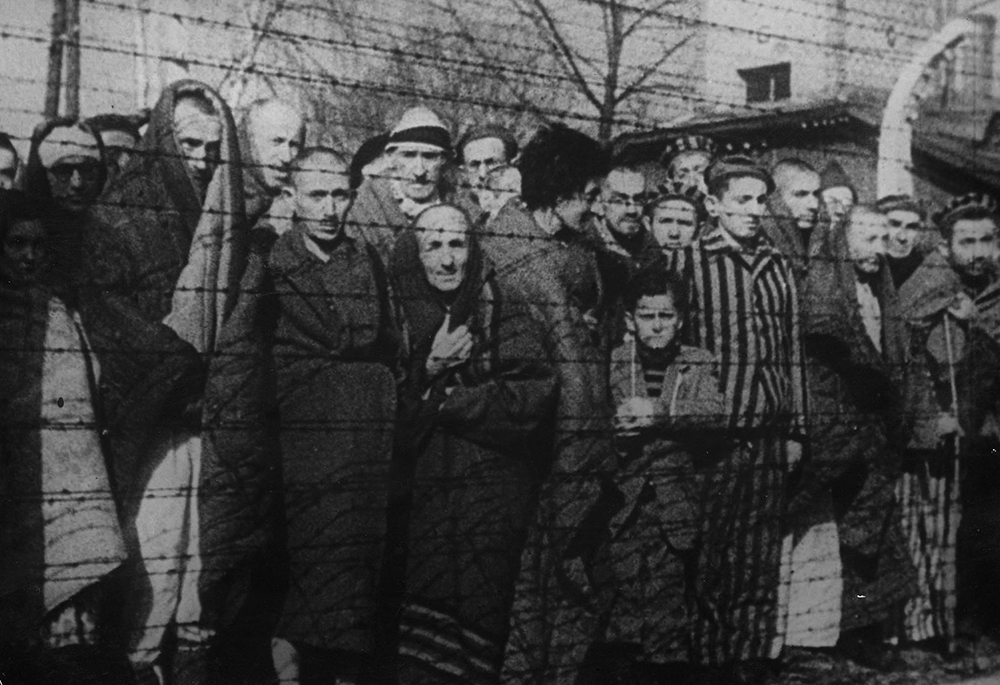
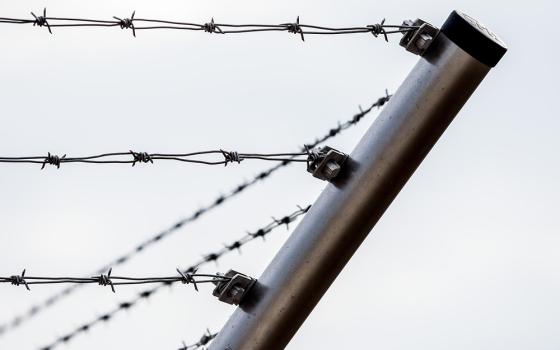
Men, women and children are seen behind barbed wire after the liberation of the Auschwitz-Birkenau Nazi death camp in 1945 in Oswiecim, Poland. Historians estimate that the Nazis sent at least 1.3 million people to Auschwitz between 1940 and 1945, and it is believed that some 1.1 million of those perished there. Auschwitz was liberated by the Russian Army Jan. 27, 1945. (OSV News/Reuters/Yad Vashem Archives)
Worse still, the Shoah exposed a barbarism that was almost impossible to contemplate. In the heart of what was considered the civilized world, death became an industry. The cold calculations of the Nazi camp commanders, carefully tracking their efforts to increase the rate at which they could exterminate Jews, stand as a monument to cruelty and inhumanity, a kind of anti-civilization. Perpetrated by the country that brought us Beethoven and Brahms, Goethe and Schiller.
The vast intellectual, moral and social architecture of Christendom had withered in the face of totalitarian barbarity. The pastors of the Catholic Church had to ask themselves: How could this happen? And how was it that most Catholics in Germany and Italy went along with this evil, or at least did not actively resist it? Existentialism emerged as a philosophy — how could it not? — and it sought answers beyond the walls of Christian theology. This crisis of conscience was only somewhat muted by the practical need to rebuild Europe, and the prominent role of Catholic politicians in that effort: France's Robert Schuman, Italy's Alcide De Gasperi and Germany's Konrad Adenauer. Still, the shadow of Auschwitz hung over the moral conscience of the West and of its religions.
The church had stood aloof from, or even hostile to, many of the developments of modern liberalism in the 19th century. It condemned religious freedom and was suspicious of democracy. It rejected freedom of the press and of conscience. Many Catholics demonstrated a keen antisemitism throughout the 19th century and into the 20th. Not until Pope Leo XIII's reign did it try and engage the modern world, and his efforts came to little in the short-term. The election of Pius X in 1903 returned the Catholic Church to a reactionary posture. The 20th century illustrated the futility of such a stance. Ignoring and condemning modernity had not worked. The church, with the rest of European culture, was overwhelmed by the forces of evil that raged in the first half of the 20th century. Something new must be tried.
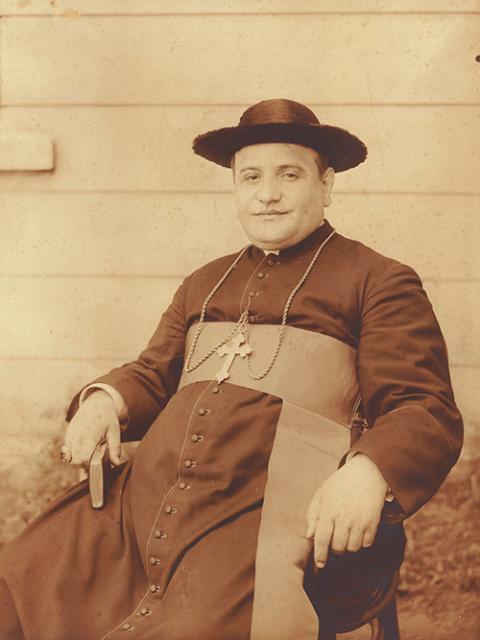
Archbishop Angelo Giuseppe Roncalli, the future Pope John XXIII, is pictured in 1926, the year after he was ordained to the episcopacy. Blessed John XXIII, who convened the Second Vatican Council, was canonized with Blessed John Paul II on April 27, 2014, at the Vatican. (CNS/Courtesy of Archbishop Loris Capovilla)
One other postwar reality was breaking into the church's self-consciousness: the Global South. The church was beginning to grow in Africa and Asia, while the countries of Latin America, which had long been Catholic, saw their populations grow steadily. In 1960, Pope John XXIII bestowed the cardinal's red hat on Archbishop Laurean Rugambwa of Tanzania, the first cardinal from Africa. The church was becoming less Eurocentric demographically.
The third necessary antecedent to Vatican II was the person of Angelo Roncalli who was elected pope in 1958 and took the name John XXIII. Roncalli had been under suspicion during the reign of St. Pius X, the last pope who hewed to a rejectionist stance towards modernity. More importantly, Roncalli had edited the acta of St. Charles Borromeo's apostolic visitations in the Diocese of Bergamo. It was the means by which Borromeo, who was archbishop of Milan, implemented the reforms of the Council of Trent. Roncalli realized that while Trent had become something steadfast and unchanging in the minds of 20th-century ecclesiastics, in fact it had been a great reforming council.
Trent had altered the requirements for ordination, establishing seminaries and a defined curriculum of theological studies for those aspiring to holy orders. It had altered the definition of what constituted a valid marriage. It had developed the church's teaching on grace and works. It ended the abuse of non-resident bishops who collected the revenues of a diocese while ignoring their pastoral responsibilities. Trent had unleashed a great apostolic fervor, precisely what Pope John knew the church needed again.
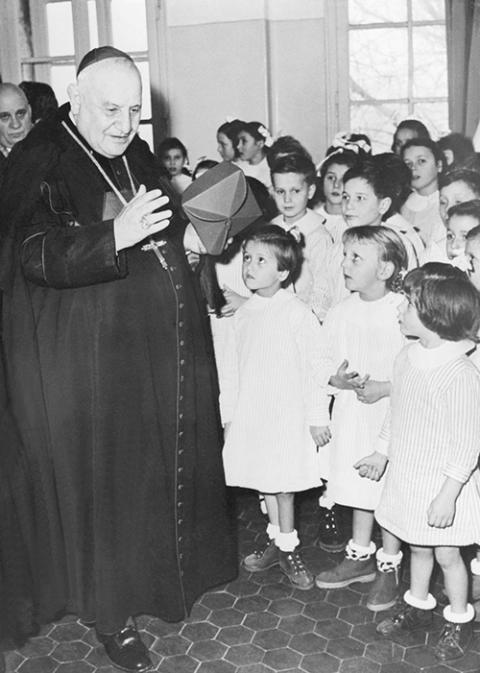
Then-Cardinal Angelo Giuseppe Roncalli, Pope John XXIII from 1958 to 1963, is pictured in an undated photo visiting with school children. (OSV News/KNA)
Roncalli had served as apostolic delegate in Bulgaria (1925-1934) and in Turkey and Greece (1934-1944), so he was familiar with ecumenical relations in ways bishops who had lived entirely in Italy or Spain were not. In France, as nuncio, he helped the church reconstitute itself after years of oppression, easing the historic tensions between Catholicism and the secular government, and also dealt with the complex situation of the "worker-priests." As patriarch of Venice, he had come to see the plight of working people and the need for the church's pastors to defend them in the face of capricious business owners and powerful changes in the economy. Throughout his career, pastoral concerns shaped his diplomatic and episcopal leadership.
These were the events and experiences which led Pope John XXIII to summon the Second Vatican Council just a few weeks after his election and they shaped the theological discussions the council ignited. The documents and the historical event of Vatican II were the result of twin impulses, aggiornamento, or bringing the church up to date, and ressourcement, returning to the sources. You cannot understand Vatican II without appreciating both impulses and the role they played in the lead-up to the council and to its unfolding. Vatican II became, as St. John Paul II said, "the great grace bestowed on the Church in the twentieth century."