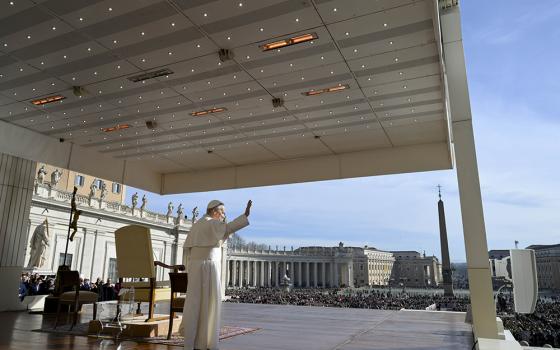
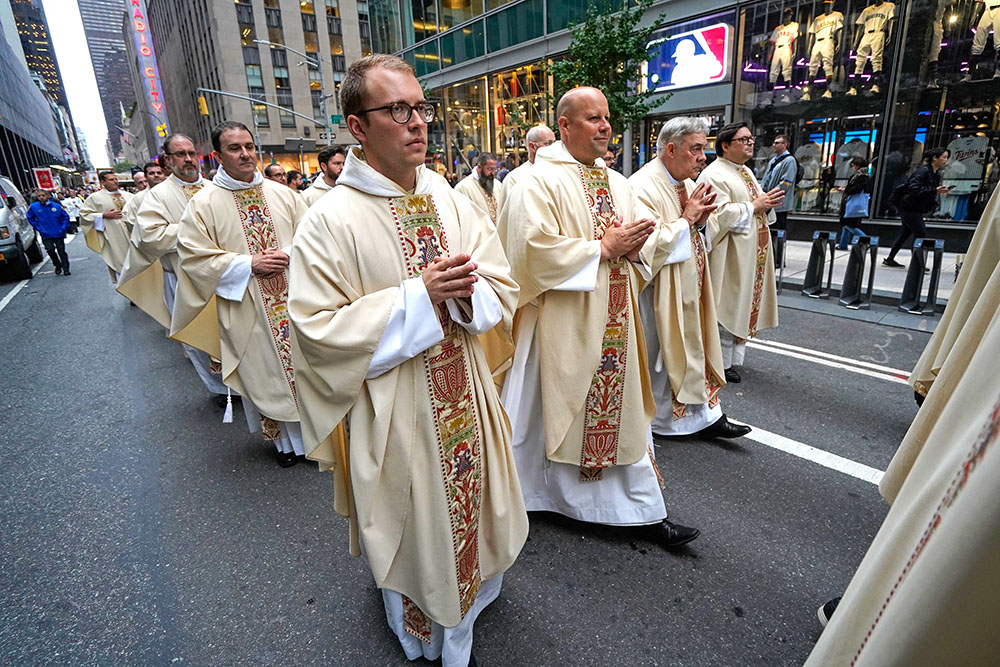
Priests participate in the fifth annual Napa Institute-sponsored Eucharistic procession through the Midtown Manhattan section of New York City Oct. 14, 2025. (OSV News/Gregory A. Shemitz)

The 2025 National Study of Catholic Priests conducted by the Catholic Project at the Catholic University of America is an important window into the nation's changing presbyterate. Authored by Brandon Vaidyanathan, Stephen Cranney, Stephen P. White, and Sara Perla, the survey received responses from 1,164 priests. The findings largely confirm the narrative that older clergy are far more liberal, in both politics and theology, than the younger clergy.
Connecting politics and religion is one way, and an accurate way, to look at the survey results. My colleague Jesuit Fr. Thomas Reese concluded his column on the survey by focusing on a question in the survey itself and with a prediction. The question was: "Are these men being asked to do things that were not asked of previous generations of priests, or is it just that they do not see those things as a priest's responsibility while previous generations did?"
Reese then offers this ominous prediction: "Whatever the answer, the National Study of Catholic Priests raises concerns about the future of priestly ministry in the American Catholic Church. If the younger clergy aggressively push their political and theological views on the Catholic people, church attendance will continue downward, and fewer Americans will identify as Catholic."
This angle is accurate but not exhaustive. I spoke with an 80-plus former pastor about this difference between older and younger clergy, and he reminded me that when he was newly ordained, the whole culture was focused on civil rights and the Vietnam War and Roe v. Wade, and there were protests every day of the week it seemed. That was his experience, but he added that this is not the experience of the younger clergy.
Advertisement
The younger priests, at least those in formation before the advent of Trumpism, grew up in a time that was in many ways a reaction to the social activism of the 1960s and '70s. The promise of a racial equality had receded, new wars were fought by an all-volunteer army, and the battle over Roe placed Catholics on the right, rather than the left, of a searing political and cultural debate.
Most of all, conservative families still encourage and produce vocations to the priesthood. The Catholic left has failed by comparison to produce vocations, and some live in a fantasy world that thought fewer vocations would lead to a greater push for ordaining women. If the ordination of women is desired by the Holy Spirit, having fewer priests, and thus fewer opportunities for the unique grace the Eucharist provides, is not likely to help the Spirit achieve anything.
Something else is at work, however, with these younger priests, and I wish the survey had dug more deeply into it. I find that younger clergy are more focused on the other worldly promises of the Gospel than on its implications for social justice. Some are stridently political but the majority view their role as apolitical and see the church as a refuge from a culture that they find abhorrent in its excessive vice and luxury. They aspire to a simpler life and there is nothing wrong with that.
One of the more striking findings of the survey is that 88% of priests ordained after 2000 identified eucharistic devotion as a pastoral priority, compared to 66% of clergy ordained between 1980 and 1999, and 57% of those ordained before 1980. Is there something inherently "conservative" about eucharistic adoration? Eucharistic adoration is not a proxy for otherworldiness but it might be an antidote for excessive worldliness. There is certainly a case to be made that the Catholic left collapsed the eschaton into a variety of social causes, some with a tenuous relationship to the revelation of God in Christ contained in the Gospel. The Gospel is many things but it is not a story of sexual liberation.
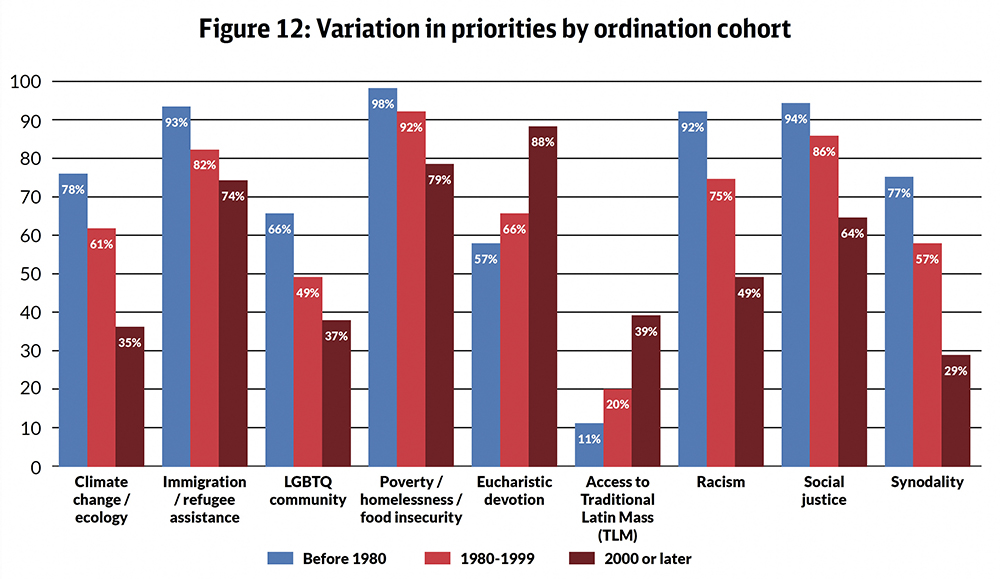
The 2025 National Study of Catholic Priests findings on U.S. priests' pastoral priorities, by year of ordination. The study was conducted by the Catholic Project at the Catholic University of America. (Courtesy of the Catholic Project)
Thirty-nine percent of younger priests said that access to the traditional Latin Mass was a pastoral priority, compared with 20% and 11% for the older age cohorts. This is a better gauge of "conservative" versus "liberal" in their popular understanding, although "the tradition" speaks through ecumenical councils and the popes. The Second Vatican Council is in the tradition. Some yahoo with a blog may not be.
There is one thing in the survey that was deeply troubling. The authors write:
Priests' theological views (not shown) followed a similar pattern, though with an even sharper decline in progressivism and a stronger consolidation on the conservative side. For example, among priests ordained before 1975, more than 70% described themselves as theologically progressive, while in the 2010-or-later cohort only 8% did so. By contrast, over 70% of the youngest priests described themselves as either "conservative/orthodox" or "very conservative/orthodox," leaving only about one in five in the "middle-of-the-road."
It is wrong to suggest that being "conservative" is necessarily more aligned with being "orthodox." Young priests who possess deep reservations about Vatican II, though few, may consider themselves orthodox but they are not. It is odd to label suspicion of an ecumenical council and papal teaching as "conservative."
Still, this report is very useful. The questions about priest morale, fears of burnout, priests' relationships with their bishops or religious superiors, all will help bishops better tend to the needs of their presbyterates. The good people at the Catholic Project have done a great service to the church in the U.S. I hope they will expand the questions to delve into different issues about the relationship of grace and nature, different understandings of sin, and other less political and more theological categories, building on the good work they have done here.