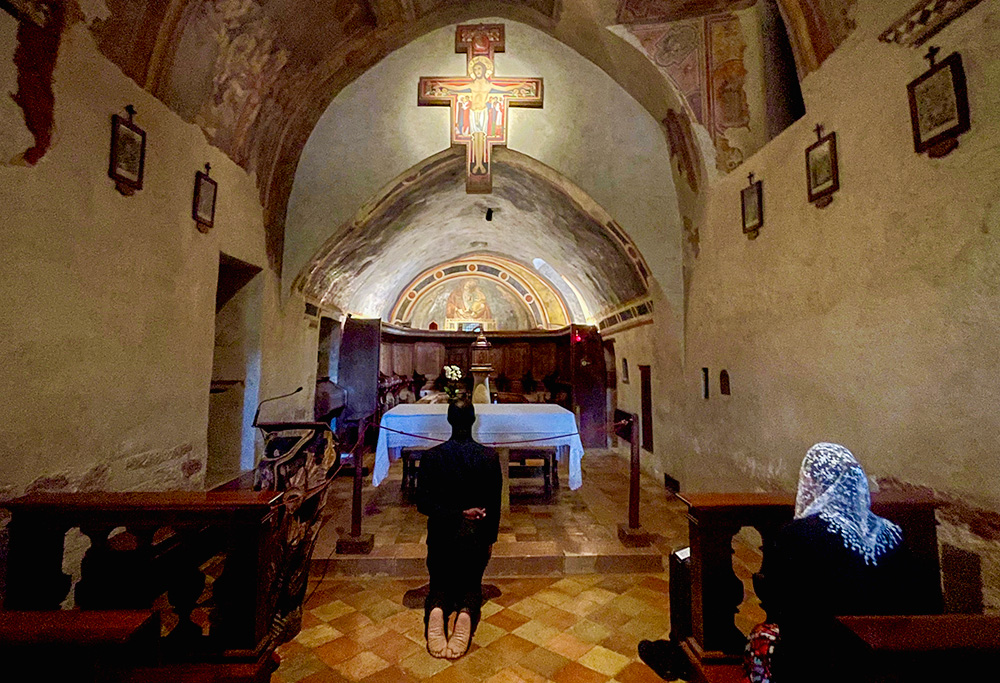
The interior of the Church of San Damiano outside of Assisi, Italy. Above the altar today is a replica of the crucifix from which Christ spoke to St. Francis of Assisi, saying: "Francis, go and repair my house, which, as you see, is falling completely to ruin." (Dreamstime/Debra Reschoff Ahearn)

by Daniel P. Horan
Later this year, on Oct. 3, 2026, we will commemorate the 800th anniversary of the death of St. Francis of Assisi. As one of the most popular saints, revered within and beyond Christianity, Francis is both cherished and misunderstood. Remembered for his simplicity, embrace of evangelical poverty and love for all God's creation, he is a perennial model of Christian discipleship and a wisdom figure worthy of our emulation.
However, Francis is also often misunderstood. I have written here before about how his radical vision of God's community of creation and the implications of that spirituality are regularly reduced to a caricature, resulting in what I call the "birdbath industrial complex." Thought of as a medieval romantic troubadour or a proto hippie, the figure of the poverello ("little poor one") from Assisi that many people conjure bears little resemblance to the real, historical and faithfully radical follower of Christ who walked the Umbrian valley of Italy and unwittingly founded one of the most impactful religious movements within Christian history.
For this reason, I plan to dedicate some of my columns during the coming year to unpacking the continued relevance, inspiration and challenge that Francis offers us even 800 years after his death. It is my intention to highlight some of the lesser-known insights of his life and writings, including, for example, times when he didn't act in accord with popular hagiographic depictions of his sanctity. I also want to revisit some of the best-known features of his legacy to illustrate how they continue to be relevant in the 21st century and beyond.
I want to start with the beginning of Francis' own Christian journey: his conversion.
Across the early sources, which include the first hagiographies and collections of remembrances of his contemporaries, there are three major theories about Francis' profound conversion of life. We might phrase the question this way: When did Francis become Saint Francis?
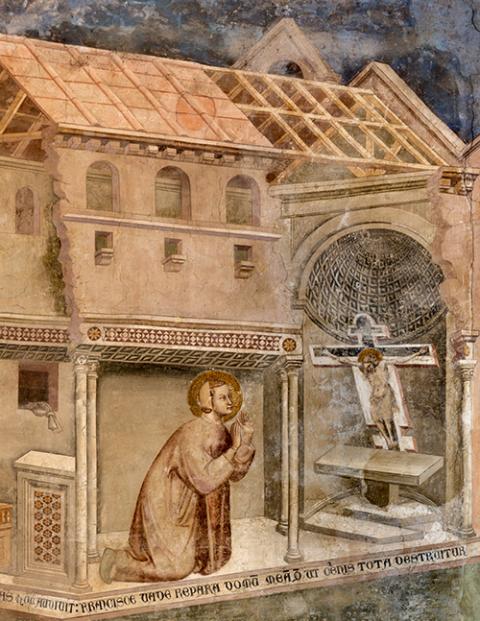
A 14th-century fresco in the Church of St. Francis in Pistoia, Italy, depicts the story of St. Francis of Assisi's conversion before the cross in the Church of San Damiano. (Dreamstime/Jozef Sedmak)
One version of the story has Francis encountering a leper along a road. It suggests that Francis was moved by the sight of the unfortunate and unnamed man and, compelled by the sudden overwhelming conviction of his inherent fraternity with the leper, the young man from Assisi embraced the leper as a sign of love and solidarity. A popular version of this narrative suggests that Francis turns to leave and when he looks back to see the leper, the leper has miraculously disappeared. This has been interpreted to suggest that the man Francis embraced was actually Christ himself disguised as a leper. And from then on, Francis' life was completely changed.
Another narrative depicting Francis' conversion centers on his experience of hearing the Gospel passage from Matthew instructing Jesus' followers to "not take gold or silver or copper for your belts; no sack for the journey, or a second tunic, or sandals, or walking stick" (Matthew 10:9-10). According to the Major Legend of St. Bonaventure, Francis immediately exclaimed in response: "This is what I want, this is what I desire with all my heart!" And from then on, Francis' life was completely changed.
And still another account of Francis' conversion takes place in the country chapel of San Damiano outside of Assisi, where Francis would go to pray. The early sources tell of a time when Francis went into the church and knelt before the Byzantine crucifix in the sanctuary. As he prayed, the poverello heard Christ speak to him from the cross, saying: "Francis, go and repair my house, which, as you see, is falling completely to ruin." At first, Francis understood this to be Christ exhorting him to physically repair the dilapidated rural chapel, but later it would be reinterpreted to portend Francis' reforming influence on the Catholic Church. Either way, from then on, Francis' life was completely changed.
While these three episodes are repeated across a range of early Franciscan sources, suggesting some degree of veracity if not absolute historical accuracy, one of the problems they share is the manner in which they have been remembered, repeated and interpreted over the centuries. Placing too much emphasis on a large, dramatic event as singularly life-changing (something akin to the way we recall St. Paul's experience on the road to Damascus) hides the more complex and, frankly, relatable truth of Francis' conversion experience.
Advertisement
His was not some kind of spiritual light-switch occurrence after which his life was immediately and inexorably changed in its entirety. Whatever may have happened when he prayed before the San Damiano crucifix or embraced a leper on the roadside or heard a particularly moving passage from the Gospel, there was no one-and-done moment.
Instead, as Francis himself attests in his own writings, his conversion was an experience of ongoing metanoia or life change.
There is a particularly telling passage at the beginning of Francis' "Testament," or deathbed remembrances of his life, in which he does recount an early experience of coming to embrace a leper. Francis wrote:
The Lord gave me, Brother Francis, thus to begin doing penance in this way: for when I was in sin, it seemed too bitter for me to see lepers. And the Lord himself led me among them and I showed mercy to them. And when I left them, what had seemed bitter to me was turned into sweetness of soul and body. And afterwards I delayed a little and left the world.
It's true that part of Francis' deepening and maturing Christian faith was his increasing concern for and solidarity with the lepers and other marginalized people in his time. But as he himself admits, this encounter did not immediately result in a radical life change. Instead, he "delayed a little" (sounding more like St. Augustine's petition to "Lord, make me chaste, but not yet," than St. Paul's blinding roadside conversion), devoting what historians note was at least three years to serious discernment.
Francis' conversion experience was not some kind of spiritual light-switch occurrence after which his life was immediately and inexorably changed in its entirety.
Thomas of Celano, Francis' first biographer, describes this period in Francis' journey as him having been "changed in mind but not in body." The future saint had some intellectual sense of God's call to a more serious living of the Gospel, but he was not yet able to embody this vocation.
How many of us can relate to this experience of sincerely wanting to live our faith more seriously but struggling to put that desire into practice?
At a time in our secular calendar when many people have recently made and are trying to stick to "New Year's resolutions," it might be worth recounting that major life changes do not happen in a day, or a month, or even a year. What the entirety of Francis' story teaches us is that Christian conversion is lifelong, dynamic and ongoing.
His is a story of an ordinary Christian, someone baptized into the faith like the rest of us, who slowly and at times reluctantly opened himself up to Christ's invitation to take that baptismal call more seriously. As the Franciscan historian Fr. Regis Armstrong once wrote, "From his writings, it might be concluded that [Francis] simply wanted to live the fullness of life he received at baptism. "
St. Francis of Assisi was not that different from us, despite the centuries that span between his lifetime and ours. Rather than imagine him as some sort of medieval superhero, we would do well to remember his full humanity and the lifelong journey of Christian conversion he experienced, including the inevitable stumbles and mistakes he made along the way. In this way, Francis is truly someone worth celebrating, because he models for us a way to embrace an authentic journey of faith.