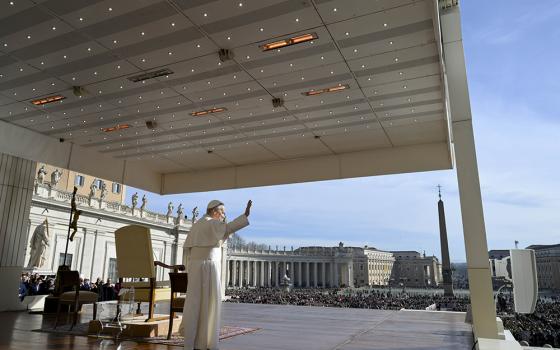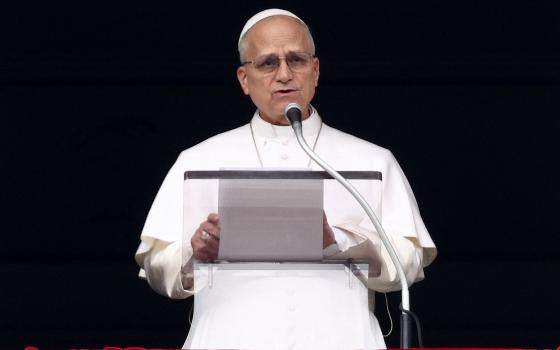
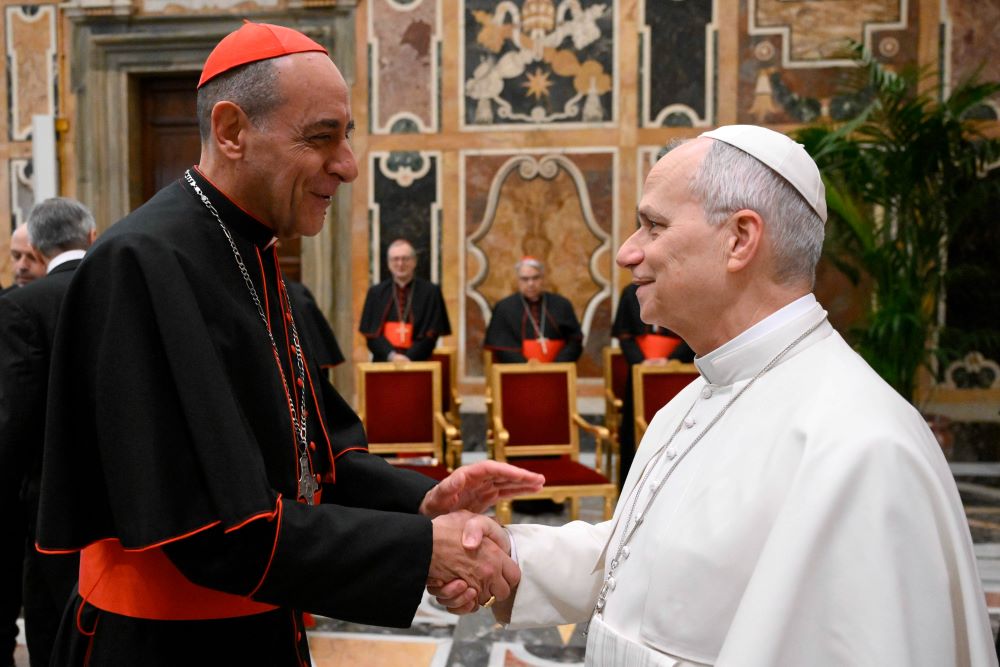
Pope Leo XIV meets Cardinal Víctor Manuel Fernández, prefect of the Dicastery for the Doctrine of the Faith, during an audience with members and officials of the dicastery and others participating in its plenary session at the Vatican Jan. 29. (CNS/Vatican Media)

by Daniel P. Horan
Last week, the Dicastery for the Doctrine of the Faith gathered in plenary session at the Vatican, which means that all its members were gathered at once. These plenary sessions are held every two years to review documents, examine questions and cases and discuss key themes or topics. This particular gathering is focused on the theme of transmitting the faith and evangelization for a new generation. While nearly all the DDF's work is done in private, two aspects of the meeting are typically made public: the opening reflection offered by the prefect, Cardinal Víctor Manuel Fernández, and remarks given by the Holy Father during an audience with the DDF officials.
Pope Leo XIV's Jan. 29 address to the DDF was rather straightforward. It featured pro forma notes of gratitude and a review of some recent documents and projects undertaken by the DDF during the last few years.
Cardinal Fernández's reflections, however, were much more interesting.
His meditations centered on the virtue of intellectual humility. He opened with a personal explanation for the focus on humility, explaining: "Recently, while in prayer, I have felt a strong call to intellectual humility, recalling those ancient words: 'Ubi humilitas, ibi sapientia' ('where there is humility, there is wisdom')."
Framed within the context of God's gift to humanity of intelligence and capacity for thought, Fernández noted that:
This universal capacity for thought does not mean that humans possess the capacity for exhaustive knowledge or a comprehensive perception of reality. Even with the help of the most powerful technologies imaginable, it is impossible for a human mind to be aware of reality in its totality and in every one of its aspects. This is possible only for God.
Indeed, there is great wisdom expressed in this statement. Humility begins with realizing our limitations. It is not a form of self-flagellation or self-deprecation, but an honest reckoning with the finite horizon of our own human knowledge. When we are shut down to new information, or maintain willful ignorance as I discussed in my last column, we are more inclined to exhibit hubris and adopt a posture of arrogance. Such a position leads to lecturing, condemnation and hostility toward anything perceived as new or different.
What if the whole church heeded this call to humility?
Whereas arrogance inhibits true conversation, the virtue of humility, as the Catholic historian Christopher Bellitto notes in his 2023 book Humility: The Secret History of a Lost Virtue, "produces dialogue, not a monologue." He adds: "Humility helps us restore the idea that there is yet something to be learned from somebody else."
That Fernández has decided to emphasize the need for humility from within (and beyond) the Vatican's doctrinal office is significant.
The DDF, the successor of the office once known as the "Sacred Roman and Universal Inquisition" (1542-1908) and then the "The Sacred Congregation of the Holy Office" (1908-1965), has a centuries-long history of hubristic posturing, intellectual arrogance and ideological violence. Founded in an era of extreme defensiveness resulting from the emergence of the Protestant Reformation and Catholic Counter Reformation, the office's raison d'être was condemning perceived heresy and crushing potential schism. At times, consequences arising from the office's decrees and actions included physical violence or worse.
Even in more modern times, some of the decrees and actions of what is now the DDF have stifled legitimate theological inquiry, scapegoated and stigmatized LGBTQ+ people, and inhibited ecumenism and interreligious dialogue. It's easy to see how these actions, which were widely criticized by academics at the time, stemmed from the absence of humility by those entrusted with the work of the doctrinal office.
In his inspired remarks, Fernández rightly noted that "The more science and technology advance, the more we must keep alive the awareness of our limits and our need for God, so as not to fall into a terrible deception — indeed, the very same one that led to the excesses of the Inquisition, the world wars, the Shoah, and the massacres in Gaza: all of which rely on fallacious arguments for their justification."
He added: "we repeat that deception by living too securely in what we think we know."
Over the last few years, we have witnessed both the DDF and the U.S. Conference of Catholic Bishops "repeat that deception" of "living too securely" in what those in these kinds of positions of religious authority think they know.
We see this lack of humility, for example, in the fourth section of the DDF's 2024 document Dignitas Infinita ("Human Dignity,") where no effort appears to have been made to consult with and take seriously the experiences and expertise of transgender people or examine the latest in scientific research. Dignitas Infinita reflects arrogance about the way things work in the world without bothering to confirm whether such assumptions are true.
Closer to home, the USCCB has likewise demonstrated its lack of humility with its 2023 "Doctrinal Note on the Moral Limits to Technological Manipulation of the Human Body," which was grounded neither in solid science nor sound theological reasoning. And in November, the USCCB adopted health care directives for Catholic hospitals that effectively ban gender-affirming care for transgender patients, a policy position largely informed by the bishops' own 2023 document.
If repeating antiquated pre-scientific claims as justification for preventing the medical care of actual, living human beings in the world today doesn't reflect an absence of humility, then I'm not sure what does.
To his credit, Fernández outlines two principles aimed at helping the DDF and others avoid what he calls a "terrible deception."
First, we must always remain humble before God, seeking divine guidance through prayer and openness.
The second principle, as Fernández says, is that
[W]e must reflect, think, and analyze reality, but while also listening to others, welcoming their perspectives — which allows us to perceive other aspects of that same reality — and opening ourselves to other points of view. For this reason, it benefits us to pay attention to the 'peripheries,' where things are seen differently.
This latter point, if taken seriously and embraced with intellectual humility, would result in a theological and pastoral renewal that better reflects the purpose of theology according to St. Anselm of Canterbury: fides quaerens intellectum (faith seeking understanding). On the contrary, an arrogant and hubristic approach seeks nothing but a reaffirmation of previously held convictions, views and ideologies.
Advertisement
It is also striking that Fernández — echoing the late Pope Francis and affirming statements by Leo — specifically mentions "listening to others" and "opening ourselves to other points of view" while affirming the need to "pay attention" to those at the peripheries of society and the church. This would seem to include LGBTQ+ communities, including transgender people, as well as others whose voices and experiences are too often ignored or erased in arrogance.
Returning to Bellitto's study of the history of humility, it would behoove the DDF, the USCCB and others to embrace the humility that Fernández advocates and the requisite vulnerability that such a posture requires. "Being humble and vulnerable means you're more likely to be listening, not talking at someone," Bellitto explains. "You're conversing, not telling. You understand that your information and opinion might be incomplete or shaded by factors you can't see because they are so ingrained."
What if the whole church heeded this call to humility? What if the DDF did not respond to new developments in theological, philosophical and scientific research with fear and arrogance, but humbly sought to understand and learn from such human experiences and insights? What if not just the DDF, but the bishops in the United States and beyond, prioritized "listening to others, [and] welcoming their perspectives" especially those at the peripheries "where things are seen differently"?
Perhaps we might then be able to work together toward understanding our complex and beautifully diverse world more deeply while also embracing God's call to announce the in-breaking of God's reign by our words, deeds and lives.