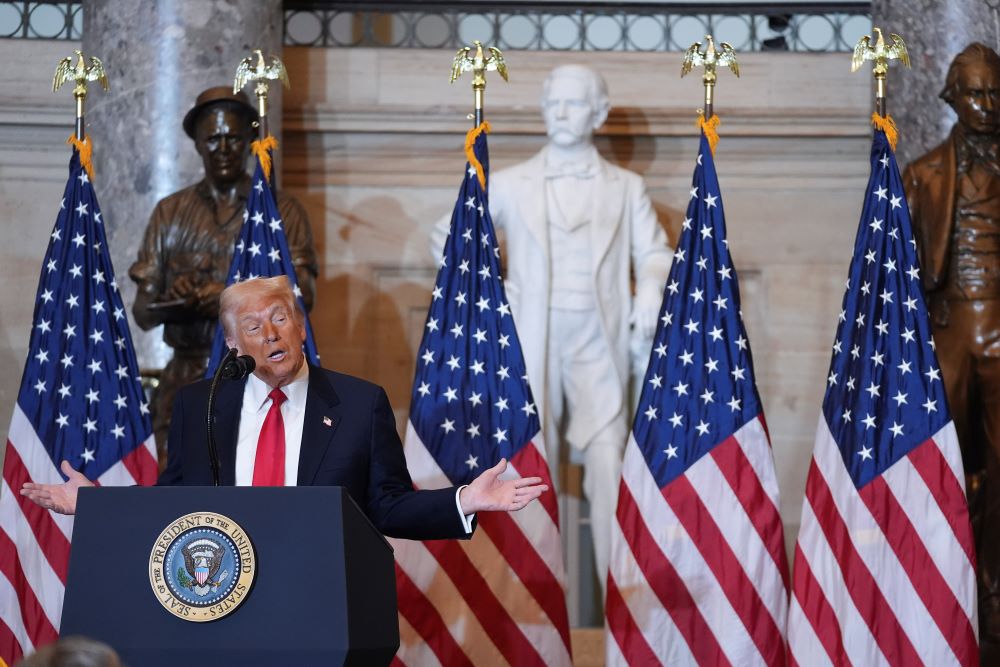
President Donald Trump speaks at the National Prayer Breakfast at the Capitol in Washington, Feb. 6. (AP/Evan Vucci)

John Gehring, who manned the Catholic desk at the progressive nonprofit group Faith in Public Life for many years, has published a new book, Reclaiming American Catholicism: Faith, Politics, and the Future of the Catholic Church. The prose is as easygoing as Gehring is himself, but his analysis is uneven.
Much of the first part of the book examines the ways conservative Catholics crafted a coalition with various conservative political forces, sometimes in ways that deeply compromised their faith, and how this effort enlisted some very prominent Catholics, both clerical and lay. He also explores how this coalition, after years of invoking papal authority, resisted the leadership of Pope Francis.
Many of the stories Gehring relates will be familiar to NCR readers, but it is good to have them all in one place and organized into a narrative whole. Frankly, I had forgotten about Capuchin Fr. Thomas Weinandy, former lead staffer at the doctrine committee of the bishops' conference, and his open letter to Pope Francis, scolding the pope for making decisions of which Weinandy disapproved. The story of Leonard Leo's rise to influence, first within conservative legal circles and then with President Donald Trump, is a story that can't be told too often, even if it frightens the children.
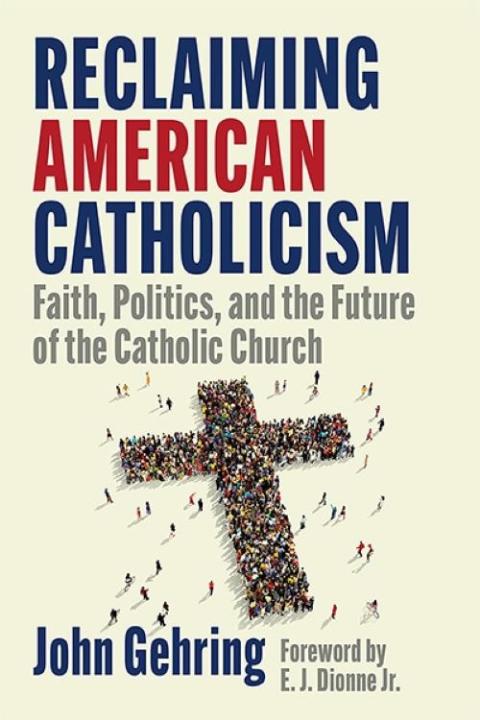
"Reclaiming American Catholicism: Faith, Politics, and the Future of the Catholic Church" by John Gehring
Gehring also looks at the intellectual game of Twister played by Tim Busch, founder of the Napa Institute, who championed libertarianism until Trump became the only game in town on the right side of the political ledger, and Busch contorted himself to embrace this extremely non-libertarian president. Libertarianism requires principles, and the president is allergic to principles. This is part of a larger tale of the corruption of the conservative movement by the man from Mar-a-Lago, but you would have thought that a conservative Catholic, unafraid to question 120 years of Catholic social teaching, might refuse to bend the knee to a man who has emptied the word conservative of all meaning for at least a generation. Nope.
The attacks on the Catholic Campaign for Human Development are shown by Gehring to be one of the more outrageous examples of conservative Catholic paranoia distorting the teachings of the church. Newsflash: Catholics are not Puritans and you are allowed to collaborate in the public square with all sorts of people who do not agree with church teaching provided the work advances the good of the community and the dignity of persons. Gehring's treatment of these attacks returns to a fine report he authored back in 2013 on the subject.
Unfortunately, Gehring does not bring this rigorous analysis to his discussion of Catholics on the left of the spectrum. His outrage is selective. Gehring writes about the Catholic Information Center, a conservative, Opus Dei-run organization, and its decision to give conservative legal impresario Leonard Leo its John Paul II New Evangelization Award. His disgust comes through, as he quotes a professor who asserted the award was an attempt to "hijack the name and reputation of Pope John Paul II to support a political agenda that runs deeply contrary to the actual teachings" of that pope. True enough. But, can't the same objection be raised against pro-choice politicians? Gehring's treatment of the pro-choice advocates, and the Catholics who apologize for them, lacks the criticism he so easily hurls at conservatives.
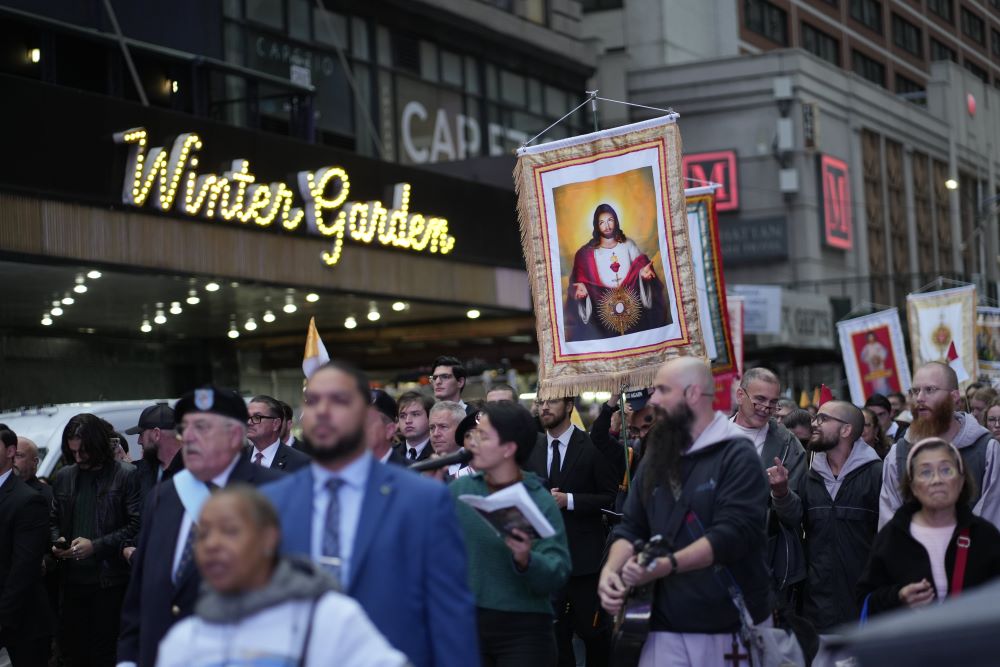
A participant carries a banner featuring an image of the Sacred Heart of Jesus during the fifth annual Napa Institute-sponsored eucharistic procession through Midtown Manhattan in New York City Oct. 14. (OSV News/Gregory A. Shemitz)
When Gehring turns to the issue of race, he similarly reserves all his criticism for the right. He explores critical race theory, but only by citing those who advocate for it and who see it as in alignment with Catholic social teaching. Deeper questions about the problematic anthropology that undergirds all so-called critical theories are not posed, nor does Gehring explore the degree to which these critical theories build up the culture of grievance in which it is almost impossible to preach a Gospel of grace and gratitude.
Similarly, in his treatment of LGBT issues, Gehring often sounds like an MSNBC host who throws in a few biblical citations to give the argument a Catholic gloss. It is one thing to be sympathetic to the situation of people who experience gender dysphoria and quite another to sign on to the ideological claim that gender is fluid and can be chosen at will. It really is possible to sympathize with a person's circumstances while not adopting their arguments. He quotes a trans woman who insists: "We are not an ideology. We are people." True enough, but Pope Francis never condemned a person when he condemned gender ideology. Gehring needed to unpack all this with a more even-handed sensibility and with an appetite for engaging the profound anthropological questions that lurk beneath the surface.
Advertisement
Turning to the conflicts between religious liberty claims and arguments for gay rights, Gehring is much more balanced, quoting scholars like the University of Virginia's Douglas Laycock who rightly takes a "plague on both your houses" attitude. Gehring quotes Laycock who, after noting that both sides introduce legislation that favors only their own side, observes: "Neither side can pass such one-sided legislation. But hardliners on both sides have opposed any compromise. They would rather do without legal protections for their own rights than permit any protection for the other side's rights." Bingo.
This book would have been better if the kind of even-handedness with which Gehring examines the issues of conflicting rights pervaded the entire book. Conservative Catholics are allowed to organize themselves, give money to support causes they care about and make their case in the public square just like liberals. The fact that we may disagree with the arguments or resist their causes does not make their efforts illegitimate.
Cardinal Joseph Tobin recently said self-criticism is "the price of admission of anyone who wants to deal seriously" with polarization. Gehring's next book should have more self-criticism.