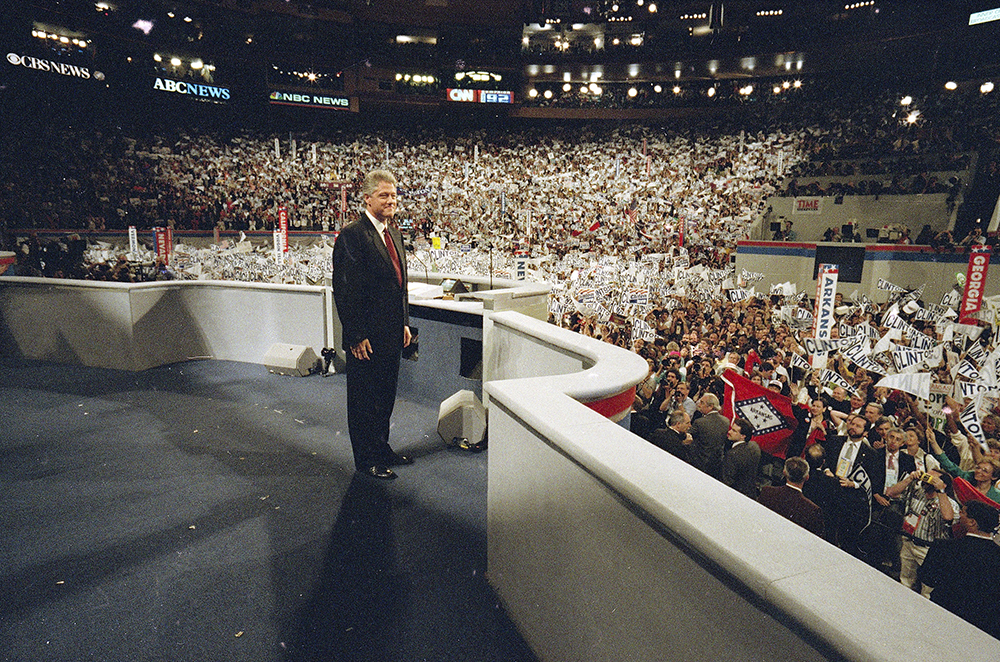
Democratic presidential nominee Bill Clinton faces a cheering audience after taking the podium to deliver his acceptance speech as his party's presidential nominee during the Democratic National Convention at Madison Square Garden in New York, July 16, 1992. (AP Photo/Stephan Savoia, File)

There are dozens of books about how politics in America has been reshaping itself in recent decades. From academic tones that examine deep-seated culture trends to journalistic analyses of particular campaigns. Timothy Shenk offers a different lens in his book Left Adrift: What Happened to Liberal Politics. He looks at the politics of the last 45 years by comparing the careers of two of the left's most prominent political strategists, Stan Greenberg and Doug Schoen.
Greenberg was born in a family that was "teetering on the border between working and middle class." He excelled as a student first at Miami University in Ohio and then at Harvard University for grad school. There he conducted his first survey of 1,000 poor people in five different cities as part of his dissertation, "Politics and Poverty." He noted the complex political attitudes of the poor and also the role race played in shaping opinions. In 1968, he conducted a survey for the campaign of Robert F. Kennedy whose coalition included diverse incomes and races.
Schoen was born in elite circumstances, growing up on Manhattan's Upper East Side and attending the prestigious Horace Mann school, where he met his future business partner Mark Penn. "By the age of sixteen, he was already spending much of his time on local campaigns" and worked with another future business partner, Dick Morris. Early on, as he began working outside Manhattan, he discovered that "the voters who had turned the city into a New Deal bastion were simmering with resentment toward racial minorities and the liberal establishment." He also went to Harvard but where Greenberg was idealistic, Schoen was a realist.
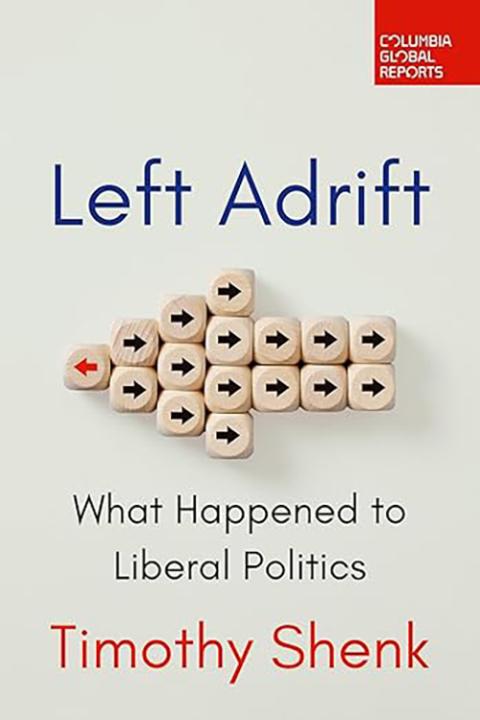
Cover of "Left Adrift: What Happened to Liberal Politics" by Timothy Shenk
"When Stan Greenberg looked at Bill Clinton, he saw the answer to his prayers," writes Shenk. Like Greenberg, Clinton had supported Robert F. Kennedy in 1968, not Eugene McCarthy, and the candidate and the consultant seemed bent on resurrecting the New Deal coalition. Greenberg believed that the only path to a Democratic majority lay through a strategy that appealed to the working class, especially to African Americans, with a mix of economic populism and putting a brake on cultural liberalism. It worked — sort of. Clinton won in 1992, ending 12 years of Republican control of the White House, but he never captured a majority of the electorate in either presidential race.
In the 1994 midterms, the GOP shellacked the Democrats and Clinton began looking for an alternative strategy for his reelection bid. He turned to his old friend Dick Morris who brought his old friend, Doug Schoen, with him. The populism of the 1992 campaign vanished. "When you divide rich and poor, the middle-class sides with the rich," Schoen argued. The campaign focused on two key groups of swing voters. "Swing 1" was more highly educated voters, many of them women, who leaned right on economics and left on cultural issues. "Swing 2" was more working-class and male, and it was suspicious of social change. "There wasn't one 'center' to the electorate, but two, and Democrats had to contest both fronts," Shenk writes.
Again, the strategy worked — sort of. Clinton won, even improving on his margins from four years prior. But the GOP held the House and picked up two Senate seats. Schoen felt he had done his job: He got Clinton across the finish line. Greenberg was dissatisfied with the result. "Rather than ushering in a new progressive era the current period seems to reflect the exhaustion of political forces that have battled to an inconclusive and ugly draw," Shenk writes.
Here is the key difference between the two strategists. "For Greenberg, winning a campaign was never good enough," writes Shenk. "He believed that elections should be part of a larger political project, and his was bringing the New Deal coalition back to life." On the other hand, "Schoen's reading of the electorate told him that cultural polarization had permanently skewed the playing field toward Republicans. If Democrats wanted to survive, they had to follow voters rightward, tacking to the center on both economic and social issues in a desperate bid to fight a winning battle on hostile terrain."
Advertisement
The fundamental difference between the two men's conception of politics played itself out in all the future campaigns that Shenk details. "The alternatives were clear. Conflict versus consensus. Division versus unity. Reviving the FDR coalition versus accepting Reagan's America. Focus groups in Macomb County funded by the UAW versus sessions at the mall paid for by AT&T."
One of the more interesting aspects of the two men's careers, and one to which Shenk spends considerable time, is his examination of their work abroad, in Britain, Israel and South Africa. Here, a deeper cultural treatment would have been helpful but Shenk still makes some observations that strike one as true. For example, toward the end of the chapter on South Africa, he writes:
Time is the greatest threat to the ANC [African National Congress] today. It's the same problem that the Labor Party in Israel encountered in the 1970s. Successful liberation movements often turn into their country's dominant political party, but hegemony comes with an expiration date. The average age in South Africa is twenty-eight, meaning that most people in the country were born after apartheid. They came into politics with a different set of concerns, and without the loyalties of their elders.
For all the differences between the two countries, the analogy works.
Politics in the world's democracies had long been driven by local community leaders organizing themselves to create party structures that could win elections. With the advent of polling and television advertising, campaigns are now run by consultants who sell their candidates the way any other product is sold. Greenberg and Schoen could work in all three countries abroad, despite their vast differences from the U.S., because salesmanship is mobile in ways political machines are not. Every system has its problems, but at least the political machines of old kept politics from overwhelming the culture. The pathologies of the smoke-filled rooms were real, but so are those of politics as marketing. They may be worse.