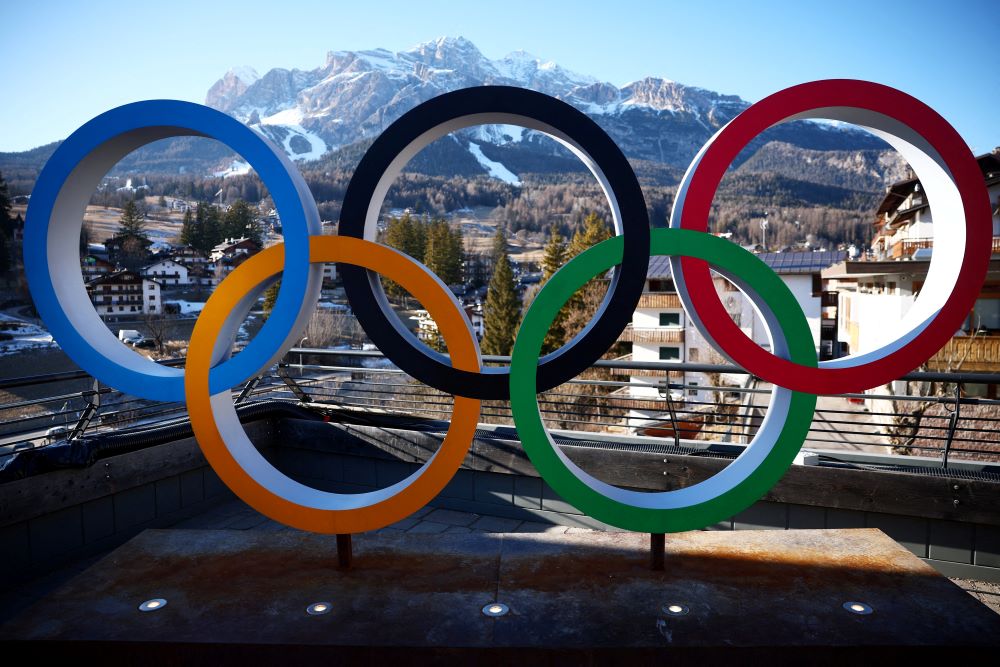
The Olympic rings are seen in Cortina d'Ampezzo, Italy, Jan. 21, ahead of the Milan Cortina 2026 Winter Olympics. The Games started Feb. 6 and run through Feb. 22. (OSV News/Reuters/Guglielmo Mangiapane)

by Daniel P. Horan
The Olympic Games reflect some of the most inspiring and impressive aspects of the human condition. It can be emotionally and spiritually moving to see countries from around the globe — including some currently in hostile relationship with one another — send their best athletes to compete on the world stage with dignity and respect.
Some athletes use their international platform to protest what they perceive as their own government's injustice, as was the case with some Americans critical of the Trump administration's treatment of immigrants and anti-LGBTQ+ policies. Ukrainian skeleton athlete Vladyslav Heraskevych was disqualified for his helmet honoring athletes who have died during Russia's invasion. But the general spirit has been positive and affirming among the athletes and their countries' delegations.
I'm not a diehard Olympics spectator, but I do enjoy tuning into the coverage when I can. The Winter Olympics, in particular, are fascinating to me because of the range of specialized or even obscure sports that most people see only once every four years. But, inevitably, whatever I tune into — including "weird sports" (check out The Athletic's interview asking Olympic athletes to name the weirdest winter sport) — tends to captivate and inspire me. I can even find myself getting emotional, moved by the dedication, training, commitment and passion that these athletes display.
This heightened emotional experience has stayed with me since the games' start on Feb. 6. And as I reflect on what I have been witnessing during the 2026 Milan Cortina Games, I have been thinking of two songs. They have been stuck in my head and have provided the soundtrack to my experience of these games.
The first is from the renowned composer John Williams. His "Olympic Fanfare and Theme," composed for the 1984 Los Angeles Summer Games, is iconic. It is absolutely one of my favorite scores from one of my favorite composers. Who doesn't love the soundtracks for "Star Wars" or "Jaws" or "Superman" or "Indiana Jones" or "ET" or "Jurassic Park"?
The Olympics are to me a wonderful celebration of the "Beautiful Mess" that is humanity when we are honest with ourselves.
This piece has remained a staple of modern Olympic broadcasts, especially if you watch the games on NBC, which acquired the rights to the music ahead of the 1996 Atlanta summer games. NBC paired Williams's score with Leo Arnauld's familiar 1958 theme "The Bugler's Dream." The piece, with its bold timpani notes and loud brass, has been used as a prelude to William's score ever since.
There is something tremendously uplifting in the opening fanfare. It is bright, energetic and uplifting. The way Williams frequently uses the trumpets, with quick staccato-like punctuation, provides a rhythm that conveys both excitement and anticipation.
Some music critics have described Williams as a storyteller and his scores as narratives presenting a symphonic world that resonates with the hearers. Like his classic movie scores, "Olympic Fanfare and Theme" draws the listener in and takes us for a journey. In a 1992 interview, Williams said that he intended the score to represent "the spirit of cooperation, of heroic achievement, all the striving and preparation that go before the events and all the applause that comes after them."
What William's masterpiece gives us is a soundtrack of hope and achievement. It is a celebration of the athlete specifically and for humanity in general. It signals performance at its best and the moments of victory we witness during these worldwide games.
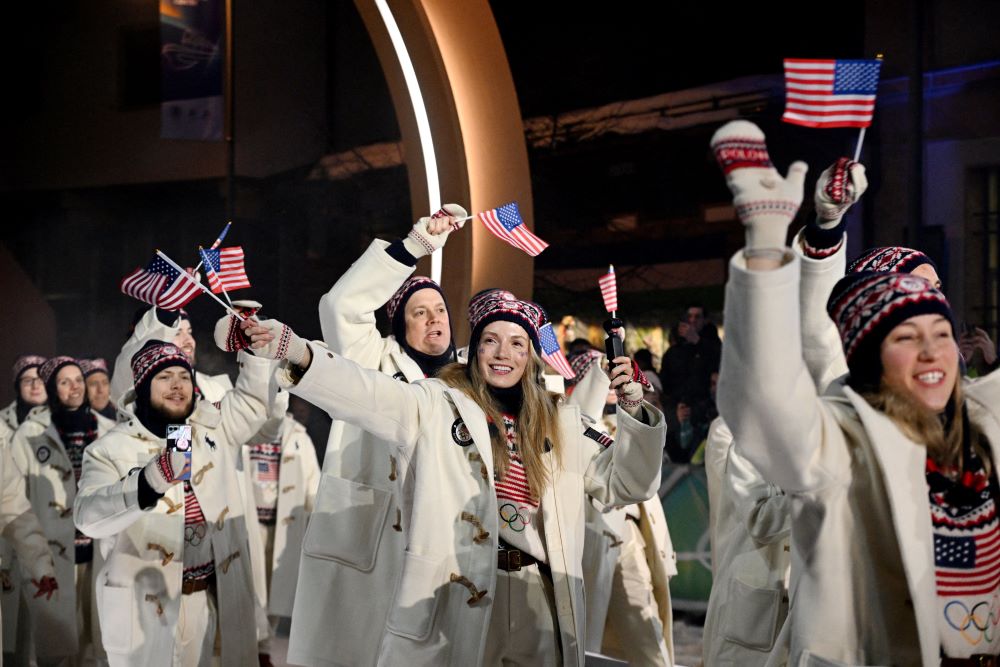
Athletes from the United States wave flags during the opening ceremony of the 2026 Milan Cortina Winter Olympics in Italy Feb. 6. (OSV News/Reuters/Jennifer Lorenzini)
But the Olympics are not just about the highs and celebrations of humanity at its finest. They also display human struggle, injury, pain and loss. The song I think of during the Olympic games that narrates this dimension best is the singer-songwriter Jason Mraz's 2008 song "Beautiful Mess," which he performed live at the 2008 Nobel Peace Prize concert.
While Mraz is best known for radio hits like "I'm Yours" and "The Remedy," among others, I have always liked some of the deeper cuts on his albums, including "Beautiful Mess." To give you a sense of how much I like Mraz, I've seen him in concert more than a dozen times over the years.
Although "Beautiful Mess" is ostensibly about the messiness and complexity of a romantic relationship and the experience of falling in love, the feel of the song and the lyrics seem to me an apt description of the human condition in general. Put another way, I have always felt that this song conveys something like a theological anthropology — we are indeed messy, finite, imperfect and yet beautiful, lovable, graced creatures. We are both sinners and saints, contradictions who contain multitudes.
Advertisement
Mraz's poetic lyrics describe vulnerability and love, struggle and acceptance, which also aptly put into words another feature of the Olympic Games: the heartbreak and fragility of human personhood, which is not as clearly present in Williams' triumphant theme.
While the verses are beautiful and multivalent, it is the repetition of the phrase "here we are" in the bridge, with its persistence and defiant feeling, which expresses the hope I see in the Olympic athletes who fall short of the prize. So far in the games, we might think of the career-ending injuries skier Lindsey Vonn suffered or the disappointing performance by the figure skating wunderkind Ilia Malinin.
When I see how they and other Olympians pick themselves back up after falling in front of the world, I can hear Mraz singing "Here we are / We're still here. What a beautiful mess this is / Well, it's like taking a guess when the only answer is yes." And, at that point, the song shifts into soaring heights with a hopeful celebration of life and love that does not erase tragedy or loss, does not miraculously heal wounds or provide a cosmic reset, but affirms that we are more than we are at our lowest and always remain capable of more.
The Olympics are to me a wonderful celebration of the "Beautiful Mess" that is humanity when we are honest with ourselves. Yes, we should join the jubilant chorus of cheers and celebration for the winners, but we should also see ourselves in the struggles and challenges likewise on display. Williams and Mraz have provided me with a soundtrack for these winter games, for which I will continue to be grateful.