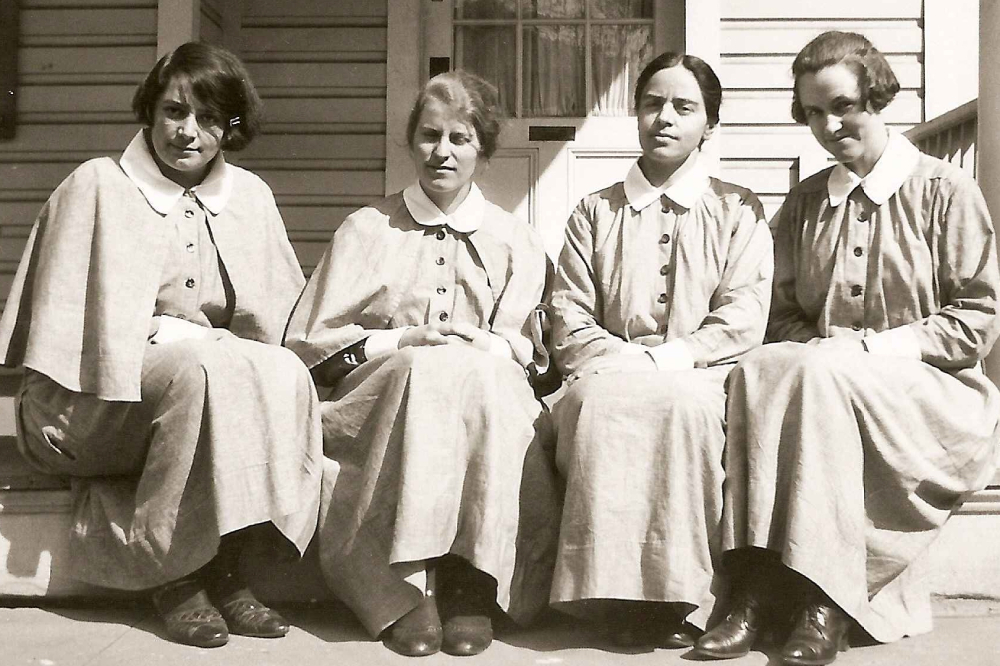
Agnes Ulbrich RN, Evelyn Flieger RN, Dr. Anna Dengel and Dr. Joanna Lyons, the first four women in Medical Mission Sisters pictured in Washington D.C., 1925. (Courtesy of Medical Mission Sisters)
by Christine Schenk
Sept. 30 marked the 100th anniversary of the Medical Mission Sisters, an international community of women whose outsized impact on the well-being of those made poor could be compared to the proverbial mustard seed. From a tiny kernel would burst a worldwide network of clinics, dispensaries, hospitals, training programs for nurses, midwives and other health professionals — and, more recently, grassroots community-based preventive health, advocacy and development initiatives.
From England to India, the Medical Mission Sisters' centenary is being celebrated with special liturgies and lavish praise.
At a Sept. 30 celebration in Pune, India, Bishop Malcom Sequeira of the Diocese of Amravati told the sisters: "You've been salt in forgotten places — adding the flavor of dignity where there was despair. You've been light in dark systems, not only treating wounds, but questioning the structures that caused them. ... You adapted — not because it was easy, but because love demanded it. … You've proven what Dr. Anna Dengel believed: that real love is endlessly inventive."
To honor the centenary, Dr. Ana Jelniker addressed England's House of Lords on Sept. 9. She offered this praise: "The fearless, dynamic, radical spirit of the foundress continues to inspire over 400 sisters from 23 different nationalities and working across five continents to promote healing and wholeness in all aspects of life. …" Jelniker specifically lauded the sisters' advocacy for women: "Through their specific call to uplift women (themselves included) they have been strong in addressing systemic gender inequalities. … Despite being marginalized, women religious are 'quiet powerhouses' in the humanitarian sector."
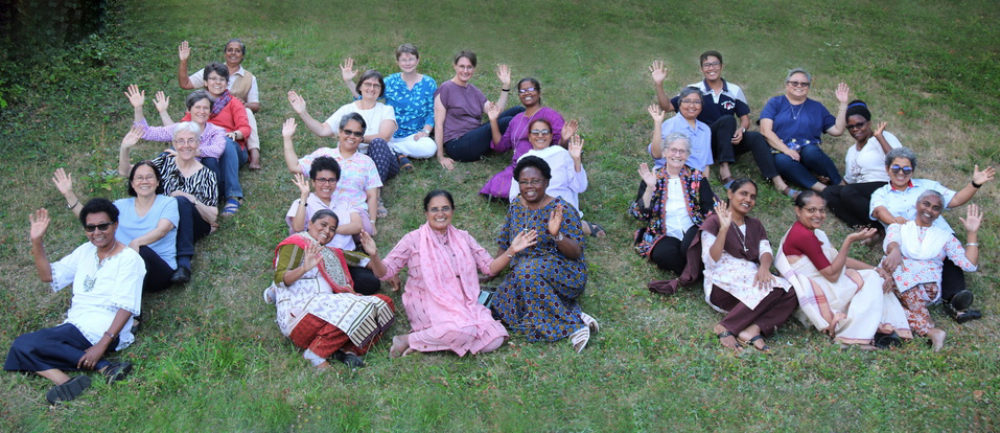
Medical Mission Sisters form the shape of the number 100, celebrating their organization's centenary. (Courtesy of Medical Mission Sisters)
Birth of a pioneering medical mission
On Sept. 30, 1925, four women — two doctors (Anna Dengel and Joanna Lyons) and two nurses (Evelyn Flieger and Marie Ulbrich) — came together in Washington D.C., and the Society of Catholic Medical Missionaries was born. But the idea of a Catholic religious community composed of women physicians, nurses and health professionals had actually begun years earlier.
In 1911 Scotswoman and suffragist Dr Agnes McClaren founded St. Catherine's hospital in Rawalpindi to serve Muslim women who could not receive medical care from male doctors due to strict purdah rules. McClaren became convinced of the need for Catholic sister-doctors and nurses to serve Muslim women, but canon law forbade vowed sisters to witness childbirth. McClaren made five trips to Rome trying to convince church officials to change the rules. Her pleas fell on deaf ears. She changed course and decided to subsidize young women who would study medicine and bring health care to Muslim women.
Enter Austrian-born Ann Dengel, who became the founder of the Medical Mission Sisters. "I was fire and flame and wrote to Dr. McLaren immediately, telling her of my interest," said Dengel. Later she reflected, "This was the answer to my subconscious desires and aspirations, to be a missionary … filling an unfulfilled need which only women could fill … The decision to offer myself in service was so simple and clear to me that I did not feel the need to seek advice." (If You Love, a biography of Anna Dengel by Medical Mission Sister Miriam Therese Winter, was published in 2016.)
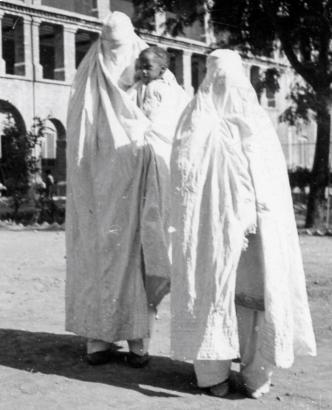
Muslim women are pictured fully observing purdah, Rawalpindi, 1940s. (Courtesy of Medical Mission Sisters)
After receiving her medical training in Ireland, Dengel journeyed to St. Catherine's hospital in North India (now Pakistan) where she served for four years. The needs were overwhelming. Too few female providers meant that thousands of women were dying in or around childbirth. Dengel became convinced of the need for a female religious institute of health professionals to serve pregnant women and the sick in foreign lands.
In 1924, with the help of benefactor Pauline Willis, Dengel traveled to the United States to raise awareness of the need for a Catholic medical mission ministry in poorer lands. To make the medical mission cause known, she wrote newspaper and magazine articles and spoke in countless Catholic schools and churches. With the help of Catholic benefactors, priest consultants and the Catholic Medical Mission Board in New York, Dengel developed a Catholic financial network to support her vision. Even so, in the early years — and still today — paying the bills was always a challenge.
For the first 16 years, because of canon law, the nascent community could only be known as a "pious society," rather than a bona fide Catholic religious order of women. Finally, Dengel and her ecclesiastical supporters, succeeded in convincing the Vatican to change archaic rules. On Aug. 15, 1941 the Medical Mission Sisters were permitted to make public vows for life in the church for the first time.
Women from many nations embrace healing charism
The small community soon attracted other women health professionals who were quickly sent to mission lands. Younger, as yet untrained, women also entered. Sr. Helen Lalinsky arrived in 1927 at the age of 19. She graduated from the Women's Medical College of Pennsylvania in 1935 and is believed to be the first woman to attend medical school as a religious. In 1938, Lalinsky was missioned to Rawalpindi. She spent the next 40 years in Pakistan where she built hospitals, survived riots and lived through the birthing pains of India's independence from Britain. She is remembered as navigating all of these adventures, "with determination and good cheer."
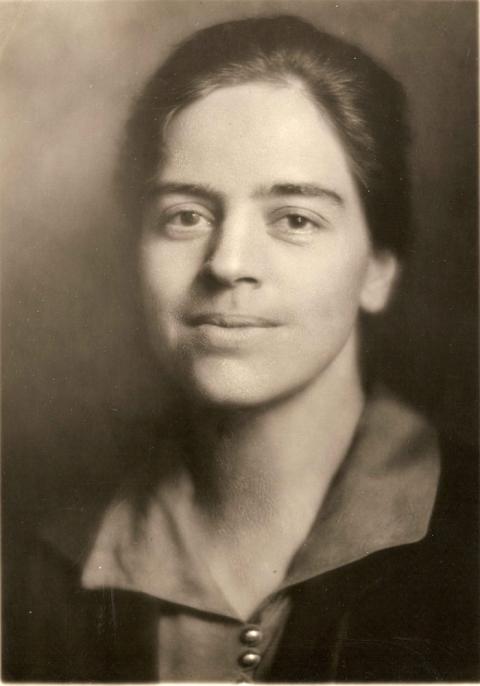
Anna Dengel, founder of the Medical Mission Sisters, pictured in 1924. (Courtesy of Medical Mission Sisters)
The Society grew rapidly and welcomed sisters from India, Africa, Pakistan, the Philippines, Indonesia and Latin America as well as North America and Europe. Today's leadership team is made up of four sisters from India, Ethiopia, Germany and the Philippines.
Ask any Medical Mission Sister or associate and she will tell you one of the things she loves about her community is its internationality; the many beautiful cultural lenses through which to appreciate the richness of the world's people and the mystery of an ever-present healing God at the heart of it all.
For the first 40 years, the sisters focused on building hospitals and creating excellent training programs so indigenous women and men could bring professional medical care to poorer populations — especially women and children. People came to the sister-owned-and-operated hospitals, clinics and dispensaries to receive care. Gradually the sisters began to ask themselves "Why is it that the patients keep coming back to the hospital or clinic with the same disease? What is the real basis of the diseases we are seeing?" As more governmental health facilities became available, they also realized they were often duplicating services.
A paradigm shift
In the wake of Vatican II and a paradigm-shifting worldwide community chapter in 1967, the sisters began to focus on community based preventative care and health education. Now sisters went to live and work among the local people. They learned firsthand how poverty, food availability and the environment were impacting the lives of their neighbors. In the 1980s they relinquished hospital-based models of health care delivery, gifted their hospitals to others and began to pioneer new community-based ways of supporting the health and well being of marginalized populations.
Advertisement
Today, a diverse global community of Medical Mission Sisters and associates continues their uniquely inventive mission to five continents through community centered programs which aim to "combine healing with justice." These include pioneering initiatives that promote environmental education, ecological living, health care, mental health, food security, financial cooperatives and advocacy at the local level and at the UN. Other programs involve justice projects with indigenous peoples, child protection and disability inclusion, promotion of interfaith understanding and combatting sex trafficking and domestic violence.
Perhaps the closing sentences of Bishop Sequeira's homily best capture the present moment:
We look at the century of tireless service and witnessing, not as an end but as a threshold … Your vocation is still radically needed:
In a world that glorifies efficiency, you offer presence.
In a world addicted to quick fixes, you offer long-term accompaniment.
In a world that divides, you build bridges — between faiths, cultures, generations.
May your next century be marked by the same courageous adaptability, the same inventive love, and the same deep faith that began 100 years ago in Rawalpindi — and now reaches the ends of the Earth.
Christine Schenk is a Sister of St. Joseph and an associate with the Medical Mission Sisters. In her 20s, she spent six growth-filled years with the community.