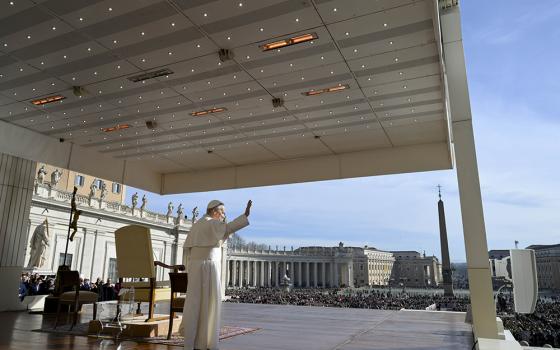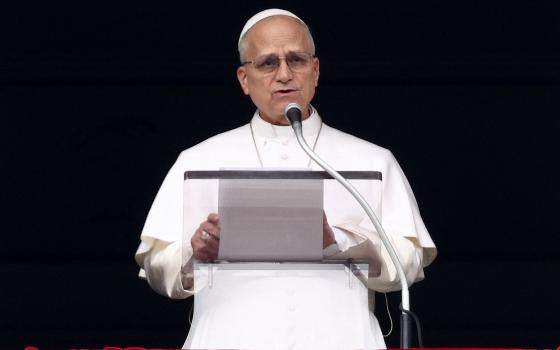
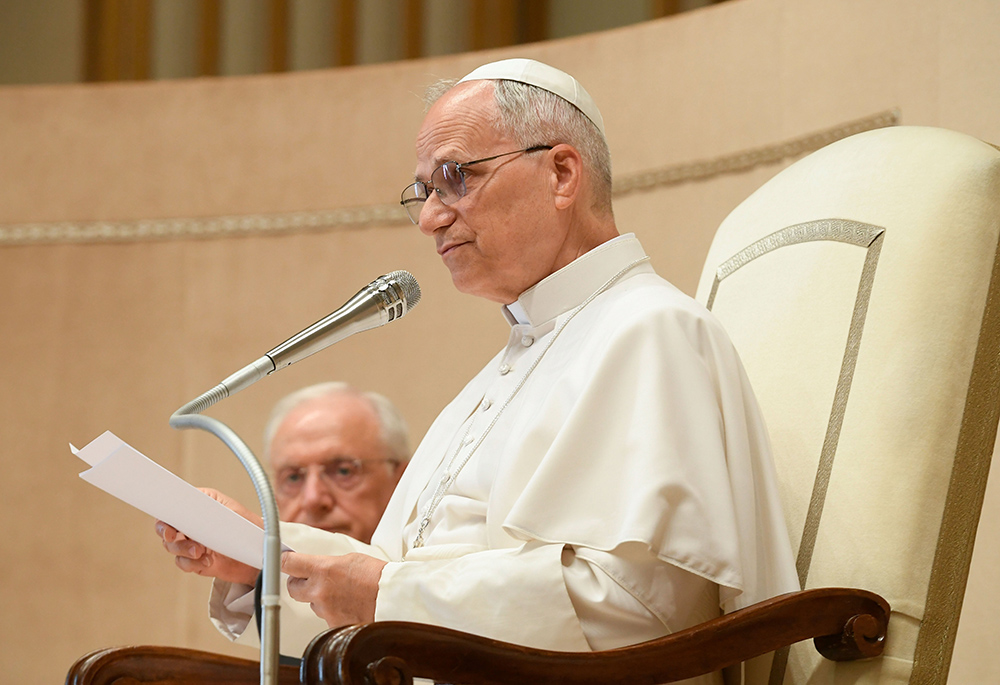
Pope Leo XIV addresses people attending the Conference of the International Inter-Parliamentary Union during an audience in the Hall of Benediction at the Vatican June 21, 2025. He reflected on the ethical challenges posed by artificial intelligence. (CNS/Vatican Media)

by Berit Reisenauer Guidotti
While New York's Cardinal Timothy Dolan referenced the 1978 election of Pope John Paul II as a possible response to the "Communist hegemony" of the Soviet Union, he said Pope Leo XIV was not handpicked by the cardinals to duke it out with the eponymous figurehead of our increasingly isolationist U.S. political order, President Donald Trump.
"I don't think at all my brother cardinals would have thought of him as a counterweight to any one person," Dolan said one day after Chicago-born Cardinal Robert Prevost was elected pope.
Perhaps Prevost's elevation to Roman pontiff was not a response to "any one person," but rather to a group of people connected to a much larger system of power.
When Trump was sworn into office in January, he chose Meta CEO Mark Zuckerberg, Amazon CEO Jeff Bezos, Google CEO Sundar Pichai and now-DOGE-infamous Elon Musk to sit with him on the dais of power. Typically reserved for former presidents and family members, Trump instead reserved precious space on his inaugural platform for billionaire technologists with unfettered access to computing power. These CEOs shepherd artificial intelligence-based technologies capable of transforming cultures and communities around the world through the accumulation and deployment of vast swaths of data.
Prevost’s papal priorities, revealed in his choice of namesake in his predecessor Pope Leo XIII, suggest the cardinal electors were concerned about something more important than U.S. political showdowns. Leo XIII promulgated Rerum Novarum at a time when the steam engine and the Industrial Revolution were dramatically transforming traditional labor arrangements. The European economy was moving to a new factory-based capitalist order and European homes were shifting from units of production to consumption.
The new pope's namesake sought resources from within the Catholic tradition to answer perennial questions about how the church might respond prudentially in times of rapid and wide-reaching sociopolitical and economic upheaval. Like then, the world is now in the midst of another industrial revolution, this time an algorithmic one.
Machine learning algorithms like those pioneered by Facebook, Google and Tesla have already transformed concrete opportunities for flourishing in local communities around the world. For example, people searching for apartments in most major U.S. cities now could be subject to opaque price-setting algorithms, used by corporate rental companies to extract every dollar possible based on the time of the month, location of unit and demand for units among potential renters.
Algorithms have disrupted social practices around dating, too. Those searching for a spouse or partner on apps feel like they must develop strategies to make themselves appealing to others, honing a beacon with words and images that might successfully cut through each matchmaking algorithm to find a potential partner on the other side.
The rise of addictive social media algorithms may have contributed to the rise of political polarization in the U.S. and the promotion of online extremism.
In his first homily to the cardinal electors, Leo XIV argued that they have a special commitment to sharing the Gospel in "settings in which the Christian faith is considered absurd, meant for the weak and unintelligent. Settings where other securities are preferred, like technology, money, success, power or pleasure."
With these words, Leo communicated his intention to speak truth to power, and specifically to speak the truth of Christ's humility in places of power where "a lack of faith is often tragically accompanied by the loss of meaning in life, the neglect of mercy, appalling violations of human dignity, the crisis of the family and so many other wounds that afflict our society."
Nowhere might this loss of meaning seem more evident than in the advent of AI, but perhaps not for the reasons some might think.

The ChatGPT app is seen on a phone placed atop a keyboard in this photo taken in Rome March 8, 2024. (CNS/Lola Gomez)
Until now, Catholic philosophers and theologians have focused on theoretical questions about AI, including questions about how communicative large language models like ChatGPT challenge distinctive claims about personhood in Catholic theological anthropology.
While important, the church's attention to these abstract questions over the past decade means we have also largely ignored the ways in which Silicon Valley's technological powerbrokers have mastered a global supply chain that extracts raw materials and labor from regions reaching from sub-Saharan Africa to China and Ukraine.
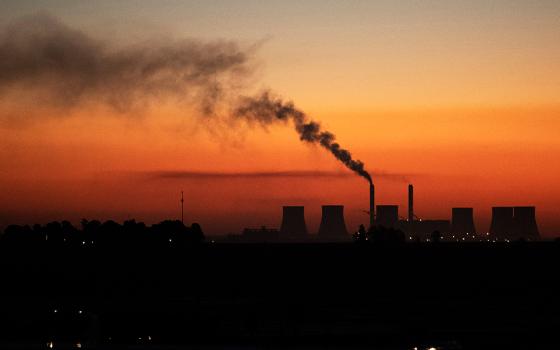
Those working to mine and refine cobalt, silicon and rare earth minerals for Silicon Valley's computing systems are subject to horrifying violations of human dignity. Likewise, mining communities are exposed to harmful health risks from irreversible heavy-metal pollution, while microchip manufacturing itself involves exposure to carcinogenic chemicals and toxins that disrupt women's reproductive systems and can cause birth defects.
Data laborers, many in the Global South, who teach AI models how to identify important variables are woefully underpaid. Social media content moderators are inundated with horrific images of violence and abuse. Yet these attendant systems of dehumanizing labor, resource and data extraction supply the basic foundation of the technological feats now undergirding algorithmic power.
Like the societal changes of the Industrial Revolution that were advantageous to the new capitalist economic order, we already see vast sociopolitical and economic changes taking place in accord with a new algorithmic political order. As philosopher Seth Lazar argues, algorithms are increasingly used by states, local governments, and employers to exercise power over others. This political order is reflected not only in Trump's choice of attendees at the inauguration, but also in his selection of Elon Musk to identify and eliminate "inefficient" offices within the federal government.
Yet so far, the much broader changes wrought through algorithmic power — personal, political, economic and environmental — appear widely disadvantageous for both humanity's personal capacity to engage in intimate face-to-face encounters with one another and for humanity's capacity to live according to any larger conception of the common good. In June, Leo told the Italian Episcopal Conference AI is "profoundly transforming our perception and our experience of life. … The person is not a system of algorithms: he or she is a creature, relationship, mystery."
Leo XIV studied mathematics at Villanova; he should know generally how algorithms operate, at least a bit more than the relatively rudimentary understanding held by most Catholic prelates. In his first dinner as pope, Leo reportedly told Chilean Cardinal Fernando Chomalí that he is "very concerned about the cultural shifts we are living through, a Copernican revolution really — artificial intelligence, robotics, human relationships."
Yet the new pope has also spent a great deal of time working in Peru, in communities surviving on the underside of Western technological expansion. As a result, in the first few days of his pontificate Leo XIV also expressed an intuitive understanding of AI as one of the most pressing social — not merely philosophical — issues of our time.
Advertisement
While meeting with the cardinals to continue discussions from the pre-conclave congregational meetings the day after his election, Leo argued that AI "pose[s] new challenges for the defense of human dignity, justice and labor." He seems to understand that the wide-reaching effects of AI demand more from the church than theologians' faithful engagement with philosophical debates about AI personhood. Catholic social teaching itself is "a treasury" waiting to be unlocked and explored in response to AI.
The cardinal electors seem to have identified something within their own communities that they brought with them to the conclave, perhaps even a sense of the globally disruptive effects of AI. And in choosing Leo, they appear to have decided that the church needs a pope prepared to share the joy of the Gospel in an algorithmic age.
AI has "immense potential," Leo told reporters on the Monday after his election. Yet it "nevertheless requires responsibility and discernment, in order to ensure that it can be used for the good of all, so that it can benefit all of humanity. This responsibility concerns everyone in proportion to his or her age and role in society." Algorithmic power concerns all of us. And algorithmic power — how the world understands it, how we produce it, how we deploy it and how we live alongside it — is clearly at the forefront in Leo's thoughts. Combined with his appeal to Catholic social teaching, Leo XIV is beginning a concrete turn to questions posed by AI concerning power, responsibility, dignity, justice and labor.
Algorithmic power — how the world understands it, how we produce it, how we deploy it and how we live alongside it — is clearly at the forefront in Leo's thoughts.
Leo seems to have come at just the right time. We need a pope who is sensitive to the novel machinations of algorithmic power — not just the mediating power of algorithms, evident now across the many cultures and communities where interruptive algorithms are deployed throughout daily life, but also someone sensitive to the ways in which algorithmic power involves the global extraction of natural resources, and the dehumanizing forms of labor required for these systems to grow and perpetuate themselves. A pope capable of listening to a truly global, synodal church might be able to bring us together to think with the expansiveness of these revolutionary systems.
Through repeated references to AI as an important social reality, Leo could be positioning himself as a counterweight — not to the current U.S. president, but to the disruptive reach of the same powers and principalities which have undergirded the president's rise to power. As then-Fr. Robert Prevost remarked in his 2012 address to the world Synod of Bishops, the church fathers "understood with great precision the techniques through which popular religious and ethical imaginations of their day were manipulated by the centers of secular power in that world."
The conclave may not be a direct response to the United States' political turmoil, but in these early days it certainly seems the new pope offers an important ecclesial response to the technocratic paradigm undergirding Trump's DOGE-ified political regime.
Hopefully, in Leo XIV, the cardinals have found for the church a person uniquely positioned to listen "from below" and "on our knees" to those whose lives are harmed by unjust uses of AI. Leo holds a precious opportunity to continue the journey to the peripheries begun by Pope Francis, by inviting the global community to explore AI from perspectives rooted uniquely in the disarming peace of Christ, who comes first to bring good news to the poor.