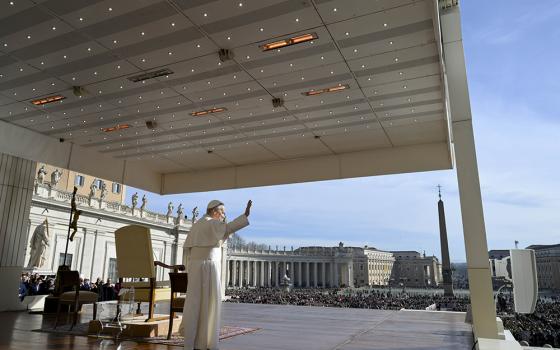
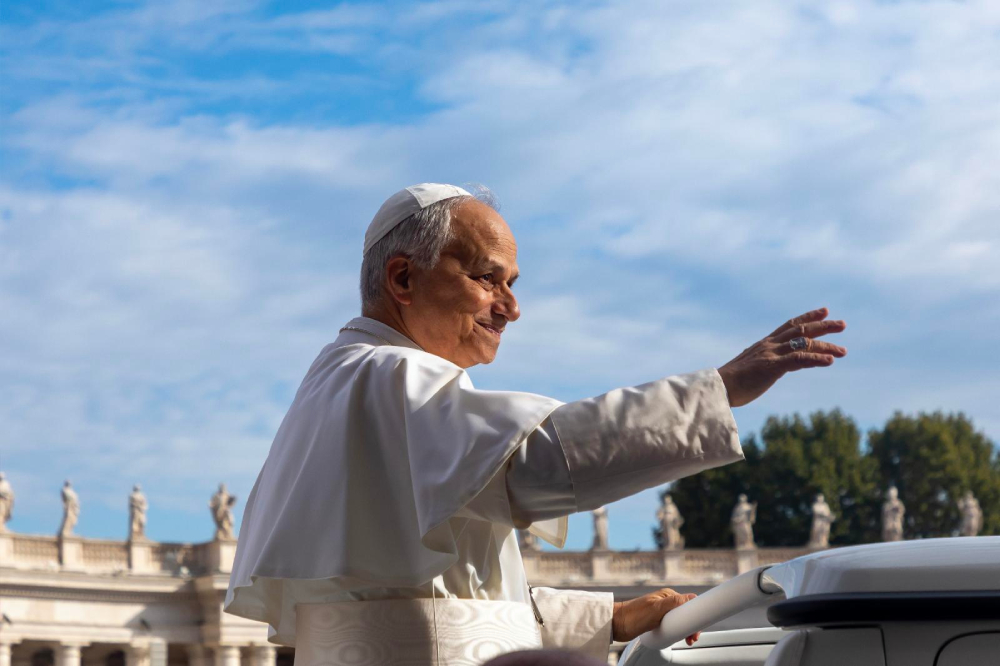
Pope Leo XIV greets visitors and pilgrims from the popemobile before his weekly general audience in St. Peter's Square at the Vatican Oct. 1, 2025. (CNS/Pablo Esparza)

The controversy surrounding Cardinal Blase Cupich's decision to grant an award to Democratic Sen. Richard Durbin has come and gone. Durbin withdrew from the ceremony after 10 bishops publicly criticized Cupich's decision because of the senator's advocacy for abortion rights.
The biggest takeaway from the ecclesiastical kerfuffle was this: Pope Leo XIV, in commenting on the situation, provided the clearest, substantive evidence that his papacy will be in profound continuity with Pope Francis.
Ever since Leo emerged on the loggia of St. Peter's for the first time, wearing the red mozzetta that Francis had not worn at his first appearance, conservatives' hearts hoped Leo would chart a different path from his predecessor. Within hours of his election, EWTN's Raymond Arroyo was contrasting "his look" with that of Francis.

Cardinal Robert Francis Prevost, who has chosen the papal name Leo XIV, appears on the central balcony of St. Peter's Basilica at the Vatican May 8, 2025, following his election during the conclave. (OSV News/Reuters/Claudia Greco)
In style and personality, the differences are obvious. In substance, not so much. Leo, like Francis, is challenging the belief that our Catholic faith requires us to not only prioritize abortion when voting, but insists that abortion is really the only preeminent issue. Those who disagree with the church are beyond the pale and we should not even enter into any dialogue with them. One wonders how this approach will ever convince people to change their minds, but its lack of strategic viability is not the primary consideration. The church's moral theology is the preeminent concern here.
Bishop Thomas Paprocki of Springfield, Illinois, who started the public criticism of Cupich with an essay at First Things, may well believe, in conscience, that abortion trumps all other political issues. (The verb choice is intentional.) He may well think that the issue is so foundational, so linked to a libertarian mindset that is not only alien to Catholic theology but destructive of the common good, that it warrants the kind of culture war approach he has embraced.
But it is not what the church teaches.
Advertisement
In 2009, Judge John Noonan spoke at the Notre Dame commencement after Professor MaryAnn Glendon declined to give the Laetare address because the university was also conferring an honorary degree on President Barack Obama. The president was, like Durbin, an advocate of abortion rights. Noonan filled in and delivered a poignant commentary on conscience and its relations to the day's events:
One friend is not here today, whose absence I regret. By a lonely, courageous, and conscientious choice she declined the honor she deserved. I respect her decision. At the same time, I am here to confirm that all consciences are not the same; that we can recognize great goodness in our nation's president without defending all of his multitudinous decisions; and that we can rejoice on this wholly happy occasion.
We can rejoice that we live in a country where dialogue, however difficult, is doable; where the resolution of our differences is done in peaceful ways; where our president is a man of conscience.
The note about dialogue, which is the finest way to honor differences of conscience and to prevent them from disturbing the commonwealth, is also on-point in the current debate.
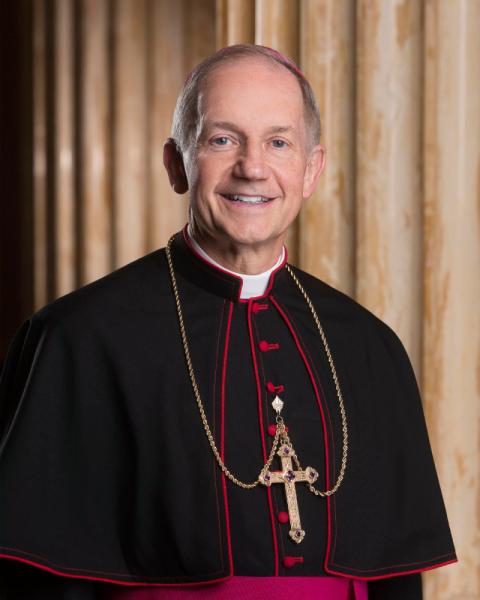
Bishop Thomas J. Paprocki of Springfield, Ill., is pictured in a July 11, 2018, photo. The prelate has criticized the Archdiocese of Chicago's decision to present a "Lifetime Achievement Award" to U.S. Sen. Dick Durbin, D-Ill., Nov. 3, 2025, for his work on migration issues, because of Durbin's public position on abortion. (CNS/Courtesy Diocese Springfield)
In his First Things article, Paprocki had to distort the church's teaching in order to justify his approach. He opens his argument with a shell game: "The Church teaches that abortion — the intentional killing of an unborn human being in the womb — is 'intrinsically evil,' an action that is always and everywhere 'incompatible with love of God and neighbor.'" So it does. But, so far as we know, Durbin has never procured an abortion. Voting in Congress – or at the ballot box – cannot be an intrinsic evil.
Intrinsic evil is the wrong category for discussions of the morality of public policy. Lying is intrinsically evil, but it may not be a mortal sin. Nor do we legislate against lying except in cases when it creates an injustice in commerce, fraud, or distorts our system of justice, perjury.
The pope, on the other hand, did not label the pro-choice Durbin beyond the pale. Like all his predecessors, he believes what the church teaches about abortion and, like them, he does not act as if being pro-choice places one beyond the pale of dialogue. Just as Pope John Paul II did not deny Communion to the pro-choice mayor of Rome, and Francis embraced the pro-choice President Joe Biden, Leo understands that dialogue with people holding different views is a necessary recognition of their dignity and essential to the common good.

Pope Leo XIV waves as he rides the popemobile around St. Peter’s Square at the Vatican May 28, 2025, ahead of his second weekly general audience. (CNS/Lola Gomez)
The pope said: "I don't know if anyone has all the truth on them, but I ask that first and foremost there be greater respect for one another, and that we search together — first as human beings, and in this case as American citizens or citizens of the state of Illinois, as well as Catholics — to really look closely at all of these ethical issues and to find the way forward as church. Church teaching on all of those issues is very clear." That last sentence also contradicts one of the more bizarre talking points from the abortion-only bishops who fret that honoring a pro-choice politician will confuse the faithful. Is there anyone on the planet who does not know what the church teaches about abortion? Our teaching is very clear.
This whole episode will shape the forthcoming discussion about the bishops' adoption of a new document on Faithful Citizenship. The bishops should consult theologians, not apologists, in drafting a document that reflects Catholic teaching in its fullness, not in its culture war drag.
Conservative Catholics had hoped that Pope Francis' reforms would follow him into the tomb, that the universal church would view his papacy the way they did, as a bit of bad weather that had finally and thankfully passed. The things about Francis that they disliked, however, are not things anyone should expect Leo to forswear. He will continue to steer the church clear of culture wars. Conservative Catholics must reckon with the fact that it is they, not the pope or Cardinal Cupich, who need a course correction.