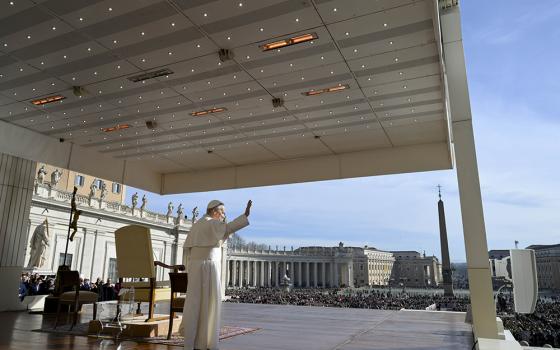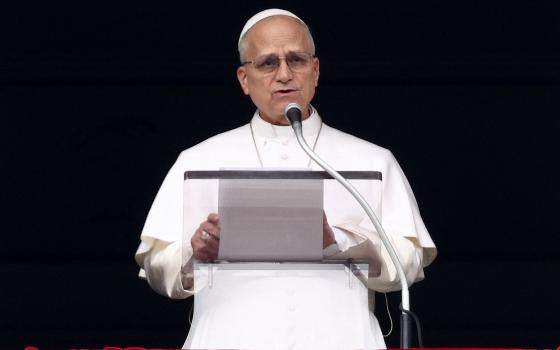
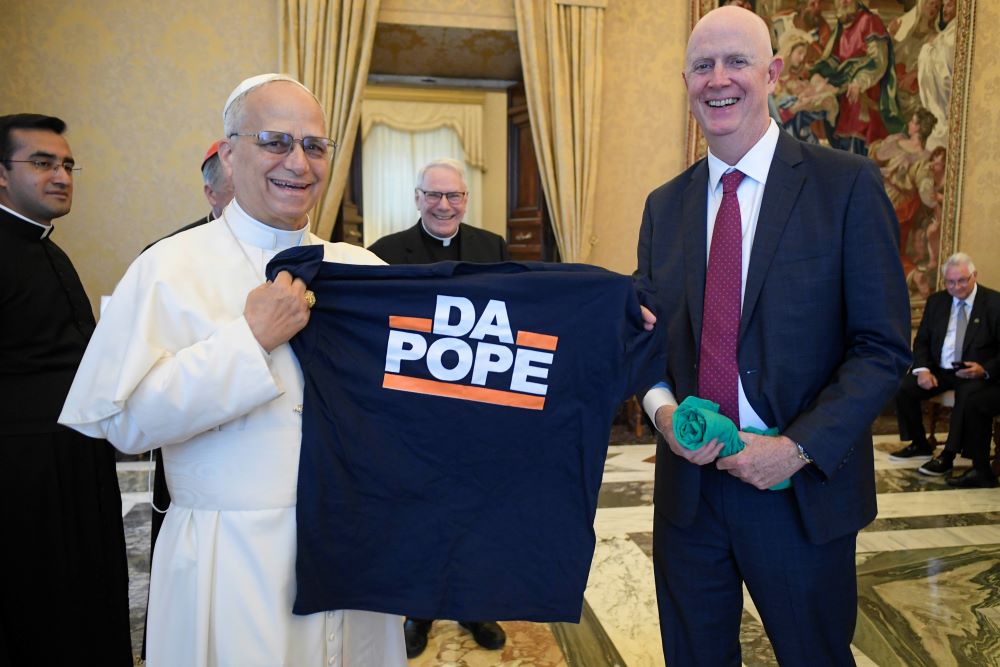
Pope Leo XIV receives a T-shirt that says, "Da Pope," from a member of a pilgrimage of labor union leaders from Chicago visiting the Vatican Oct. 9. (CNS/Vatican Media)

Pope Leo XIV met with a delegation of labor leaders from his native Chicago earlier this month. In his remarks, the pope commended them for their support for the church and for their work to better society.
Here at NCR today, my colleague Brain Fraga reports on the scandalous decision by Loyola Marymount University to abrogate its union contracts with certain faculty. Perhaps no one on the board of trustees is familiar with Catholic social teaching. Perhaps they should have joined the Chicago labor leaders to hear what the pope had to say!
"In a particular way, I would like to express my gratitude for your collaboration with the Church. Cardinal Cupich has informed me about your many contributions, including your support of seminarians through hosting, together with civil and business leaders, the annual Rerum Novarum Award banquet," the pope told them Oct. 9 .
He also thanked them for their efforts at "broadening the participation and inclusion of minorities in the labor movement through apprenticeships and training," their "commitment to the protection of the environment" and voiced his "appreciation for your welcome of immigrants and refugees" The pope then greeted each member of the delegation and received a baseball jersey marked "Da Pope."
"The whole thing was amazing," said Robert Reiter, president of the Chicago Federation of Labor. "The chaplain of the Chicago Federation, Fr. Clete Kiley, helped organize the pilgrimage in this Jubilee Year of Hope. We had our private audience with the pope, but we also had a meeting at the Dicastery for the Promotion of Integral Human Development where we discussed the migration issue, looked at some current statistics on migration and how migration impacts work. And we went to the Borgo Laudato Si', which is really a reflection of the work of Pope Francis for the environment."
'It is ordinary workers who will stand up to some of the oppressive measures we are facing in the U.S.'
—Fr. Clete Kiley
Reiter also told NCR he had been to a meeting in Rome 18 months ago that focused on Laudato Si' and the role of workers in protecting the environment.
Kiley was also very moved by the audience with Pope Leo. "One of the great joys for me in the pilgrimage was that, in the past 15 years, my bishop has freed me to work in the labor movement," he told NCR. "A sense of mission I have had in that work is an aspiration, a sense of mission, to bring labor back closer to the church and the church back closer to labor. That has been my great hope these 15 years. Standing at the papal audience, and I am standing there with the pope and with my cardinal and all these labor leaders and I thought, you can't get any closer than this. It was a beautiful thing to see."
Reiter said, "Pope Leo delivered a very clear message on immigration to us, and he also validated many other things that we do." The group's meeting at the Dicastery for the Promotion of Integral Human Development included a presentation by Davide Bernocchi, secretary general of the International Catholic Migration Commission, based in Geneva. "He was excellent," Kiley said. "He helped recognize that in the U.S. we are dealing with these significant immigration concerns, and all the trauma, but also that there are millions of migrants around the world and we need a global conversation about the root causes of migration."
The group also went to the Basilica of St. Mary Major to lay a wreath at the tomb of Pope Francis. "We were very mindful that Francis was a workers' pope, a labor pope. There was a really strong sense of solidarity we felt. We went through the Holy Door at St. Mary's, and we laid the wreath. It was very meaningful for all of us."
One stop on the pilgrimage was not on the usual tourist route, the Church of San Giocchino. Pope Leo XIII was distressed that among the many churches in Rome, none were dedicated to his baptismal saint. Workers from around the world contributed to the church's construction.
The church also contains another story about a worker standing up to tyranny. "In February 1944, the janitor at the church spoke with the pastor. The Italian government had collapsed and the Gestapo was running the city," Kiley explained. "The janitor built a false wall in the dome and they hid 44 Jews in the dome. He and his daughter cared for them and are counted among the righteous gentiles at Yad Vashem in Jerusalem. Here was an ordinary worker and he and his daughter stood up to the Gestapo. He had the courage to do what he did from his vocation as a worker. I used our visit as a teaching moment. It is ordinary workers who will stand up to some of the oppressive measures we are facing in the U.S."
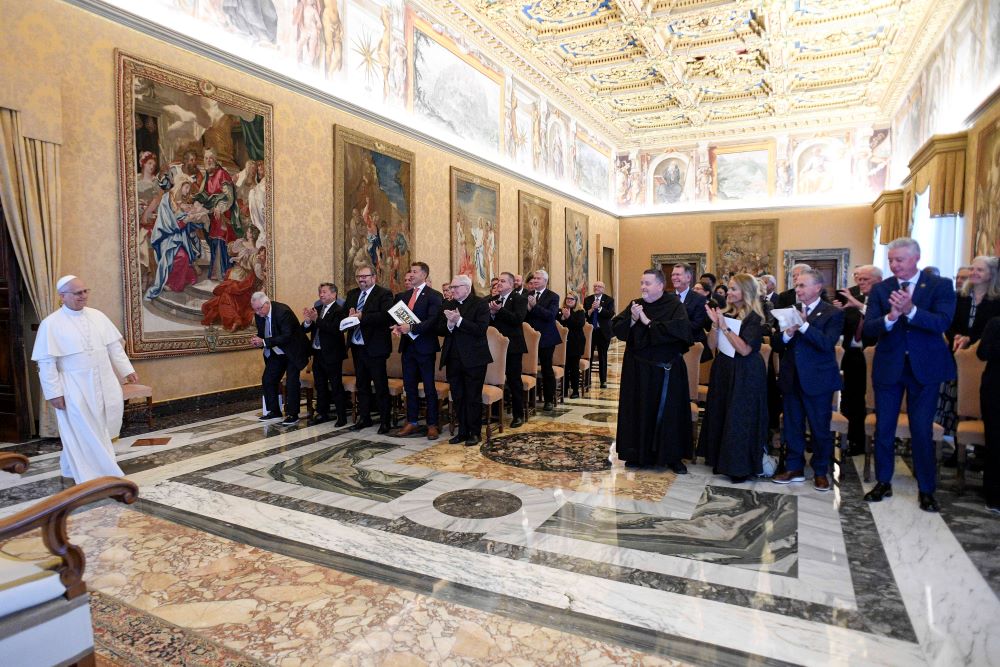
Pope Leo XIV arrives for an audience at the Vatican Oct. 9 with labor union leaders from Chicago making a Jubilee pilgrimage to Rome. (CNS/Vatican Media)
In many places, the once vibrant relationship between church leaders and organized labor has lessened over the years, but not in Chicago. "Here in Chicago, our relationship with the archdiocese has always been strong and transparent," Reiter said. "It is always encouraging to have on-the-ground support from the cardinal. As a Catholic labor leader, I want to strengthen the Catholic labor community."
Reiter and Kiley are both forward looking. "I want to lean into the work at Borgo Laudato Si'," said Reiter. "And we Catholic labor leaders need to stand up for migrant workers in the face of these immigration raids. The leadership of the clergy in Chicago has been tremendous and they are advocating for people who are often members of our unions. We're marching in the same direction on all these issues as it relates to workers."
Kiley took part in a meeting of ecclesial and labor leaders from the U.S., Latin America and the Holy See in August at the headquarters of the U.S. bishops' conference in Washington, D.C. "A sentiment that came up again and again was, from our different lanes, how can we start working on a new social contract? What are the elements of that contract, one that transcends the current politics in which neither party really thinks about this. I mean, one job should be enough." Others who attended that meeting felt it was seminal, the start of an important collaboration both between North and South and between the Catholic Church and labor.
Advertisement
Organized labor lives the solidarity that is at the heart of Catholic social teaching. There is no way our society and our politics can become healthy again unless the labor movement gains renewed strength. And, as Reiter said, the church and labor are "marching in the same direction" on a host of clamant issues.
Church organizations must choose whether to follow the pope or to follow the lead of the Loyola Marymount board. The Jesuit fathers on the Loyola Marymount board should have resigned in the face of this union-busting decision. There is little doubt what the first Jesuit pope would have done! There is little doubt where the first U.S.-born pope stands. It is time for Catholic schools, hospitals and other organizations to embrace the church teaching on the right to organize and to work with organized labor for the betterment of our fractured society.