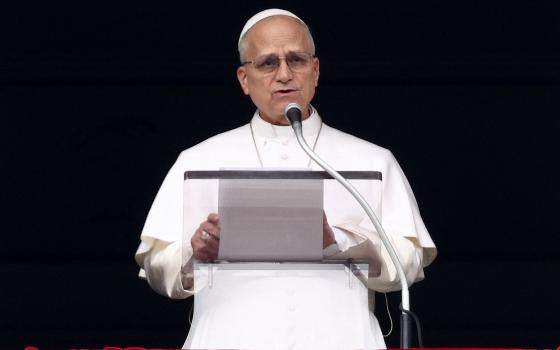
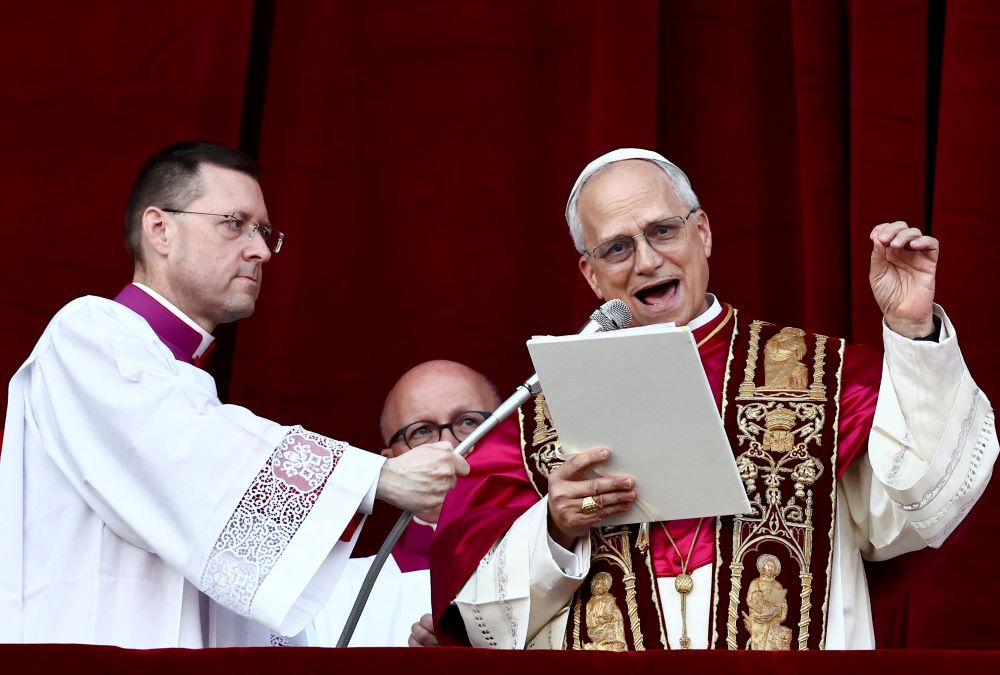
Cardinal Robert Francis Prevost, who has chosen the papal name Leo XIV, speaks on the central balcony of St. Peter's Basilica at the Vatican May 8 following his election during the conclave. He is the first U.S.-born pope in history. (OSV News/Reuters/Yara Nardi)
More than 30 years ago, one of us urged Democrats to "speak American." The point: The nation's leaders need to trade policy jargon for plain talk rooted in everyday life, a little angry, a little funny, always human.
Now, Pope Leo XIV, the first North American-born pontiff, requires no translation for the ordinary listener. For the first time, Americans can listen to a pope and understand him instantly because he speaks unpretentiously in Italian, Spanish, French and Portuguese and he can switch on demand to unmistakably American English.
When Leo first appeared on the balcony May8, his greeting in Italian was simply: "Peace be with you all! … Let us move forward, without fear, together, hand in hand with God and with one another." Then, a few weeks later, in a video message to young people gathered at Chicago's White Sox ballpark, he urged them in American English to "become beacons of hope." At the ALS Walk for Life, again in American English, he offered "greetings from Rome" and said: "The quality of our lives is not dependent on achievement … [but] on love."
Leo doesn't need bishops to decode him; his American flock can hear him directly when he wants to make himself heard.
The pope also favors short sentences and concrete imagery. At the Jubilee of Sport he told athletes: "No one is born a champion or saint." Even Pentecost theology came without marble: "The Spirit … breaks down our selfishness, the fears that enchain us." And his simplest pastoral summary — "Even at the darkest moment, it's never too late to love and forgive"— needs no footnotes. When he must use church jargon, the pope translates first: "God created the world so that we might all live as one," he explained, adding that synodality "is the Church's word for that unity."
While prior popes have mastered speaking simply, all have spoken English as a second, third, or fourth language, or relied on interpreters. American bishops were their intermediaries — translating papal texts, contextualizing homilies and tuning up messages as they saw fit. Even Pope Francis, whose warmth transcended words, spoke an Argentine English that still felt foreign. Leo doesn't need bishops to decode him; his American flock can hear him directly when he wants to make himself heard.
For bishops accustomed to mediating between Rome and the pews, Leo's mother tongue potentially narrows their interpretive space. The pope's voice now competes with theirs in the vernacular the faithful use. When he says "you all" to Americans, he claims cultural intimacy; when he talks about "achievement," "champions" and "hope," he borrows the idiom of the American middle class. In terms an American politician would understand, he has found the populist register that fuses values and emotion without losing moral weight.
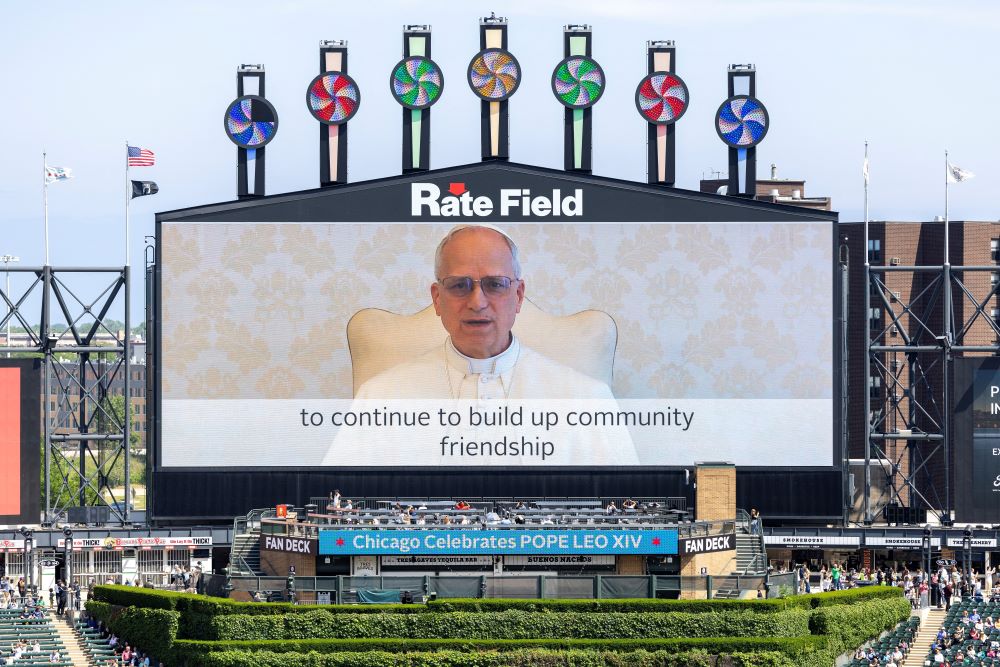
Pope Leo XIV delivers a video message during a public celebration hosted by the Chicago White Sox and the Archdiocese of Chicago for the election of the pontiff ahead of a Mass in his honor at Rate Field in Chicago June 14. (OSV News/ReutersCarlos Osorio)
In any language, Leo's's speech sounds like the way Americans think about virtue: concrete, motivational, pragmatic. He preaches mercy as resilience—"never too late to love and forgive" — and holiness as teamwork — "no one is born a champion or saint." In American English, he will echo the civic spirituality of Abraham Lincoln and Martin Luther King.
This reflects the fact that Leo is, as a Saul Bellow character introduced himself: "an American, Chicago-born." Midwesterners — among them, Abraham Lincoln, Mark Twain, Langston Hughes and Willa Cather — played an outsized part in creating American English, whose simplicity made it more democratic than the more formal rhetoric of the Old World.
Lincoln forever defined American democracy — "government of the people, by the people, for the people" — in his Gettysburg Address, consisting of 10 sentences and 272 words that is approximately 2 to 3 minutes long. Whether spoken by presidents or popes, such language appeals to what Lincoln called "the better angels" of our nature.
For Catholics — and all Americans — that clarity is liberating. When the pope's words land directly, from parish bulletins to cable news and Instagram feeds, authority shifts from translation to resonance.
Advertisement
From Capitol Hill to the Vatican to the pews and barstools of daily lives, language divorced from ordinary experience becomes sterile. Leo's remedy is populism as plain speech — an invitation to belonging. The most morally resonant doctrine should sound like dialogue: Lincoln honed his ideas in stump speeches in small towns. The Gospel's first audience was not a think tank but fishermen.
Simplicity can also signal depth. Saying "love and forgive" condenses the catechism into two verbs. Telling the world "move forward … hand in hand" translates hope into motion. Declaring "We have nothing to fear but fear itself" conveyed the confidence that Americans could overcome the Great Depression without sacrificing democracy in an age of dictators. That is language Americans — and all of humanity — can live by.
In a polarized age, a pope who speaks fluent American English with a Midwestern accent may be exactly what the church, our country and a weary world need. Leo's speech reconnects moral authority to common sense. For U.S. Catholics — and Americans from every faith and viewpoint — long used to hearing Rome relayed through an interpreter, it may soon feel like a direct line to the moral authority of the ages and the moral imperatives of our moment.