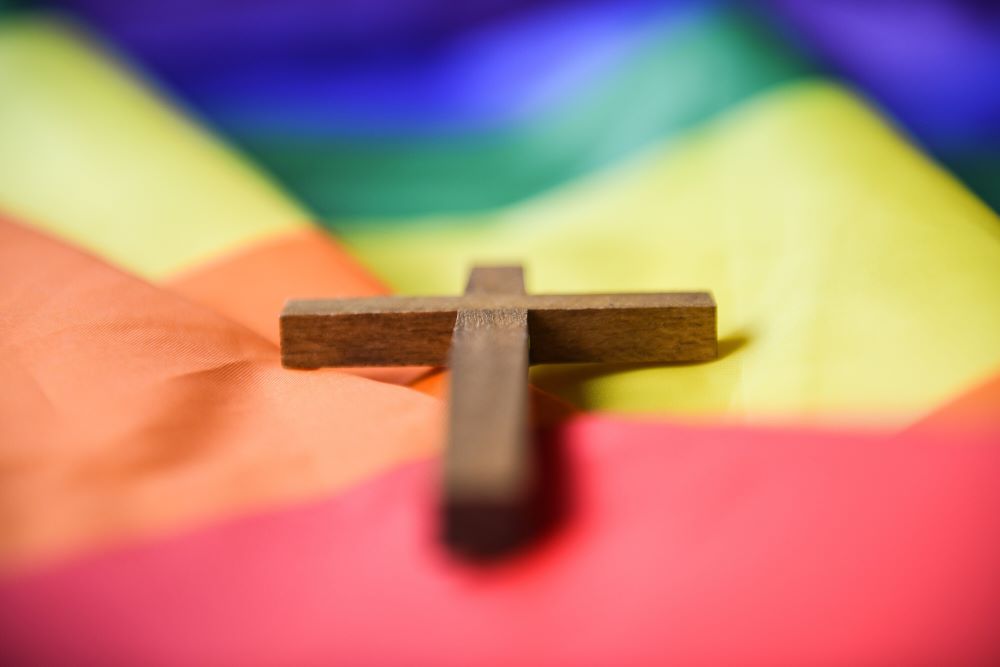
A wooden cross lies on a rainbow flag in Bonn, Germany, March 16, 2021. (OSV News/KNA/Julia Steinbrecht)

by Maxwell Kuzma
Queerness is not a problem Catholicism needs to solve — it is a lens through which the church can recover its liberatory core. By queerness, I mean not only LGBTQ lives and experiences, but a theological way of seeing that resists rigid norms, enforced hierarchies and false binaries. This lens is urgently needed because Catholicism has repeatedly struggled with its own attraction to power — too often confusing authority with domination, violence and control. Queer liberation theology offers the church a way to resist these temptations, calling it back to a Gospel rooted in dignity, solidarity and freedom rather than fear.
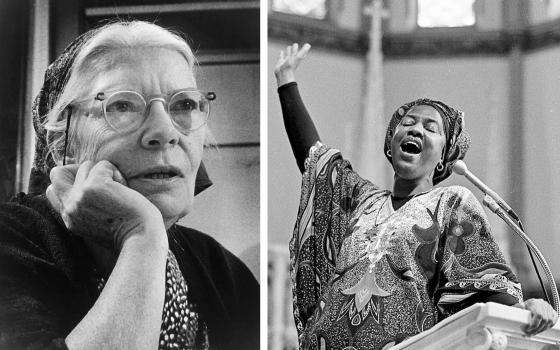
Catholicism has always wrestled with the question, "How do we meet the present moment?" At times, the church has responded with courage and imagination, and at other times with violence, repression and fear. Its history includes clergy who were wolves in sheeps' clothing, bloody crusades later apologized for, and high-control organizations that cloaked abuse in religious language. Too often, Catholic institutions have aligned themselves with power rather than liberation. And yet, as we know, running alongside this history is another tradition — one rooted in resistance, justice and fidelity to the Gospel's most disruptive claims. With examples like medieval saints and mystics who embraced gender-expansive ways of imagining God, figures like Oscar Romero, Dorothy Day, Lawrence of Rome and Thea Bowman, the church has also produced witnesses who stood with the poor, the excluded and the condemned.
This current of resistance was expressed in mid-20th-century Latin America through liberation theology, born right after the Second Vatican Council (which Pope Leo is currently celebrating). Liberation theology emerged as a way of thinking about God from the ground up, shaped by real lives rather than abstract doctrine. Rather than beginning with the perspectives of those with power or social status, it centers those pushed to the margins and takes their lives seriously as places where God is already at work.
The heart of queer virtue is simple: Christianity continually calls followers of Jesus to rupture false binaries that pit people against one another.
Importantly, this framework is not foreign to Catholic tradition. Liberation theology is directly compatible with the church's own social teaching, which insists that human life is sacred, dignity is nonnegotiable and society must be judged by how it treats its most vulnerable members. That demand feels especially urgent now. We are living in a time marked by mass displacement, preventable death and the deliberate abandonment of the vulnerable. We see families separated by deportation and militarized immigration enforcement unleashed on civilian communities and U.S. citizens with lethal consequences. Trans people are legislated out of public life, families are priced out of housing while wealth concentrates in fewer and fewer hands, and entire populations are rendered disposable in service of political power. War, climate collapse and carceral violence are treated as acceptable costs of upholding an authoritarian definition of economic and political dominance.
Within this landscape, conservative and far-right Catholic movements often present theological messaging designed to validate these systems, articulating Catholicism as not only compatible but necessary for their authoritarian, theocratic views.
And so we arrive at queer liberation theology, then, which offers a nonhierarchal way of seeing. It is not simply a theology about LGBTQ people, but a broader moral and spiritual perspective grounded in the very same values enshrined in Catholic social teaching: human dignity, personal conscience and deep concern for those most easily discarded. It understands authority in Christ not as domination or control, but as a call to resist evil, care for one another, and participate in God's work of liberation through humility and service.
Advertisement
Queer Episcopal priest and political strategist Elizabeth Edman articulates some foundational principles of queer liberation theology in her book Queer Virtue. Reading Scripture closely, Edman argues that Christianity persistently disrupts rigid "us versus them" thinking — making it far queerer than many assume. Moving beyond shallow notions of tolerance, she shows how queer experience can help Christians better understand their faith, revealing queerness as ethically serious, spiritually rich and capable of illuminating how love, community and belonging are truly formed.
This insight echoes older Christian traditions as well. Medieval saints and mystics often expressed fluid, expansive and genderqueer or gender-subversive images of God, leaving behind a spiritual and artistic legacy that quietly undermines modern claims that queerness has always been incompatible with traditional Christianity.
As Edman writes, the heart of queer virtue is simple: Christianity continually calls followers of Jesus to rupture false binaries that pit people against one another. Jesus himself does this when he calls us to love our neighbor without qualification — forcing a reexamination of who belongs, who is excluded and how love must be practiced. The LGBTQ community has long walked a similar path, attending to those pushed to the margins and naming the lives that remain unseen and unacknowledged. In doing so, queer experience has a prophetic voice that calls out to all Christians, challenging the church to reckon with its failures, confront its complicity and recover a faithfulness rooted not in the preservation of power but in radical care, inclusion and the pursuit of justice.