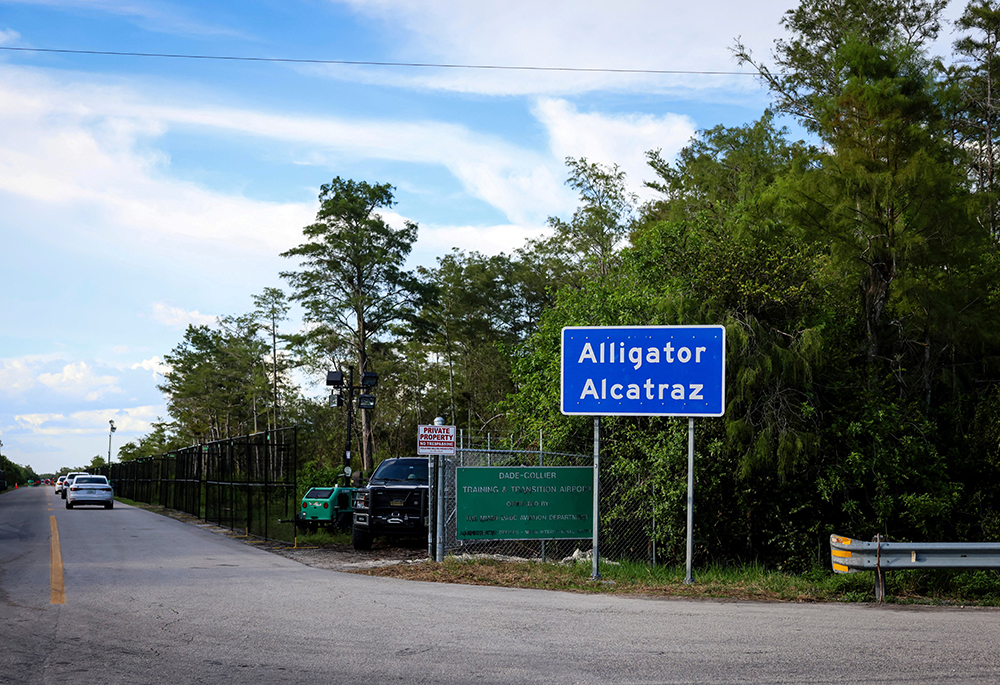
A sign is seen at the entrance of "Alligator Alcatraz" Immigration and Customs Enforcement, ICE, detention center in the Dade-Collier Training and Transition Airport in Ochopee, Florida, Aug. 3, 2025. (OSV News/Reuters/Marco Bello)
by Glenn D. Magpantay
At South Florida's immigration detention center, known as "Alligator Alcatraz," multiple constitutional violations over recent months have exposed that religious rights are being treated as revocable privileges rather than constitutional guarantees, illustrating how religious freedom remains under siege in America's correctional facilities.
On Oct. 9, faith leaders delivered a petition signed by 113 clergy members to the Florida Division of Emergency Management, requesting access to provide chaplaincy services to detainees, according to The Tallahassee Democrat. The petition came after clergy members struggled to minister to detainees' spiritual needs. These faith leaders sought to offer spiritual care to all people, regardless of race, nationality or legal status, during a "dark, traumatic time."
In July, Archbishop Thomas Wenski of Miami reported significant challenges arranging Masses and spiritual care for detainees and staff. That same month, a detainee said he had his Bible confiscated, the one thing he stated that keeps his faith, and said he was told, "there is no right to religion."
These violations at Alligator Alcatraz are not isolated incidents but symptoms of a systemic problem plaguing America's correctional system. The free exercise of religion, a foundational pillar of American society protected by the First Amendment, is fundamental to our nation's identity. Religious texts like the Bible, Torah and Quran are essential to the practice of faith for the nearly half of Americans who identify as religious, including myself. Yet, despite the constitutional promise of religious freedom for all, incarcerated citizens are denied access to sacred texts, effectively preventing them from practicing their faith while behind bars.
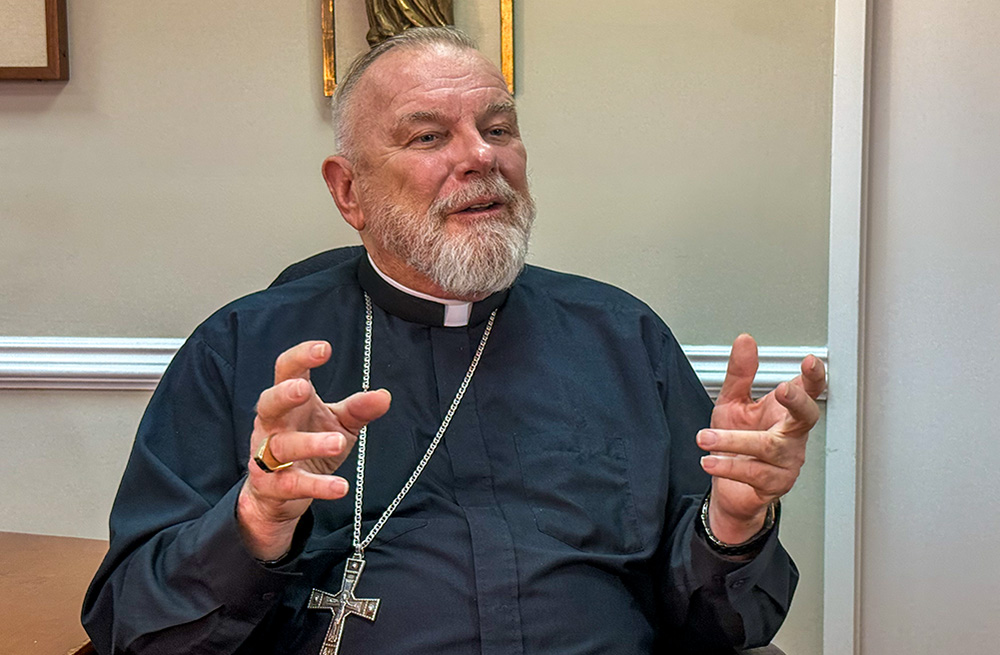
Miami Archbishop Thomas Wenski speaks with reporters July 21, 2025, at the pastoral center of the Miami Archdiocese in Miami Shores, Florida. (NCR photo/Garrett Shanley)
A pattern of constitutional violations
Over the past year, the U.S. Commission on Civil Rights investigated the religious freedom of incarcerated individuals from 2017 to 2023. This significant investigation, spearheaded by Commissioner Peter N. Kirsanow, uncovered numerous barriers to religious practice. What I found particularly disturbing were the systemic obstacles preventing incarcerated individuals from obtaining religious texts — First Amendment violations that mirror Alligator Alcatraz's alleged infringement.
PEN America, a nonprofit in pursuit of civil liberties through literacy, provided crucial evidence of restrictions on religious texts in correctional facilities across the nation. Their research revealed that prison chaplains often wielded capricious discretion in banning religious materials, resulting in what appears to be systematic bias favoring Christian material over that of religious minorities. In 2022, according to reporting by The Tennessean, at the Trousdale Turner Correctional Facility, the Quran, Torah, Bhagavad Gita, and Norse mythology books were temporarily banned while the Bible remained freely available.
The targeting of religious minorities is particularly troubling. A significant number of incarcerated individuals are Muslim or convert to Islam during their incarceration. Religion in general, and Islam in particular, facilitates rehabilitation. The Quran embodies teachings of compassion, kindness and forgiveness. Yet, Muslim inmates face disproportionate obstacles to accessing their sacred text. In a disturbing incident, an officer deliberately stomped on an inmate's Quran and threw it into the trash. The officer left a visible boot print after the prisoner retrieved it from the garbage.
While Muslim prisoners are overrepresented in state prisons, they have limited access to religious resources in comparison to their Christian counterparts. In one facility, 17 prisoners were forced to share a single copy of the Quran. In 2022, the Michigan Department of Corrections effectively banned the Quran by prohibiting foreign language books, since the text is traditionally written in Arabic. These obstacles of access, desecration and scarcity are intolerable.
Christian texts are not exempt from restrictions, as demonstrated by Alligator Alcatraz's alleged violation. Elsewhere, inmates have been denied access to materials like the Colored Pencil Painting Bible and Our Daily Bread, a popular Christian devotional.
Prison officials often justify these religious restrictions under the guise of maintaining institutional safety and security. While a reasonable goal, such prohibitions can be overly broad. It thereby prevents incarcerated individuals from practicing essential tenets of their faith, rights explicitly guaranteed by the First Amendment. Moreover, overly broad restrictions directly violate the federal Religious Land Use and Institutionalized Persons Act, which was specifically designed to protect incarcerated individuals from religious discrimination and ensure their right to practice their faith within correctional facilities.
Advertisement
A call for constitutional compliance
As a member of the Catholic faith and as a civil rights lawyer, I believe that we have a moral and constitutional obligation to protect religious rights, including for those who are incarcerated and detained. The arbitrary banning of religious texts violates the First Amendment and strikes at the heart of religious freedom.
Correctional facilities and detention centers should allow individuals to practice their faith during their incarceration. Equitable policies that ensure that all inmates have equal access to religious texts must be implemented, replacing discriminatory practices with solutions that honor both legitimate security needs and constitutional rights.
The Commission's report delves into this particular issue but also examines many other violations and injustices that incarcerated Americans experienced, particularly during the pandemic. Bans on religious texts in prisons cannot stand. The free exercise of religion is not a privilege to be granted or withheld at the discretion of correctional officials — it is a fundamental constitutional right that must be protected.
[Glenn D. Magpantay is a member of the United States Commission on Civil Rights, an independent, bipartisan federal agency that advises the White House and Congress on civil rights and equal opportunity. The views expressed herein are Commissioner Magpantay's own and do not represent the entire commission.]
A version of this commentary was originally published in Glenn D. Magpantay's statement included in the U.S. Commission on Civil Rights' 2025 report "Enforcing Religious Freedom in Prisons."