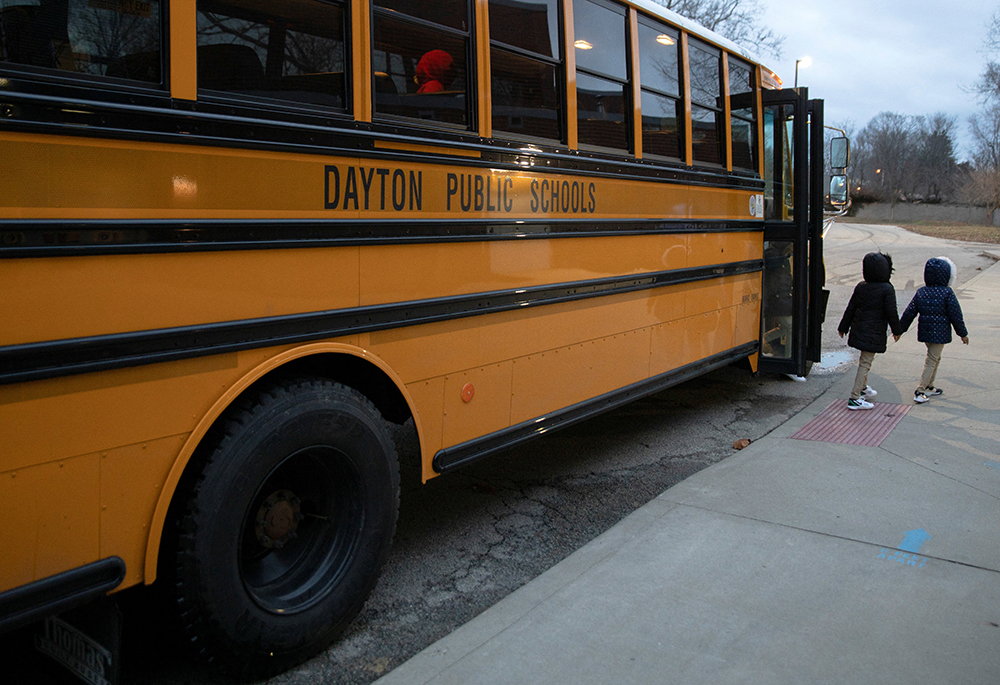
A file photo shows a public school bus dropping students off at an elementary school in Dayton, Ohio. (OSV News/Reuters/Megan Jelinger)

Education is one of those issues that rarely captures headlines. Immigration is in the news. The economy is a perennial on the front page. But education policy always seems too stuffy and too abstract for the general public. Two recent stories, however, raised the issue in ways that are interesting and, hopefully, will generate discussion about how to improve our nation’s educational system.
First was a column by Fareed Zakaria in The Washington Post. He argued that the Democrats "promise wonderful-sounding new programs — free child care, for example — but in fact preside over bloated bureaucracies and inept execution. If America has an affordability crisis, it tends to be in places Democrats govern, like New York, Illinois and California, which all feature high taxes, soaring housing costs and stagnant outcomes in basic areas like education and infrastructure." He has a point.
Turning specifically to education, Zakaria noted that in New York City, "public schools remain mediocre despite spending more than $36,000 per pupil last year — the highest in the nation among major school systems." He calls on Democrats: "Fix the schools before promising new subsidies."
Is "fixing the schools" really that simple? And would it be sufficient? How is a mom who is working two jobs in order to pay the rent able to give her children the follow-up on classroom learning and the encouragement that children need to persevere in their studies? How is a working-class dad, whose own education may have been lacking, going to help his kids with their studies?
I have long admired the central place given to education in Jewish culture. The famous line "These and those are the words of the living God" point to the role of argumentation in teaching the Torah. In the POLIN Museum of the History of Polish Jews in Warsaw there is an old painting of Yeshiva students, deeply engaged in debate. This commitment to education and critical thinking runs deep. Can the same be said of contemporary U.S. culture?
Yes, our schools need to do a better job but the problem with education is deeper than merely fixing what happens in the classroom. Until we redraw the social contract so that one job is enough to support a family, education in America will be great for wealthy kids and lousy for poor and working-class kids.
Advertisement
The second article was in The New York Times and it was an interview by the Times' Ariel Kaminer with three university presidents: Sian Beilock of Dartmouth College, Jennifer Mnookin, chancellor of University of Wisconsin-Madison and Michael Roth of Wesleyan University. The whole discussion is interesting, and the points of difference among the three presidents are telling of where the faultlines are in discussions about higher education.
Two comments jumped out at me. First, President Beilock said, "As leaders, we lost our mission a bit about what higher education was about. We're educational organizations. We're not political organizations, like the R.N.C. or D.N.C. We're not even social advocacy organizations." Amen.
For the past 10 years or so, professors and administrators failed to stand up to students who tried to impose a rigid leftist orthodoxy on their campuses. The 2015 case of Yale lecturer Erica and her husband professor Nicholas Christakis kicked off a decade in which professors and administrators cowered before screaming students and lost track of their responsibility to create and maintain an atmosphere of academic rigor.
This is not to say that academic institutions should be neutral when it comes to values. Holy Cross Fr. John Jenkins, former president of the University of Notre Dame, exposed the problems with "institutional neutrality" in a fine essay at The Chronicle of Higher Education.
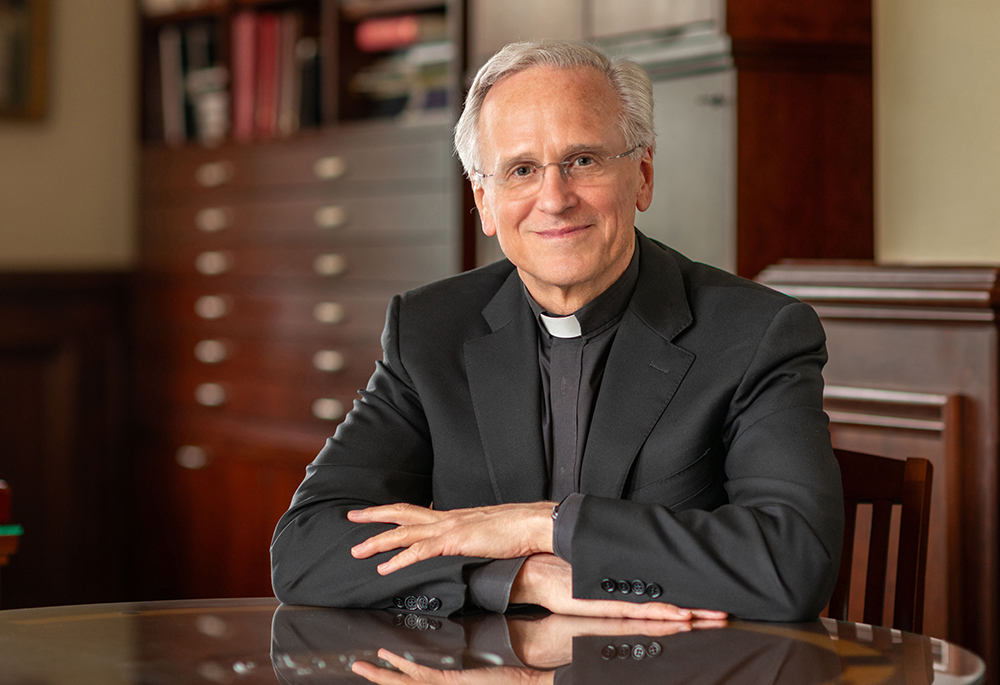
Holy Cross Fr. John Jenkins (OSV News/Courtesy of University of Notre Dame)
The other comment that jumped out was Roth's observation, which echoed Jenkins, that "I think that as colleges and universities describe what they bring to the lives of their students and their alumni, that we'll be emphasizing the human qualities that are going to become ever more essential in the work force, as A.I. gets more and more sophisticated, to teach students powers of discernment, of judgment, of teamwork, of resilience, and that they will bring that to their careers, but also to their personal lives."
Discernment, judgment, teamwork and resilience? At a time when there is so much focus on science and technology in education, there needs to be an equal focus on the importance of the humanities. It is there that students learn about these human qualities. I dream of a world in which everyone with a degree in computer technology has a fine paying job — and a boss with a degree in history or theology or English literature.
At a time when there is so much focus on science and technology in education, there needs to be an equal focus on the importance of the humanities.
Our society needs to do a better job educating the next generation, and we will only achieve that goal if the conversation about educational improvement happens in the world of culture first and the world of politics derivatively. Many of the Trump administration's reforms are needed, but the fact they are his reforms makes them less likely to be embraced or to last. Democratic mayors and governors need to see education as part of a larger social contract that is frayed and unjust.
The human mind is as restless as the human heart, so there is no expiration date on educational reform. And the Catholic Church has a great deal to contribute to that discussion.