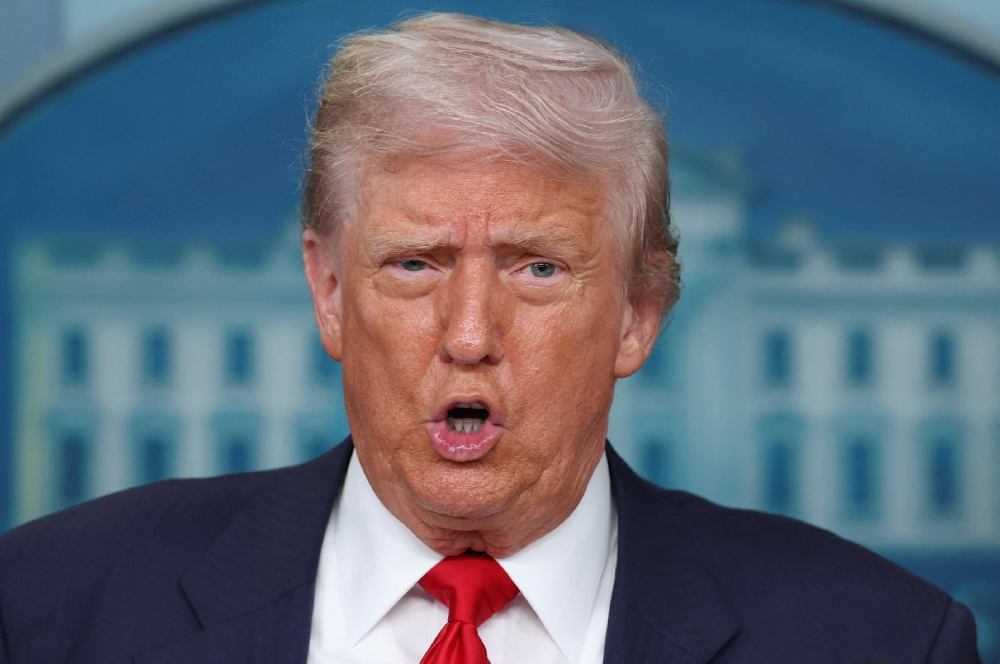

President Donald Trump has announced a review of the exhibits at the Smithsonian Institution's museums to make sure the displays "reflect the unity, progress, and enduring values that define the American story."
"This initiative aims to ensure alignment with the President's directive to celebrate American exceptionalism, remove divisive or partisan narratives, and restore confidence in our shared cultural institutions," stated a letter to Smithsonian Secretary Lonnie Bunch from two senior administration officials.
"Getting its history wrong is part of being a nation," wrote the French historian and scholar Ernest Renan in his 1882 essay "What is a Nation?"
One fears that our nation is about to get its history very, very wrong.
To be sure, America is an exceptional nation. So is France. And Peru. And Mozambique.
Let us also agree with the administration that "divisive or partisan narratives" are inevitably propagandistic in nature, and tend to be as unconvincing, and therefore counter-productive, as they are distorted.
The fear is that just as Trump claims election fraud only when he or one of his pals loses at the ballot box, or calls Democrats a "threat to democracy," while he is trying to subvert its norms, or fires the head of the Bureau of Labor Statistics who handed him bad news, the sole criterion of what constitutes "unity, progress, and enduring values" will be whatever is flattering to Trump. That is to say, this effort will not only distort American history; It will trivialize it.
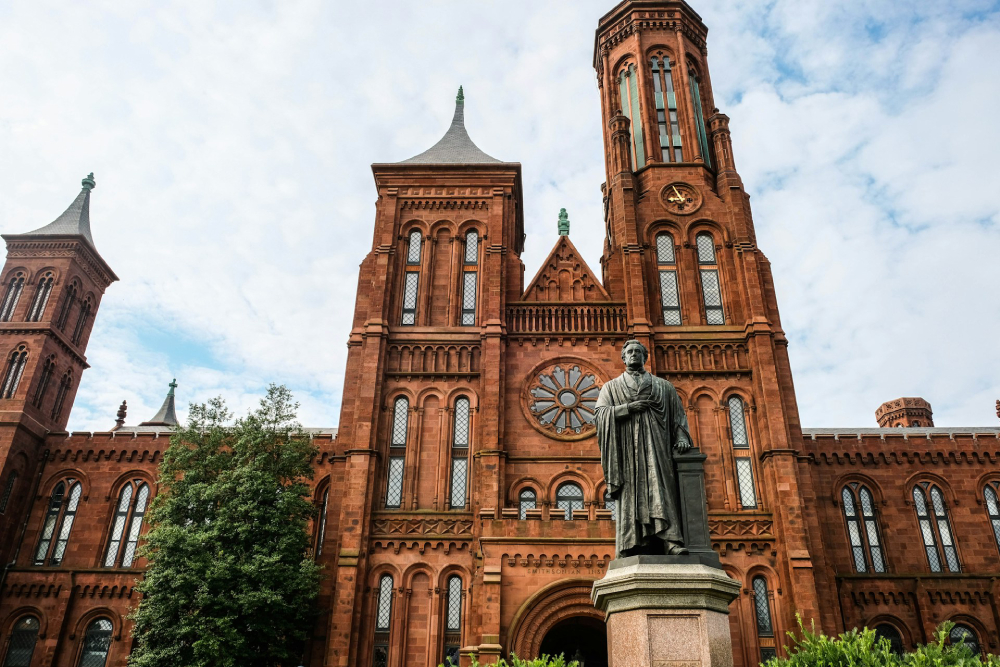
(Unsplash/Sara Cottle)
Trump is not the first president to distort history. Ronald Reagan used to tell a story about a brave pilot, returning from a bombing raid over Nazi Germany, and staying with an injured gunner as the plane went down, rather than bailing out to save himself. The problem is the story came not from the history books, but from a movie script, the 1944 war film, "Wing and a Prayer."
Some presidents simplify complex historical narratives to make an important civic point. The relationship of religion and politics in American history is one of the most complicated and multifaceted aspects of our national history. But you have to love Dwight Eisenhower's ability to get to the heart, and the limits, of civil religion when he said pithily: "Our form of government has no sense unless it is founded in a deeply felt religious faith, and I don't care what it is."
Trump's assault on the Smithsonian was made possible by liberal excess, especially in the academy. Too many historians in recent decades embraced deconstructionism, a kind of literary analysis that questions — deconstructs — historical and literary texts and their received interpretation. As a wise friend says, "Deconstructionism robs meaning." People want to feel good about their country, warts and all, but they still want to feel good about it. Robbing core texts and historical accounts of their received meaning often results in bad history and lousy civics.
Advertisement
The rise of deconstructionism occurred simultaneously with a range of new scholarship about previously overlooked parts of the historical narratives. For example, scholars began to focus on women and the role of race and racial minorities in forging our national story. All to the good. But a congeries of "critical" theories flowed from deconstructionism and some historians adopted them. These critical theories not only examined stories that had been ignored or minimized, but they insisted on placing those stories at the center of the whole narrative, no matter what the historical record showed. Ideology took precedence over historical evidence.
The most popular iteration of this ideological assault on historiography was the New York Times' "The 1619 Project," which I've previously written about. Many historians, not just conservative ones, questioned many of the assertions in the "The 1619 Project" but the story fit the zeitgeist and it even won a Pulitzer Prize.
After "The 1619 Project" was published, one of the historians the Times' consulted as part of its fact-checking, Leslie Harris of Northwestern University, acknowledged that she had warned the editors about the inaccuracy of one of the central claims in Nikole Hannah-Jones' essay and they had ignored her. This was catnip for conservatives. Liberal academics must take responsibility for handing them such an easy target.
University of Virginia sociologist James Davison Hunter explained the role deconstructionist and critical scholarship played in creating the cultural moment Trump learned to exploit. Hunter wrote in his book, "Democracy and Solidarity: On the Cultural Roots of America's Political Crisis":
The ability of those theorists and philosophers to interrogate, doubt, and highlight the imperfections and hypocrisies of the social and political order was a luxury that they could enjoy only as long as the rest of the country did not. As long as a majority of Americans — even if some of them were "deplorable" or "clinging to their guns or religion" — continued to operate within the hybrid-Enlightenment and commit to the American project (including fighting its wars), there could be relative political stability. But now the skepticism of intellectuals has percolated into the general public. Now, nearly everyone is a skeptic, nearly everyone sees the hypocrisy, nearly everyone doubts the goodwill of their leaders — and that, it turns out, is one of the keys to understanding the comprehensive epistemic crisis that is distinctive about our political moment.
The fight over our national history is not merely about history. It is about who we are as much as who we were. Better to say, it is about the relationship of who we were to who we are. Every generation must answer the question: Who are we? It is not an easy question. It will never produce an easy answer.
Trump can rearrange the exhibits at the Smithsonian, but history and the facts it contains are stubborn things. The exhibits will be rearranged in the future by others with different, hopefully only historiographic concerns, or at least with greater integrity, a word no one would associate with the president. By the time Trump leaves office, I hope historians will have shed their affinity for deconstructionism, or they will only make a second Trumpian political movement more likely.