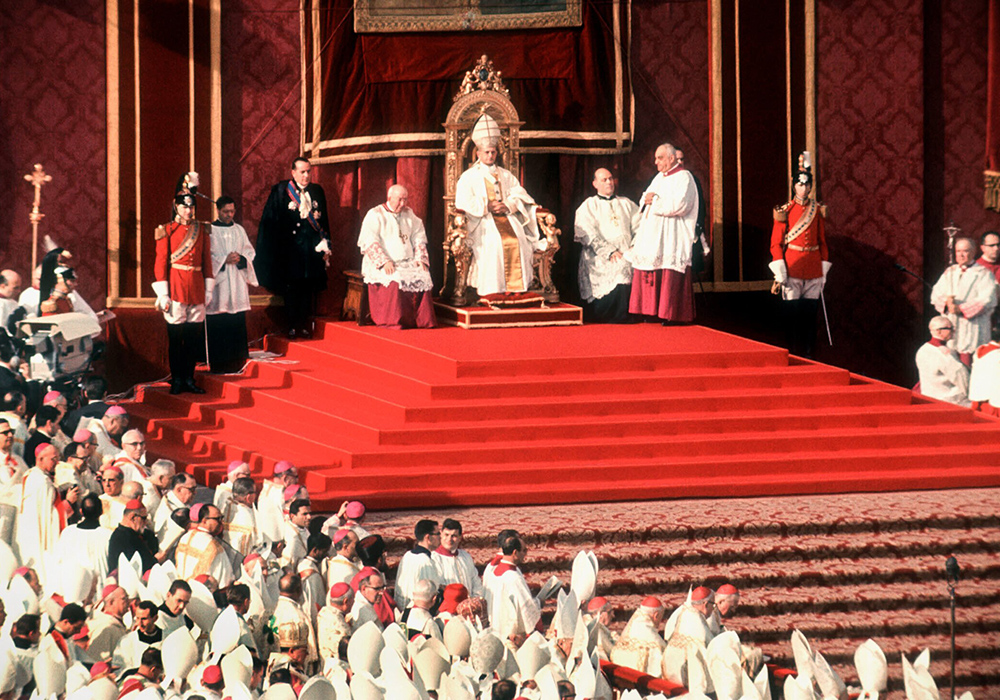
Pope Paul VI sits in the "cathedra" or bishop's chair during the Second Vatican Council in July 1965 in St. Peter's Square at the Vatican. (OSV News/KNA/Ernst Herb)

Monday, Dec. 8, marked the 60th anniversary of the close of the Second Vatican Council. It is an axiom among church historians that it takes a century for a council to be received, so we are almost two-thirds of the way. That is another way of saying, Vatican II may have ended 60 years ago but it is still a work in progress.
NCR published an OSV story marking the anniversary, written by Alexander Brüggemann, which focused on seven highlights or key themes that emerged from the council. That approach isn't wrong, but it is also inadequate.
For example, Brüggemann writes "Lumen gentium (1964), one of the four primary constitutions of the council, sets out the new self-understanding of the Roman Catholic Church. It defines the church as a community of believers, as the 'people of God' on their journey through time." That is true, but Lumen Gentium also adopted other metaphors for understanding the church. It is the "mystical body of Christ," "the spouse" of Christ, a "a people made one with the unity of the Father, the Son and the Holy Spirit," the "tillage of God," to name a few.
The "people of God" metaphor, regrettably, was misunderstood by some to suggest that the Catholic Church would become more democratic in its ecclesial structures and less hierarchical. Nowhere was this misreading more prominent than here in our very democratic, very anti-establishment culture in the U.S. In fact, the image suggests ownership: The baptized are those who belong to God, who have died in Christ to be raised with him, a new people.
Brüggemann is right to highlight the four major constitutions that issued from Vatican II: Lumen Gentium, on the nature of the church; Sacrosanctum Concilium, on the sacred liturgy; Dei Verbum, on divine revelation, and Gaudium et Spes, on the church in the modern world. If the past 60 years have taught us anything, however, it is that these four major documents work together.
Advertisement
It is commonly thought that Gaudium et Spes was the document most focused on Catholic social teaching, and in a sense that is true. It is also the text that seems the most dated, most tied to the hopes and fears of the early 1960s. A case can be made that the most extraordinary claim about Catholic social teaching to issue from the council was found in the opening paragraph of Lumen Gentium: "the Church is in Christ like a sacrament or as a sign and instrument both of a very closely knit union with God and of the unity of the whole human race." That claim places social teaching as an intrinsic part of our ecclesial self-understanding. Social teaching, bringing Christ into the world of business and labor, of culture and politics, is not an optional add-in. It is essential, of the essence, of what it means to be Catholic.
And, a case can be made that the real engine for bringing Catholic social teaching into the life of the church more profoundly than before was Dei Verbum. The Hebrew Scriptures and the New Testament are both filled with social ethics. This has been a blessing to be sure. Also a curse: Scripture alone can't inhibit polarization because both sides can cherry pick citations that fit their needs. And too many preachers are too little trained in the anthropological, soteriological and ecclesiological underpinnings of Catholic social teaching to explain to the people in their pews why such cherry picking produces only a counter-witness to the Gospel.
Brüggemann is simply wrong when he writes that Dei Verbum "paved the way for a new scientific approach to the Bible by authorizing historical-critical interpretation." Pope Leo XIII cracked open that door back in 1893 with the encyclical Providentissimus Deus and, even more, with the establishment of the Pontifical Biblical Commission in 1902. Pope Pius XII's 1943 encyclical Divino Afflante Spiritu opened the door even wider.
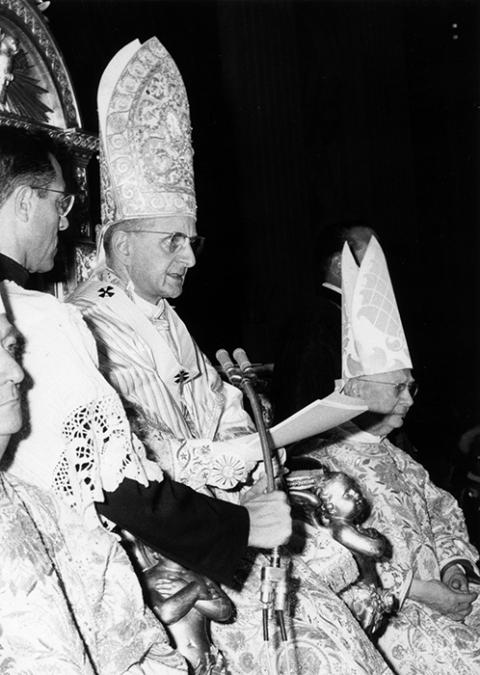
Pope Paul VI opens the second session of the Second Vatican Council Sept. 29, 1963. (CNS file photo)
Just as it is impossible to explain the whole arc of Vatican II without focusing on the Constitution on the Sacred Liturgy, so too could it be argued that it is that document which is most needed to address the social ills of our time. Sacrosanctum Concilium was the first major document adopted by the council, promulgated by Pope Paul VI on Dec. 4, 1963, at the end of the second session. The debate on it shattered many of the false theological idols held by the minority, curial party that resented the whole idea of a council. In the 60 years since the council, the sacred liturgy continues to provide us with the thing our social dialogue and our social structures most lack, a sense of gift and gratitude.
The measure of the U.S. bishops' conference stagnation, or even dormancy, it that there was no yearlong celebration of this anniversary, no invitation to all Catholics to reacquaint themselves with the teachings of Vatican II, no dialogue with other episcopal conferences about how their reception of Vatican II has differed from our own and what we might learn. Indeed, the opposition to Pope Francis in the U.S. often was rooted in a failure to appreciate the different ways Vatican II was received in Latin America, or in a more general opposition to Vatican II itself.
Vatican II was an enormous achievement. Like Trent, it was a reforming council that changed many of the ways we Catholics go about being Catholic, not by inventing new ideas but by returning to the sources of revelation in Scripture and the church's own tradition, and by attending to Christ here and now for, as Sacrosanctum Concilium states, "Christ is always present in His Church" (Paragraph 7). Vatican II is still an ongoing project as we all dig deeper into its treasures, hold ourselves accountable for any misreadings we once foisted upon the texts, and let its teachings seep into every nook and cranny of our faith. As we Catholics chart our way forward, Vatican II is the map.