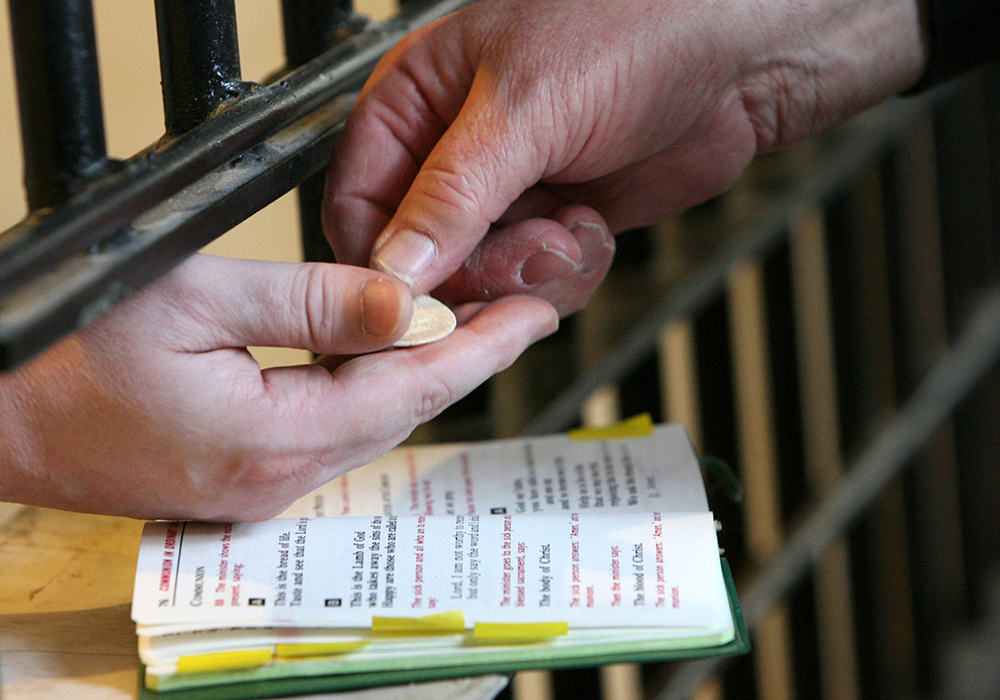
A chaplain distributes Communion to a death-row inmate at Indiana State Prison in Michigan City, Indiana. (CNS/Northwest Indiana Catholic/Karen Callaway)

by Daryl Grigsby
Both Pope Francis and now Pope Leo XIV have emphasized mercy and encounter with those on the margins of society. California prisons — located often in isolated locations and serving individuals forgotten by society — exemplify the neglected margins. In December, I had the privilege of co-facilitating a four-day retreat for 40 Catholic chaplains serving state prisons in California. The event was held in Santa Cruz, California, and represents one of the only annual opportunities the chaplains have for renewal and rejuvenation.
In many unexpected ways, as co-facilitator I benefitted from the experience as much, if not more, than the prison chaplains. I learned about the challenges of prison ministry and about life for the incarcerated, and was inspired to enhance my own vocation as a writer and community activist.
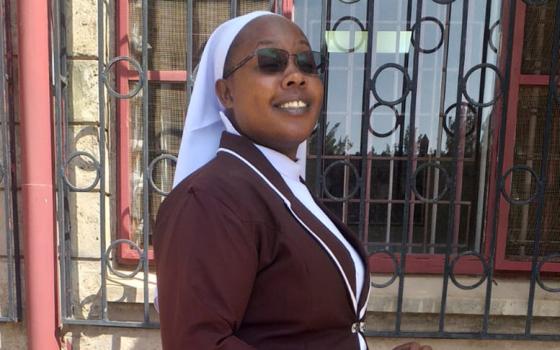
The leader of the retreat was Sr. Theresa Harpin of the Sisters of St. Joseph of Carondelet. Sister Theresa is also the founder and director of Restorative Partners, an organization providing housing, employment, counseling and support for the formerly incarcerated. Joining the chaplains was the chair of the California Catholic Conference's Restorative Justice Committee, Bishop Joseph Brennan of Fresno. His active presence in the sessions was a welcome gift to the retreatants.
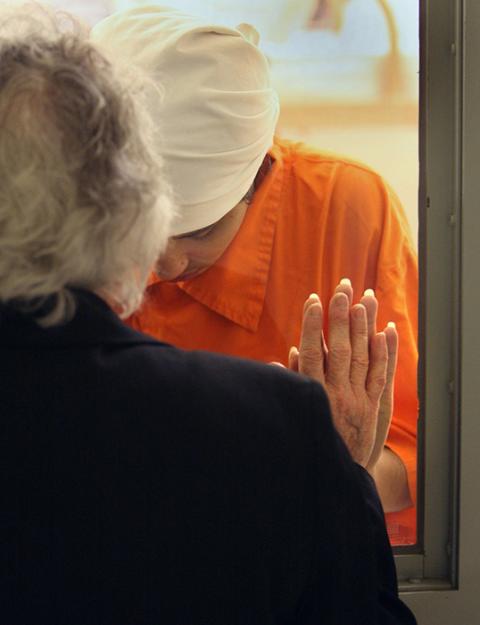
Mercy Sr. Natalie Rossi, then-a prison chaplain, is pictured in a file photo praying with a Catholic inmate in solitary confinement at the State Correctional Institution for Women in Cambridge Springs, Pennsylvania. (OSV News/CNS file/Bob Roller)
I was struck by the diversity of prison environments in which the chaplains served. I was not aware of the number of medical, hospice, psychiatric and mental health elements in the prison system, and it was clear that the individuals they serve represent a wide spectrum of challenging situations, including those convicted of murder, those on death row, people with psychiatric conditions and those needing significant medical or hospice care. I was struck by the diversity of the chaplains' gifts and backgrounds. Many of them were immigrants or the descendants of immigrants.
As our federal government transforms ICE into a domestic army rounding up grandmothers, day laborers and car wash workers, we rely on immigrants to serve some of the neediest in our nation. The chaplains had roots in El Salvador, Mexico, Nigeria, Scotland, Sri Lanka, Spain and other nations. It was evident that their experiences in other lands enlarged their hearts, enabling them to serve with courage, persistence and wisdom.
Among the chaplains were priests, deacons and laypersons. Some of the deacons were accompanied by their wives. My encounters with the deacons and their wives demonstrated to me that the wives were far more than "the deacon's wife." Each had their own ministry and were integral to their husbands' vocations. There were also laywomen represented. Talking with the laywomen reinforced my conviction that women be ordained to the Catholic diaconate. The recent vote by the Vatican commission against admitting women to diaconal service seems blind to the significant human needs that can be met by women in that important role of service.
The entire retreat reconfirmed to me the power and beauty of Catholic tradition. All of us, co-facilitators and attendees — literally bathed in the riches of Catholic spirituality. The format of the retreat drew from the Advent Gospel readings, lectio divina, visio divina, the Jubilee Year and Catholic social teaching. In addition, the liturgical year reminded us of the feast of St. Francis Xavier, whose Novena of Grace provided profound reflection questions for us all.
Advertisement
In addition, since the bishop brought along a large portrait of St. Thérèse of Lisieux, and Sister Theresa was named after her — that saint was one of our spiritual companions. Her little way of love and her prayer that she would spend heaven "doing good upon earth" inspired our time together.
Sister Theresa, one of the 36 people featured in my book, Catholics For the Common Good, mentioned that her work with Restorative Partners is intended to carry forward their prison ministry. She reminded the chaplains that Restorative Partners and other organizations "on the outside" could be resources as the formerly incarcerated reenter society. One grace I received was knowing even in prison, with all the accumulated trauma, confinement and occasional violence — there are people who bring healing and wholeness. Sister Theresa's faith confirmed the positive impacts of the work of religious orders. They are present in hospitals, prisons, drug clinics and schools, and can be found among the poor in the Amazon, walking alongside victims of human trafficking, and are healers in war-ravaged places around the world.
Each day ended with celebration of the Mass, thus confirming the centrality of the Eucharist for community and mission. One of Brennan's homilies noted "'we need to be fed by Jesus Christ, in order that we go forth to feed others." During the Eucharist the Nigerian priests sang a Communion hymn in their native Igbo language. Though I did not understand the words, I grasped the underlying prayerfulness.
Afterward I asked one of the priests to translate, and he said, "In the Communion, heaven and Earth are joined together, and as we partake of the Eucharist, Jesus is in us, and we are in Jesus." An apt description of the meaning of our Eucharist. During the Lord's Prayer, Brennan asked all present to pray in their native language; thus, our prayers to our one God were in Igbo, Spanish, English, Italian and Sinhala.
My conversations with Sister Theresa, the chaplains and the retreat organizers reminded me of what I love about the Catholic faith. They embodied the Gospel as "good news" and demonstrated how the Eucharist in action is "love beyond all telling." During the retreat I heard a call from God to do my part. I am not a chaplain or a religious sister. Yet, I am a gifted part of the body of Christ. In Scripture, 1 Corinthians 12:5-7 reminds us that "there are varieties of services, but the same Lord, and there are varieties of activities, but it is the same God who activates them in everyone. To each is given the manifestation of the Spirit for the common good." Trauma, misery, violence and injustice abound in our world. Yet, in every place and time, Christ is present in those members who bring their gifts and "do their part."