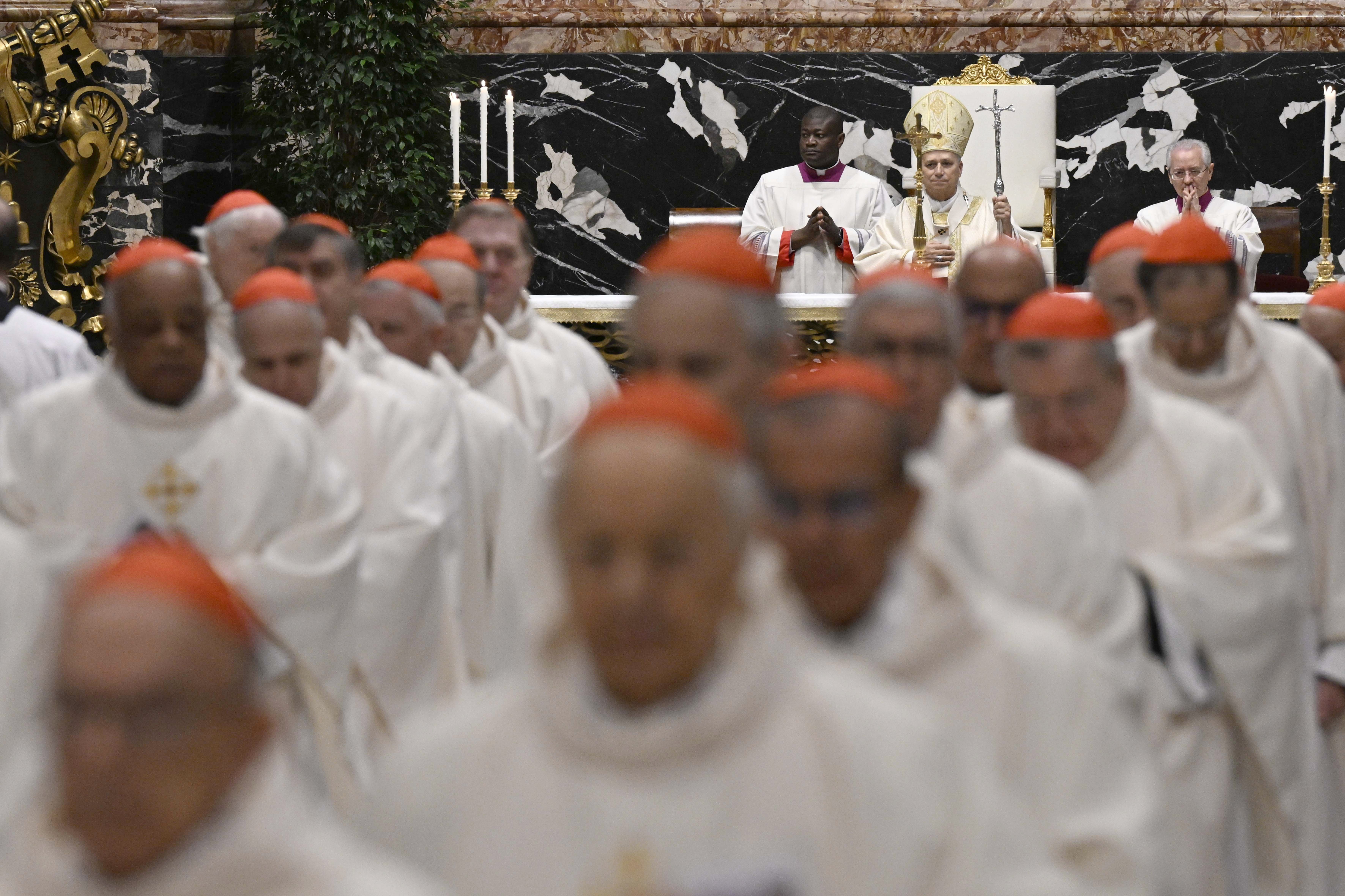
Pope Leo XIV stands with his crosier as cardinals from around the world process out of St. Peter's Basilica at the Vatican Jan. 8, 2026, after the pontiff celebrated an early morning Mass for a consistory. (OSV News/Vatican Media/Simone Risoluti)

All the popes of the post-Vatican II period have been, in different ways, faithful to the Second Vatican Council. None of them has abrogated or superseded the documents of Vatican II, on the contrary: John Paul II's engagement in interreligious dialogue, and especially with the Jews, went beyond the letter of Nostra Aetate; Benedict XVI kept mostly private his displeasure with the constitution Gaudium et Spes; Francis signaled his fidelity to Vatican II in a very visible way with gestures ad extra.
Pope Leo XIV's fidelity to Vatican II has become programmatically clear since the beginning of the new year. On Jan. 7, he announced a new series of catechetical addresses on the documents of the council, that he will deliver during the general audiences:
It will be important to get to know it again closely, and to do so not through 'hearsay' or interpretations that have been given, but by rereading its documents and reflecting on their content. … Indeed, it is the magisterium that still constitutes the guiding star of the church's journey today.
In some sense, it's a second beginning of the pontificate, also because now Leo can shape his agenda more than he could during the Jubilee Year. Leo's decision echoes John Paul II's Novo Millennio Ineunte (Jan. 6, 2001):
Now that the Jubilee has ended, I feel more than ever in duty bound to point to the Council as the great grace bestowed on the Church in the twentieth century: there we find a sure compass by which to take our bearings in the century now beginning [emphasis in the original].
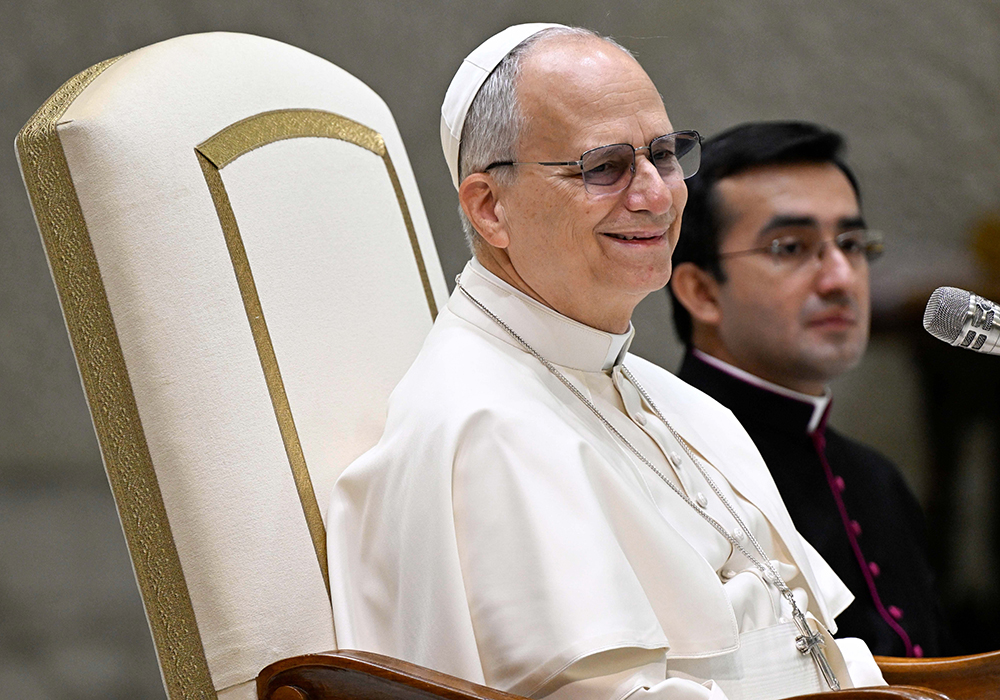
Pope Leo XIV smiles during his weekly general audience in the Paul VI Audience Hall at the Vatican Jan. 7, 2026. (CNS/Vatican Media)
Leo's catechesis will deserve a close analysis. For now, it's important to locate his decision to dedicate a series of catechesis on Vatican II in the context of his pontificate and of the church. Leo sent clear signals about his intention to continue the implementation of Vatican II from the beginning of his pontificate, particularly in his May 10 speech to the cardinals. Since then, he has cited numerous Vatican II texts including lesser known documents like those on priestly ministry and formation. A particularly important moment was the celebration, at the end of October, of the anniversary of the declaration on the relations of the church with non-Christian religions. Nostra Aetate featured prominently again, together with the declaration on religious freedom Dignitatis Humanae, in his Jan. 9 address to the diplomatic corps.
Reactions on Catholic social media reveal Leo's courage in choosing this topic. Among traditionalists and right-wingers, the mere mention of Vatican II evokes ghosts of a liberal takeover aimed at the destruction of the church rightly understood. This time was no exception. Even before Leo's announcement of his catechesis, Bishop Robert Barron posted a critical take against synodality and "the spirit" of Vatican II. Barron ignored, once again, the other meaning of that phrase in magisterial language: the spirit as the real intention of the council fathers that needs to be taken into account together with the texts.
Advertisement
Leo's status as "the American pope" also attests to his courage in going back and forward to Vatican II, as the American church is polarized by the council. U.S. Catholicism has split in two major directions when it comes to Vatican II: one looking back to the documents alone without their spirit, and another dismissing the documents of Vatican II as a cheap attempt to deal with modernity. The international success of the 2008 book by John O'Malley, What Happened at Vatican II, was more the exception than the rule.
Only recently an international network of more than 150 scholars, initiated by Tübingen theologian Peter Hünermann (the longtime editor of the Denzinger, who died on Dec. 21 at the age of 96) has made a new series of scholarly research of Vatican II in English and by English-speaking historians and theologians available in open access. (Full disclosure: I am a steering committee member and co-editor of two of the 12 volumes in the series. The series has been presented to pope Leo XIV in an audience in the Vatican on Dec. 10.)
In today's world, where world leaders say openly that they are not bound by the law, having a canonist pope is one of those blessings that could bring unexpected fruits.
The papal nuncio to the U.S., Cardinal Christophe Pierre, saw this peculiar U.S. Catholic situation throughout his entire mission in Washington, D.C. In the speech he gave in Baltimore to the U.S. bishops' conference last November, Pierre said:
We now inhabit the world that the council foresaw — a world marked by profound cultural shifts, technological change, and a secularized mindset that challenges faith at its roots. Now is the time to unfold the council's map and walk its path — to rediscover in those texts the light and courage needed to navigate this moment with fidelity and creativity.
Leo is a U.S.-born Catholic who spent two decades in Latin America. That experience in a church deeply shaped by Vatican II and the post-Vatican II period, vaccinated him from a typical disease of post-conciliar theology — the tendency to see the council as a failed revolution.
Leo — the first pope from the U.S., the first born after World War II and the first canon lawyer in a long time — can lead the church to a rediscovery of Vatican II through its texts. It was once said that there was an irreconcilable contradiction between canon law and the theology of Vatican II. In today's world, where world leaders say openly that they are not bound by the law, having a canonist pope is one of those blessings that could bring unexpected fruits.