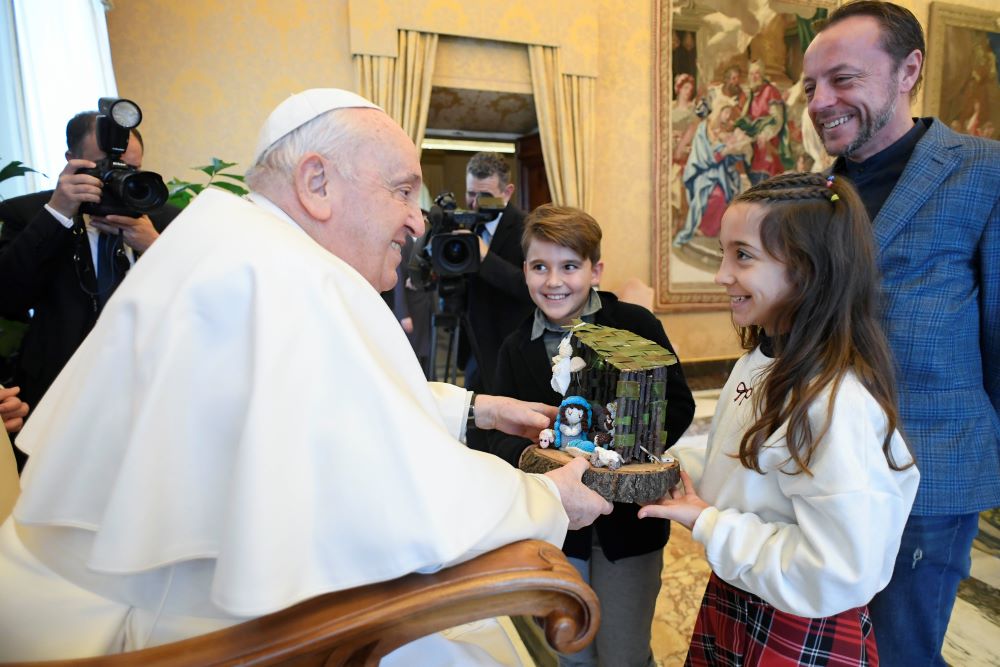
Pope Francis receives a small Nativity scene from a child during a meeting with the Italian Catholic Action movement at the Vatican Dec. 15, 2023. (CNS/Vatican Media)

We need some iteration of Catholic Action in our day. The church's engagement with the culture cannot be limited to occasional statements from the U.S. bishops' conference and the work of lobbyists at the state and federal level. It is the laity, not the clergy, who are called to bring Christ to the culture.
Wednesday, I looked at the doctrinal wellsprings from which the Catholic Action movement grows. Historically, that faith was carried by the subcultures of Catholic communities throughout the world. Those subcultures died as Catholics moved out of their urban enclaves. You search in vain for any discussion of mission in Catholic education in the 1940s or 1950s: It walked in with the priests and sisters who had begun their day with Mass and the breviary. It was in the air. That air was hospitable to Catholic Action too.
Today, our societal air is putrid and it needs the purifying breeze of the Gospel. How to do it? Where to start?
Chaplaincies are a good model for social engagement. We still have them at schools, but apart from a few urban centers, do we still have chaplains for unions? For firefighters? For migrants? Do hospital chaplains attend to the workers as well as to the patients?
A chaplain at an airport may occasionally deal with travelers, but mostly he will be present to those who work at the airport. You can spot a Catholic-inspired march for solidarity with migrants: The marchers carry banners of Our Lady of Guadalupe!
Today, our societal air is putrid and it needs the purifying breeze of the Gospel.
Chaplaincies are about accompaniment, about meeting people where they are. Ideally, a good chaplain will build solidarity with the people he or she serves. Catholic nurses, Catholic hotel workers and Catholic miners will have questions that are particular to them as Catholics. Have bishops met with nurses to discuss the frightening implications of physician assisted suicide for their work? A nurse's work depends on trust, and a family intent on getting a patient to off himself will place that nurse in an untenable situation. Have clergy met with miners to discuss the implications of Laudato Si'? Have Catholic leaders accompanied hotel workers as they plead for better working conditions and decent pay?
In terms of their value to reviving Catholic Action, chaplaincies are a starting point. Chaplains should discern when and how to encourage the people they serve to form their own organization. The accompaniment does not cease, but it is transformed. A second value, participation, is introduced and the thing in which the group participates is the spreading of Catholic social teaching.
This already occurs in some sectors. I may not be fond of all the programming at a meeting of Legatus, the Catholic organization for business leaders, but I applaud the effort to organize them as Catholics. Attentive bishops and clergy could work to better integrate Catholic social teaching in that organization, but at least there is an organization with which to work, a place to start.
If anyone worries that such efforts would appear sectarian, separating workers from their non-Catholic colleagues, they can set that worry at rest. Solidarity always expands and includes. That is the true meaning of the ordo amoris, Vice President JD Vance's comments notwithstanding.
Efforts to revive Catholic Action should focus on the local community. One reason Laudato Si' has failed to take root in this country is that the experts and the advocates tend to aggregate the data and focus on the climate of the whole earth. There is a place for that, but on an issue that has been politicized, focusing on the local and disaggregating the data removes a lot of the political opposition and makes solidarity possible.
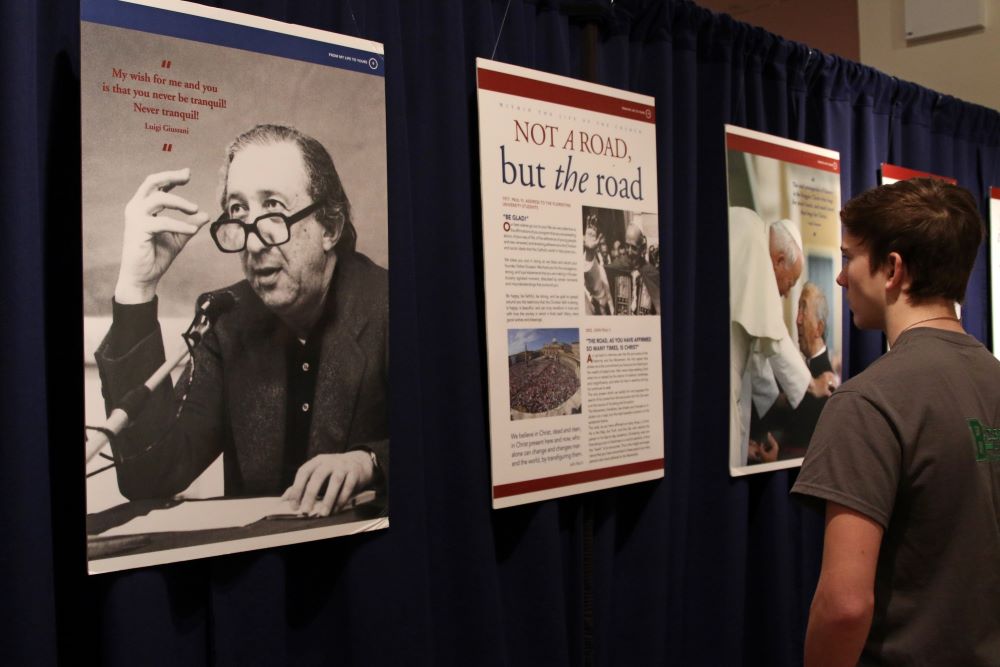
A man looks at an exhibit in New York City Jan. 14, 2017, on the life and teachings of Msgr. Luigi Giussani, founder of the worldwide Catholic lay ecclesial movement Communion and Liberation. The exhibit was part of New York Encounter, organized by Communion and Liberation. (CNS/Gregory Shemitz)
In Louisville, for example, the Christina Lee Brown Envirome Institute has done great work with its Green Heart project, which NBC's Anne Thompson highlighted in a segment on "The Today Show." In deep red Kentucky, the project garnered no political opposition. Who wants to oppose better health outcomes for kids? Once people see in their own communities how attention to the environment can make a huge difference, they will be less skeptical about melting ice in Antarctica.
Community focus need not be constricting. Consider the many places in the world that are suffering specifically because of the destruction of USAID. Could not every parish in the U.S. partner with a parish or ministry in those afflicted countries? Donating to one annual collection may be more efficient, even more effective, but will real relationships sprout up between rich and poor? You can bet if such a network of parish partnerships existed on Jan. 20, the Trump administration wouldn't have dared to touch USAID.
Accompaniment and participation can have a specific religious focus too. The revival of the Camino de Santiago is a beautiful thing, but pilgrimages can be more local. Do parishes organize trips for youth to local shrines or to the cathedral? Here in the Diocese of Norwich, Connecticut, Bishop Richard Reidy, who was just installed this spring, recently led a group of middle and high school students on a hike in a state park. Kids love hiking. And now they know their bishop does too. There is opportunity in that knowledge.
Advertisement
Ecclesial movements are another opportunity. They can be problematic. It is a shocking fact that four such movements that grew in Latin America after Vatican II — the Heralds of the Gospel in Brazil, the Incarnate Word in Argentina, the Legionaries of Christ in Mexico and the Sodality of Christian Life in Peru — were all founded by charismatic clergy who turned out to be monsters.
Yet, ecclesial movements also can be a source of Catholic culture. The movement with which I am most familiar is Communion and Liberation. I understand the Italian wing of the group has had problems, but here in the States, it is as refreshing as it is uncommon to see young families gathering to share life and share their faith. The group's founder, the late Luigi Giussani, was not a monster but an inspiration, and over big bowls of pasta and some good chianti, members study his profound works.
Chaplaincies, community-focused work and ecclesial movements are just three starting places from which Catholic Action could be reborn. There are others I am sure. Catholic Action might, just might, help overcome the polarization found in both the Catholic Church and the wider culture. Most importantly, a revived Catholic Action would restore to the laity the vocation of bringing Christ into the culture.