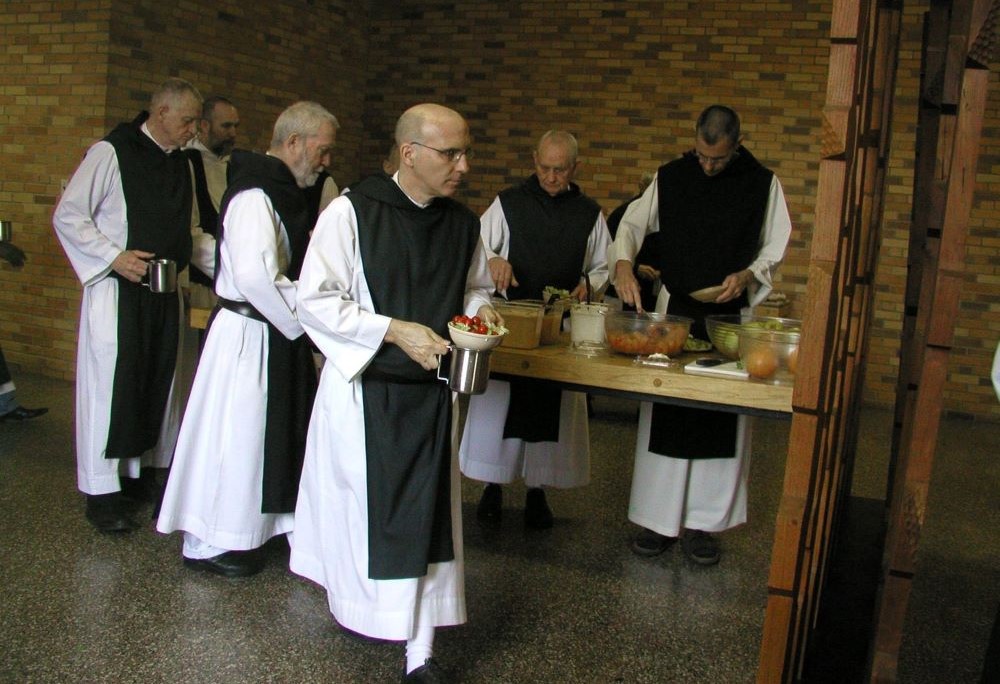
Trappist monks who live at the Abbey of Gethsemani prepare to eat lunch in their dining hall in late March 2011 in Trappist, Ky. Fifty 50 men lived in the community then; about 40 live there now. (CNS/Marnie McAllister, The Record)

by Mike O'Brien
In the late 1960s, a young NCR reporter named Colman McCarthy saw the emerging decline of American Trappist monasteries and offered a diagnosis: The monastic life is not active enough. Looking back six decades later, is that why some men left and some stayed in those vocations?
Trappist abbeys overflowed with monks in the 1940s and '50s. Today there are fewer than 200 men at these United States monasteries. That's a wild and fascinating ride.
I don't have a scientific explanation for what happened, but I had a front row seat for part of the journey. In the 1970s, a Trappist monastery in Huntsville in rural northern Utah was my second home.
My book Monastery Mornings describes that unique Catholic boyhood among the monks and the Latter-day Saints. But it also tells the painful story of how my beloved abbey closed in 2017.
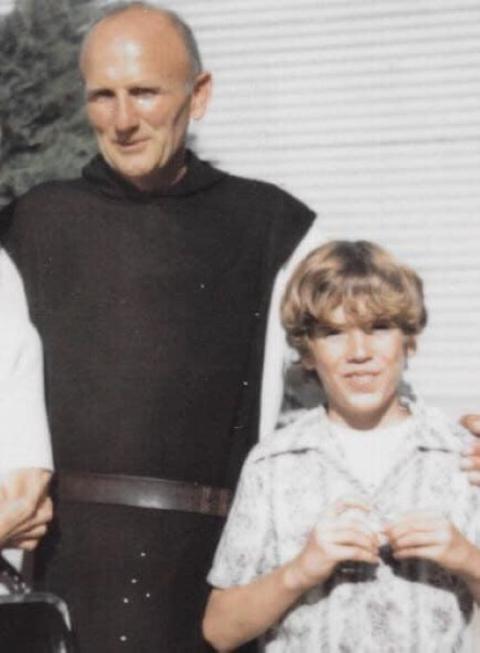
Utah Br. Boniface Ptasienski and Mike O'Brien, then 12, stand at the now closed Holy Trinity Abbey in Huntsville, Utah, in 1973. (Courtesy of Karen O'Brien Taylor)
Always keen to better understand why, I recently stumbled upon articles about McCarthy and Br. Joseph Szwedo. Their lives — and my Utah friends — help illustrate the modern history of American Trappist abbeys.
McCarthy joined a Georgia monastery in the 1960s and stayed for five years. A Dorothy Day visit pointed him in a different direction. A thoughtful career as a journalist, teacher and peace activist followed.
McCarthy wrote a December 1967 NCR article criticizing his old order. He said the Trappists' Marine-like "hairy-chestedness" and "French Foreign Legion" heroics led them "to do hard things instead of good things."
He argued that Dietrich Bonhoeffer's "secular city" had replaced Thomas Merton's "seven-storey mountain" as "the address of God." Noting Bonhoeffer's admonition — "A Christian must plunge himself into the life of a godless world" — McCarthy concluded a monastery "was where the action wasn't."
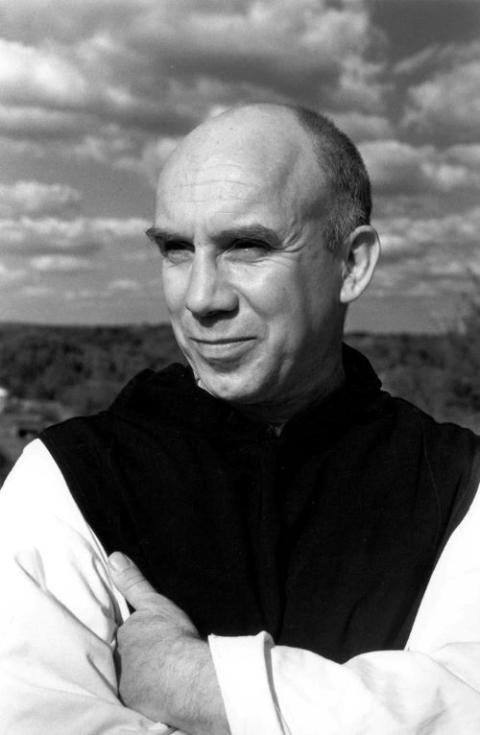
Trappist Fr. Thomas Merton (OSV News/Merton Legacy Trust and the Thomas Merton Center at Bellarmine University)
McCarthy said this explained Merton's restlessness, too. Merton had told McCarthy that keeping contemplatives away from the "problems and needs of the world" was "disastrous."
Ironically, Merton did not like the NCR article. He called McCarthy's active/contemplative dichotomy "utterly stupid."
About the same time, Szwedo was contemplating similar issues. He's featured in a 2018 New York Times article about the decline of South Carolina's Mepkin Abbey, but the more interesting story is why Szwedo stayed there until he died in 2023.
Szwedo joined Kentucky's Gethsemani Abbey in 1944 but moved to Mepkin. He navigated a post-Vatican II vocational crisis and spent 70 years praying and working as a monastic mechanic, welder and miller.
His last abbot noted Szwedo's softer skills too, "Possessing a beautiful tenor voice, he sang with the monastic schola. …[H]e continued to make rosaries even up to the week before his death … Daily he could be seen feeding the squirrels as he spoke with them in Polish which they obviously understood."
Despite this "lesser vocation," a Szwedo friend said, "[Joseph] relished every task he was given over the years. … He was completely present; he practiced a mindfulness that knew no season or fad."
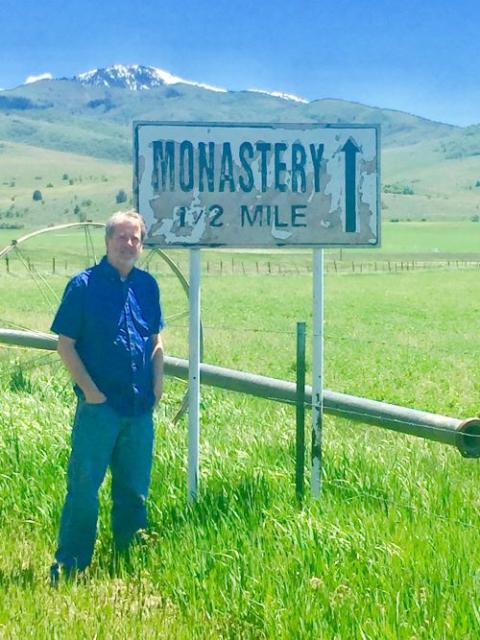
Mike O'Brien stands by the old entrance sign at the now closed Holy Trinity Abbey in Huntsville, Utah in 2016. The abbey closed in 2017. (Courtesy of Mike O'Brien)
The monks I knew were like both McCarthy and Szwedo. One left the Utah abbey to be a great father/grandfather, but other remarkable souls remained. This includes a fighter pilot named Fr. Alan, a baseball fan named Fr. Patrick, and a cowboy philosopher named Br. Nicholas.
The Trappist monastery I knew was not "where the action wasn't." The monks were not beating a fast retreat from the world we share.
The Utah monks helped a young boy — me — find his way in the world. They also had significant outside engagement such as sending money to the poor in India and helping the local Latter-day Saint town of Huntsville meet its water needs.
One Utah monk worked with Mother Teresa and then she visited him in Huntsville. Dorothy Day stopped by the abbey while in Utah. Bede Griffiths came and told the monks about his Benedictine ashram in India.
People — including non-Catholics and non-believers — regularly pull me aside and tearfully tell me how a Utah monk helped them in some important way. There are similar stories from every other American monastery.
Gethsemani's Br. Luke Armour supports trudgers from the recovery community. The monks of New Melleray Abbey in Peosta, Iowa, give away their Trappist Caskets to families in need.
Mepkin built a meditation garden to honor slaves who lived there. In what I call monkservation, American monasteries lead the way on environmental conservation and stewardship.
Even McCarthy and Szwedo don't fully fit within the active/contemplative dichotomy.
Advertisement
Citing Merton, McCarthy penned a 1989 Washington Post article defending the solitude of his old life and supporting Trappists who opposed a nearby noisy golf course. He said, "If governments enforce laws to protect endangered species of animals, they ought to be even more watchful about some endangered seekers of God."
Szwedo's friend offers charming proof of the old monk's worldly embrace. After visits, the friend's wife tried wiping lipstick from where she'd kissed the monk's cheek. "'Oh no, leave it,' he would say, proud to be a marked man when he returned for the next round of prayers."
Like many churches, Trappist monasteries have struggled the last half century for several reasons. Less religious people. Clergy abuse scandals. The sexual revolution. Better applicant screening. Alternative vocational choices. And so on.
I doubt it's because a monastery is where the action isn't.
In fact, from my own observation, the "seven-storey mountain" and the "secular city" often are found at the exact same lovely address.