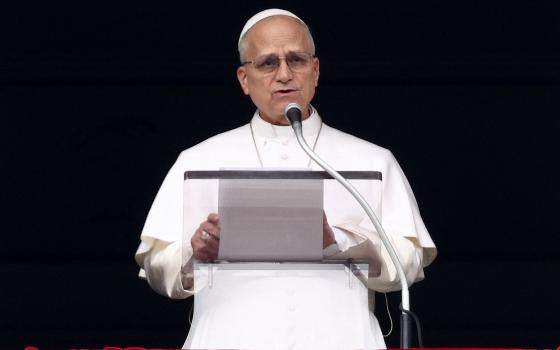
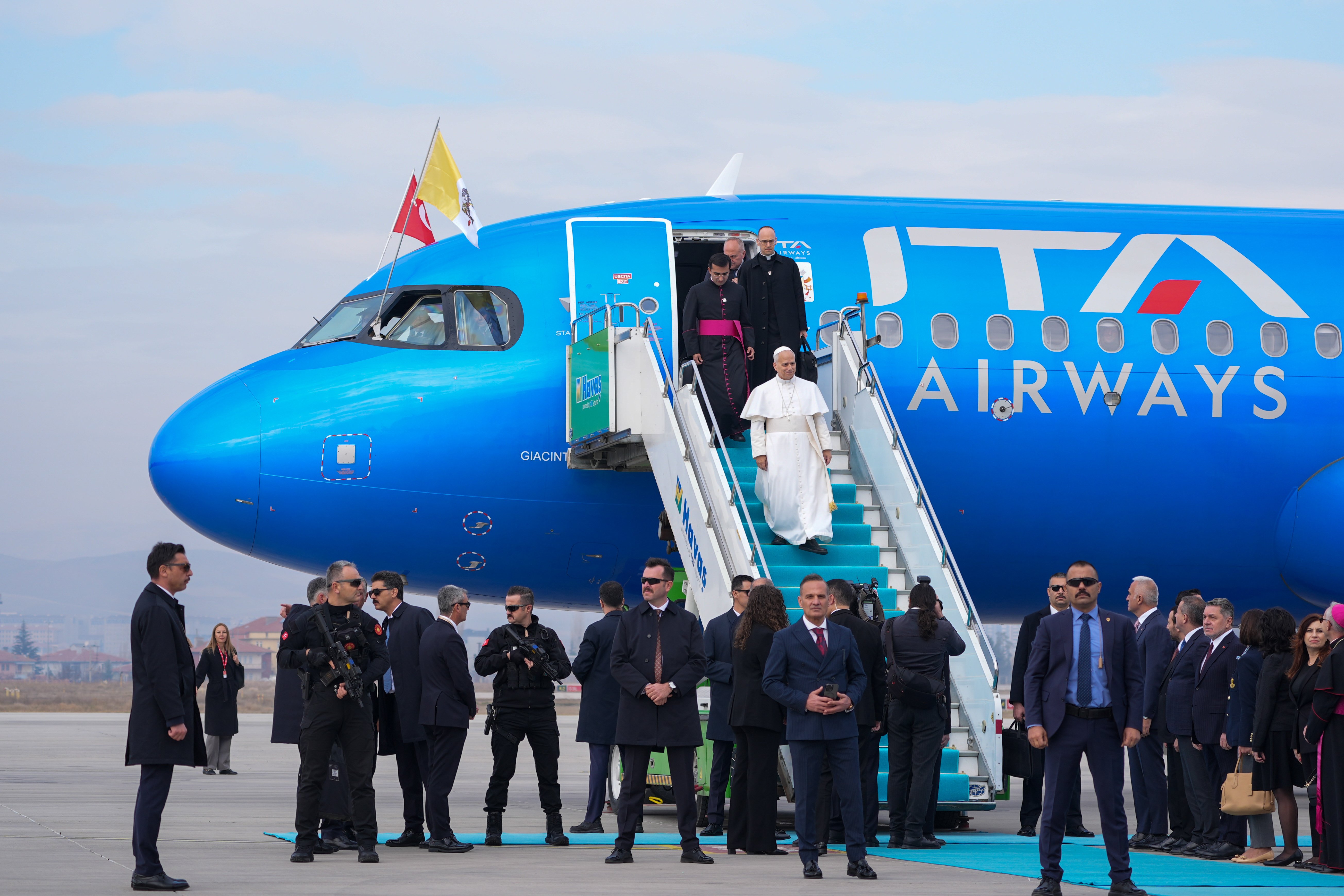
Pope Leo XIV arrives by plane from Rome in Ankara, Turkey, Nov. 27, 2025, at the beginning of his first international papal trip. (CNS/Lola Gomez)

Nearly a year into a pontificate largely anchored in Rome, Pope Leo XIV is preparing to launch a sweeping series of international trips that will carry him across Africa, to Spain and to the tiny principality of Monaco.
The pope will travel first to Monaco on March 28, the Vatican announced Feb. 25. After Easter, he will undertake a 10-day tour of Algeria, Cameroon, Angola and Equatorial Guinea from April 13-23, and he will make four stops in Spain from June 6-12.
Though largely restricted by the 2025 Jubilee which filled the pope's schedule with Rome-based obligations in his first year, Leo's travel plans open what is anticipated to be a year of marathon travel for the pope. The announcement came days after the Vatican said the pope would embark on six separate pastoral visits across Italy this year, including to the migrant hotspot of Lampedusa visited by Pope Francis.
Leo's only trip outside of Italy to date, to Turkey and Lebanon, was largely planned for his predecessor. Additional trips to Peru, Argentina and Uruguay are expected later in the year as well.
For now, the Vatican has only ruled out one destination for the American-born pope, stating that he will not travel to the United States in 2026.
Papal travel firsts
With the announcement, Leo will become the first modern pope to travel to Monaco and the first pontiff in history to visit Algeria.
Monaco presents a striking contrast. The Mediterranean microstate, known worldwide as a playground for the ultra-wealthy, is one of just five nations, including Vatican City, that names Catholicism as its official state religion. Some 90% of its population is estimated to be Catholic, and the Diocese of Monaco was established by Leo's namesake, Pope Leo XIII, in 1887.
Algeria, on the other hand, offers a dramatically different setting.
The North African nation is approximately 99% Sunni Muslims with an estimated 20,000-200,000 Christians among its 46 million people. A 2024 U.S. government report described religious freedom in Algeria as "poor," and authorities shut down the Catholic charity Caritas in 2022.
Leo has said he wants to strengthen Christian-Muslim relations during the visit and to visit the homeland of St. Augustine — the 5th-century church father who is the spiritual inspiration for the pope's religious order.
The pope will visit the capital Algiers and Annaba, the site of ancient Hippo, Augustine's hometown, which today houses the Basilica of St. Augustine.
Leo had already visited Algeria twice when he was head of the Augustinian Order, to attend a symposium on St. Augustine organized by the former Algerian president in 2001 and again in 2013 for the inauguration of the restored Basilica of St. Augustine in Annaba. The future pope also visited sites where some of the 19 Catholic martyrs of Algeria were killed during the first years of the Algerian civil war which began in 1992.
Cardinal Jean-Paul Vesco of Algiers said the martyrs "are very much present in [Leo's] personal memory."
Advertisement
A church on the rise
Following visits to smaller and Catholic-minority nations, Leo will spend the rest of his African tour in countries where the church is expansive and growing.
From Algeria, Leo will continue to Cameroon, where Catholics make up roughly 38% of the country’s 28 million people. Protestants and Muslims each account for about a quarter of the population.
In 2021, more than 40% of Cameroonians were under the age of 15.
The pope will arrive in the capital Yaoundé and will then visit Bamenda and Douala. Notably, Bamenda is some 50 miles from the border with Nigeria, a hotspot of Christian persecution.
Leo will likely speak in English and French in bilingual Cameroon. The polyglot pope read several speeches in French while traveling in Lebanon.
In Angola, a former Portuguese colony of 36.6 million people, government data estimates that 44.2% of the population is Catholic and 34.9% Protestant. The pope will visit the capital, Luanda, along with Muxima and Saurimo. Angola is projected to experience the second-largest population increase of any country by 2100.
The pope's tour of Africa will conclude in Equatorial Guinea, where approximately 88% of the country’s fewer than 2 million residents are Catholic. Leo will visit Malabo, Mongomo and Bata. Although the government moved the capital from Malabo to Ciudad de la Paz in January, the pope is not scheduled to travel there.
Equatorial Guinea is the only African nation with Spanish as its official language, which the pope speaks fluently.
Long-anticipated visit to Spain
For 12 years, Spaniards wondered whether Francis would visit Spain. Leo is ending that uncertainty with an early visit.
The pope's June 6-12 visit to Spain will begin in its capital, Madrid. He will then travel to Barcelona where Vatican News reported he will inaugurate the recently completed main tower of the Basilica of the Sagrada Familia, the world's tallest church.
Leo's visit to Spain also coincides with the 100th anniversary of the death of Antoni Gaudí, the basilica's architect whose sainthood cause is currently underway. Questions have been raised as to whether the famed architect could be beatified during the pope's visit to Barcelona.
The pope will then continue to the Canary Islands, a major migrant entry point into Europe and a visit long-desired by his predecessor, visiting Tenerife and Gran Canarias. More than 1,900 people are estimated to have died attempting to reach the Canary Islands from the shores of Africa in 2025.
The trip will be the first papal visit to Spain since Pope Benedict XVI traveled to Madrid for World Youth Day in 2011.
The National Catholic Reporter's Rome Bureau is made possible in part by the generosity of Joan and Bob McGrath.