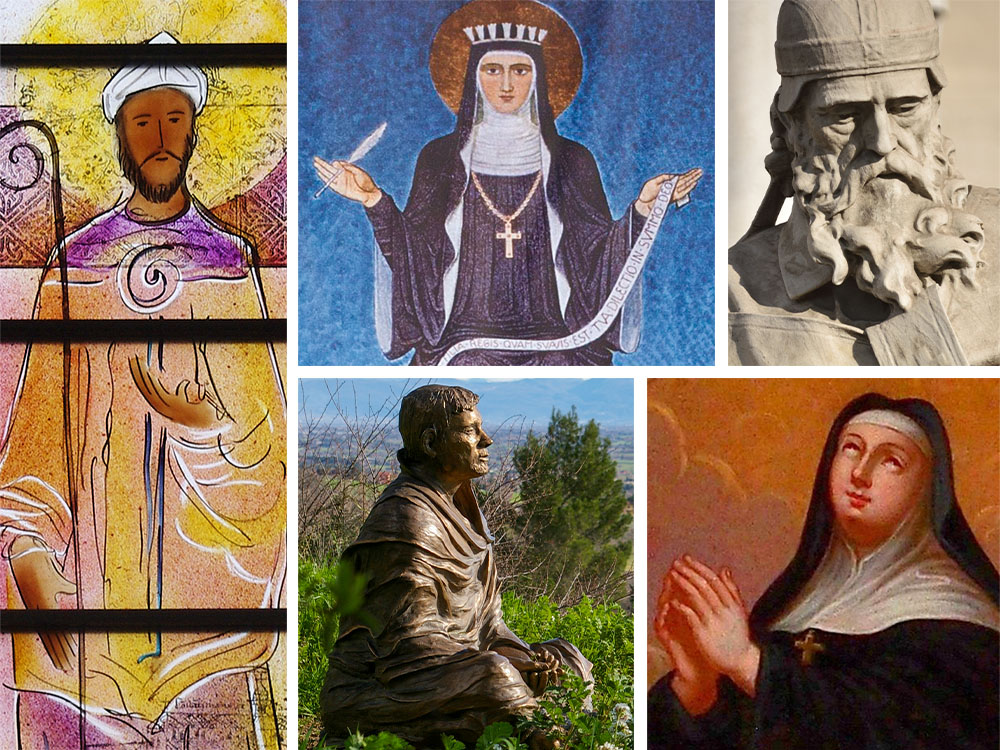
Clockwise from left, artistic depictions of: St. Augustine of Hippo (Wikimedia Commons/Nheyob); St. Hildegard of Bingen (CNS/Paul Haring); St. Isadore of Seville (Wikimedia Commons/Javier Perez Montes); St. Catherine of Siena (OSV News/Wikimedia Commons-cc 4.0); St. Francis of Assisi (NCR photo/Joshua J. McElwee)

by Vanessa R. Corcoran
Since the days of Roman persecution of Christians, when martyrs were praised for their enduring faith, Christians have continued to turn to saints for inspiration in difficult times. The recent canonization of the first millennial saint, Carlo Acutis, reminds us that sainthood is not confined to the distant past but continues into our present moment.
Below are five ancient and medieval saints whose wisdom still speaks urgently in the 21st century with timeless messages on community, knowledge, creativity, environmental care, and peacemaking in times of war.
1. Augustine of Hippo (354-430)
Pope Leo XIV is part of the Order of St. Augustine, a 13th-century religious order that derives its name and mission from St. Augustine of Hippo. The Rule of Augustine, written by the fifth-century bishop, offers the earliest guide to monastic living — and is still used today. Pope Leo XIV announced that he plans to have several members of the Augustinian Order live with him in the papal residence, so that he can maintain the sense of community that has shaped his ministry.
College professors often assign Augustine's Confessions in theology and philosophy classes for its accessibility. It also serves as a forthcoming account of Augustine's own conversion to Christianity, during which he posited, "Without you, what am I to myself but a guide to my own self-destruction?"
2. Isidore of Seville (560-636)
Often referred to as the last Christian scholar of the ancient world, this Spanish bishop and theologian was the first Christian scholar to create a major encyclopedia, the Etymologiae. The Etymologiae contained 448 chapters on subjects ranging from theology, zoology, the liberal arts and the origin of words. This popular compendium was widely used in medieval libraries.
Because of this enormous work, Isidore is the patron saint of computer users. He shares many ties to the newest saint, Acutis, whose coding abilities led to him creating an online repository of eucharistic miracles.
Advertisement
3. Hildegard of Bingen (1098-1179)
Not only was this Benedictine nun the abbess of her priory in the High Middle Ages, Hildegard of Bingen was a true polymath. Living in Germany, Hildegard wrote scientific treatises, composed music and authored theological texts — all of which led to her receiving the special designation of doctor of the church. Some refer to her as the first composer in music history, and her Ordo Virtutem ("Order of the Virtues"), was an allegorical morality play that is still performed today.
Hildegard claimed to have received numerous divine messages throughout her life, and wrote that God instructed her, "Write down what you see and hear." Now compiled in a volume known as Scivias ("The Ways of Knowing"), her messages of strength remain relevant today.
4. Francis of Assisi (1181-1226)
It's impossible to understand the vision that Pope Francis had for his papacy without understanding his medieval namesake, whose ministry espoused care for the poor and the environment. St. Francis grew up in a wealthy Italian family, but rejected it for a life of poverty, literally casting off his clothes in the public square and renouncing his wealth. He created the religious order of the Franciscans as a mendicant order that lived in poverty and community.
This year marks the 800th anniversary of his "Canticle of the Creatures," which provided a guiding framework for Pope Francis' 2015 encyclical, "Laudato Si', on Care for Our Common Home." Thomas of Celano's Life of St. Francis was published just two years after St. Francis' death, leading to his swift canonization.
5. Catherine of Siena (1348-1380)
In a world plagued with warfare on multiple fronts, Catherine of Siena is a formative model for international diplomacy and peacemaking. During the papal crisis of the 14th century (when the papacy moved from Rome to Avignon, France), Catherine crafted numerous letters to several popes on the matter. Her writing played a crucial role in bringing the papacy back to Rome after decades of unrest in the church. Pope Gregory XI entrusted her with many peacekeeping missions, an unusual responsibility to be delegated to a nun in the later Middle Ages.
As Pope Leo meets with global leaders such as Ukrainian President Volodymyr Zelenskyy and calls for a permanent ceasefire in Gaza, Catherine's guiding words stand the test of time.