(Unsplash/Chelaxy Designs)
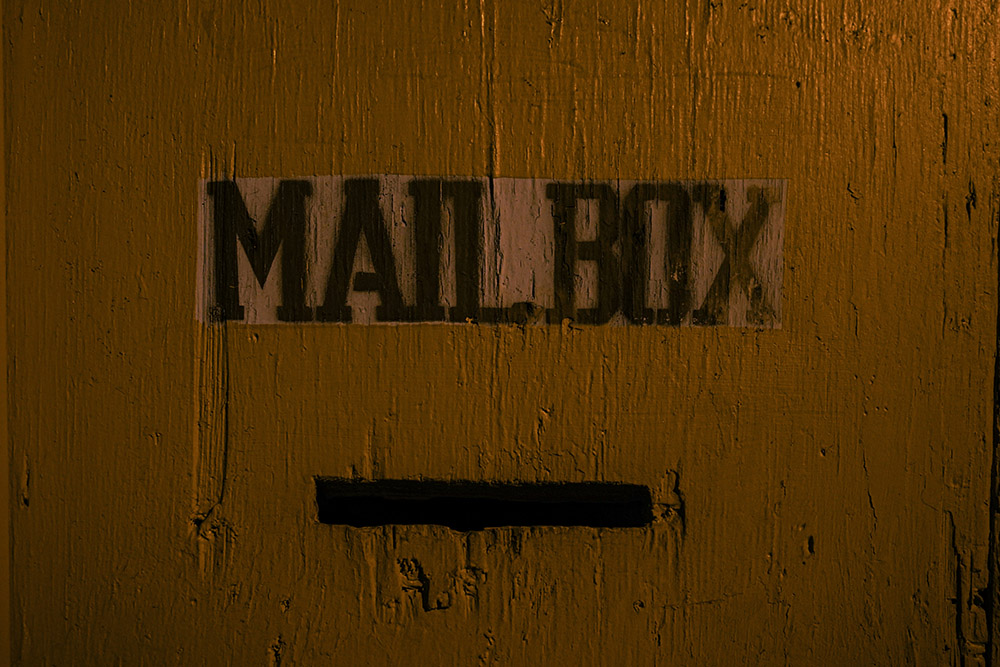
My dad loved bringing in the mail. To him, the mail held the potential for a surprise. I remember watching him saunter his long legs down the sidewalk, out to the gravel road in the late afternoon where a trio of mailboxes clustered together on a sturdy wooden platform.
Dad himself was a special kind of mailman; a U.S. postal worker who rode the "Cin and Chat" railroad route from Cincinnati, Ohio, in the north to Chattanooga, Tennessee, in the south. Trains moved the mail of a war-weary nation. Dad's job was to stand all night alongside other war veterans in a special postal train car, balancing himself, as they rocked side to side, shuffling letters and postcards into slots with small town names from Georgia and Florida taped above.
Even my 8-year-old brain understood that bringing in our mail was a highly important job. My dad, a convert to Catholicism from a Baptist family, trained me carefully to sort out what he called junk mail from our bills. Using the wisdom of his biblical instruction he would say, "The winnowing fork is in his hand, Susie. Don't be afraid to use your judgement. If something looks or feels important, hold on to it."
Advertisement
One day I had to bring in the mail, sorting out the envelopes like my dad did. One had a picture of a child sitting in a wheelchair on the outside. I opened it right away reading the letter begging my parents to help children with polio. There was a cardboard card with slots where you could slide in dimes for the scientists who were working very hard somewhere to find a cure.
I had heard of polio. Rooms filled with family laughter at Thanksgiving would suddenly turn quiet if anyone mentioned hearing of a person catching it. There were all kinds of worries with polio. One aunt knew a child who was admitted to a hospital and away from family, an uncle who thought he had a cold suddenly woke up overnight to find he was unable to walk.
There also were worry stories mothers would tell one another. "I worry that the sewage stream behind my house might give kids polio," a lady at church told my mother one Sunday. Every time my grandmother came to visit, she talked about her worries over the open ditch in front of our house. It flowed black smelly stuff out from under the sidewalk into a little stream that ran down the street where we kids rode our bikes over it to make it splash.
Without telling my parents, I took that card from the envelope and began knocking on doors in the neighborhood. Once my card was full, I taped the dimes down, glued the envelope shut and put it in the mail, certain my dad would see it and send it on to the place it needed to go.
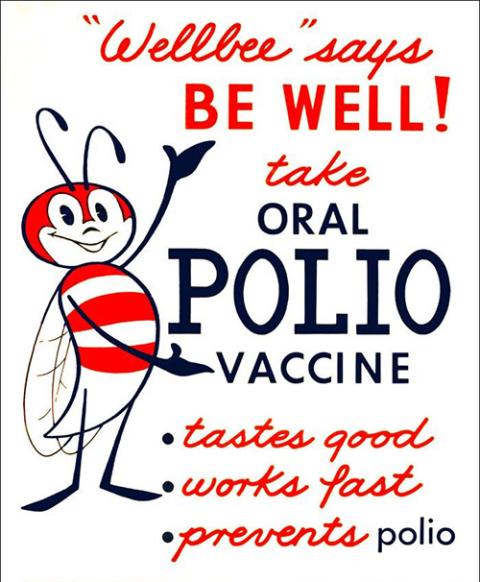
This 1963 poster featured the Centers for Disease Control and Prevention's national symbol of public health, the "Wellbee," who was depicted here encouraging the public to receive an oral polio vaccine. (Wikimedia Commons/CDC/ Mary Hilpertshauser)
Living in Iowa, I met victims of polio who told me about the epidemic in the 1950s. At one point during that decade, 25% of the population of Sioux City, Iowa, were infected. Only through the heroic hope and persistent efforts of scientists did mass inoculation efforts save thousands of adults and kids bringing us to the privileged era we enjoy today.
In the summer of 1962, our local newspapers announced where we could go to get the exciting new miracle called the polio vaccine. Standing in long lines, we all moved quickly along to the high school gym, picking up our little pink sugar cube from a cookie tray.
With the help of Dr. Albert Sabin, a hometown hero, and Dr. Jonas Salk, who could have done anything else with his life, the scientists and their teams used every bit of their education and knowledge to find a vaccine cure that saved our lives and subsequently the lives of our future children and future grandchildren. All those dimes collected paid a dividend I never dreamed of.
Recently I received an envelope containing a crucifix to be placed on a small wooden base. There was just one problem; the base had a round hole, and the crucifix was square.
Was I supposed to fix it? Maybe I should just throw it away?
How many failures in experiments did Salk and Sabin endure before they found a vaccine for polio? Why didn't they just give it up? That's the problem with effort. There's no certainty. Only hope.
I look at the round peg and the square cross and am reminded of its messiness over centuries of time. It is as it always was, has been and will be today — a call to have heroic hope.
My dad hoped for the future I am standing in, saying, "The winnowing fork is in the hand of God do not be afraid. Use your judgement. If it looks important, hold on to it!"