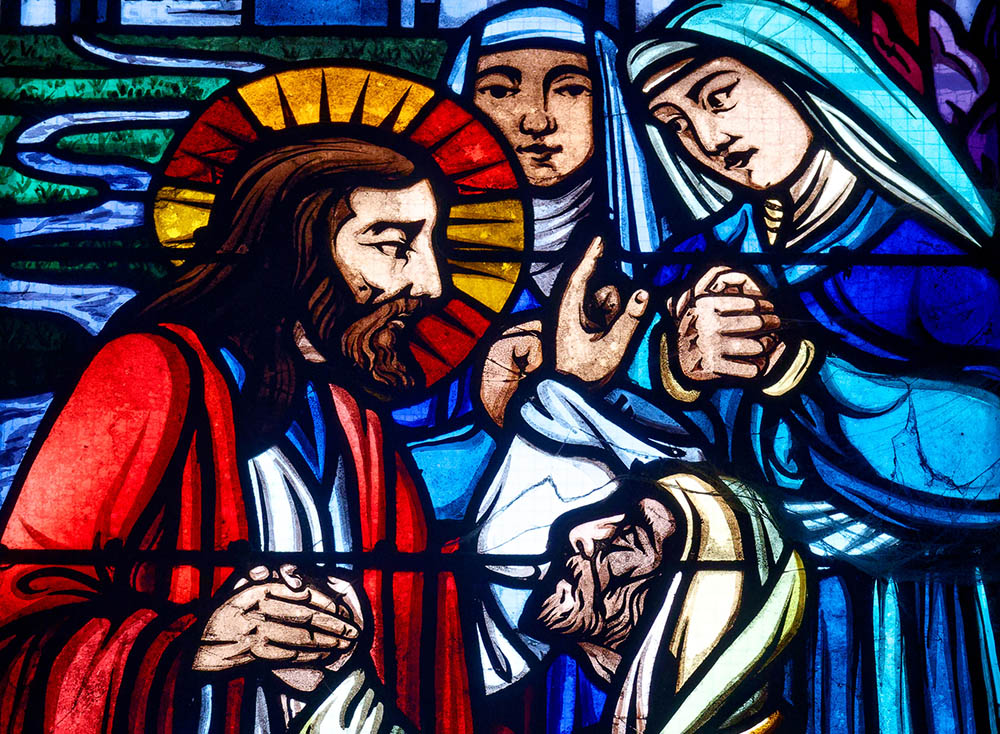
The raising of Lazarus, depicted in stained glass in a church in Orleans, France (Dreamstime/Pixelia21)

by Mary M. McGlone
"If only." We've sung this song ever since Adam swallowed his bite of the apple. "If only I had thought it through better. If only I hadn't left the iron on. If only ..."
Martha and Mary sang their own "If only" psalm when Jesus arrived after they had buried their brother. John's Gospel doesn't say why he delayed but specifies that Jesus headed to Bethany on the third day. More than a period of 72 hours, the third day is scriptural shorthand for the moment of salvation. On the third day, Isaac was saved from Abraham's knife, the Lord appeared on Sinai, Hosea's people were saved and, of course, Jesus promised to rise on the third day.
Setting off on the third day, Jesus knew well that promise and danger lay ahead. The journey toward Jerusalem was about more than Lazarus. As Thomas made clear, Jesus and company were on the way to confront death. As they walked, Jesus offered his friends an enigmatic explanation: this "is not to end in death but ... the glory of God."
When Martha met Jesus, she spoke for many: "If only you had been here, my brother would not have died!"
When Jesus said that Lazarus will rise Martha affirmed her belief that, as Ezekiel promised, God would open the people's graves on the last day. Skipping over that proclamation of faith, Jesus responded to her "if only" with an "I AM."
Jesus told Martha, "I AM the resurrection and the life." Saying, "I AM," Jesus identified himself as the fully present giver and sustainer of life: "I AM" the bread of life, light of the world, door of the sheep and good shepherd, the way, truth and life, and the true vine.
Explaining the full meaning of all these statements, he added: "Whoever believes in me, even if he dies, will live and anyone who lives and believes in me will never die."
Jesus' "I AM" turned everything upside down and inside out. Now it wasn't Martha and Mary saying, "If only," but Jesus himself. "If only you believe, evil and death can have no hold on you." What is more, Jesus' "if only" focuses not on the past but on an endless future.
Jesus' raising of Lazarus presented people with a great sign. Yet Lazarus remained mortal. Like us, Martha, Mary and the disciples, Lazarus still faced the challenge of believing that, as Paul said to the Romans, the Spirit of the one who raised Jesus could dwell in him as well.
As John weaves his Gospel narrative, he portrays the extreme reactions to Lazarus' miraculous return to life — some people came to believe in Jesus while those who saw him as a threat intensified their plans to be rid of him. Life and death were nearing the moment of their ultimate contest. Very soon there would be no more "if onlys." Death and evil were about to unleash their full fury, inadvertently opening the way to the decisive revelation of the glory of the life-giving God.
Advertisement
Like everything in John's Gospel, the Lazarus narrative has onion-like layers of meaning. On this last Sunday before Holy Week, this story introduces us to the processes of evil and of discipleship.
First, it deals with the "natural evils" of illness, natural disasters, etc. — all symbolized by Lazarus' death. Martha's "if only" expressed the wish that Jesus (and God) would control or prevent natural calamity but, rather than moving as a magician or first responder, Jesus acted from God's third day mode. He was fully present to those who sought him, sharing their grief, and promising more than they could see at the moment.
This narrative also deals with purposeful evil — symbolized by the desire to be rid of Jesus. John shows us how such evil grows more intense when goodness attracts a great following.
From the opposite side, the narrative depicts discipleship as a process. Thomas and company will move from declaring their willingness to die, through faith-shaking experience of his death and slowly into Resurrection faith. Martha and family symbolize the gradual growth of faith from theory: from "the dead will rise" to encounters with Christ's invitation to live from his Spirit.
The coming Triduum reminds us that experiencing the power of suffering and evil is inevitable. At the same time, Jesus' third day "I AM" presence reveals the glorious God who never abandons us — whether or not we realize it. As we move toward celebrating the holiest week of our liturgical year, God continues to say, "If only you believe, you will experience my death transforming glory, my life-giving Spirit, my future."
"If only we will believe."